Douro Valley Faces a 60,000-Pipa Grape Surplus for the 2026 Harvest
Producers say weak Port and DOC Douro sales could leave part of the crop without buyers, worsening price pressure.
Friday, August 28, 2026
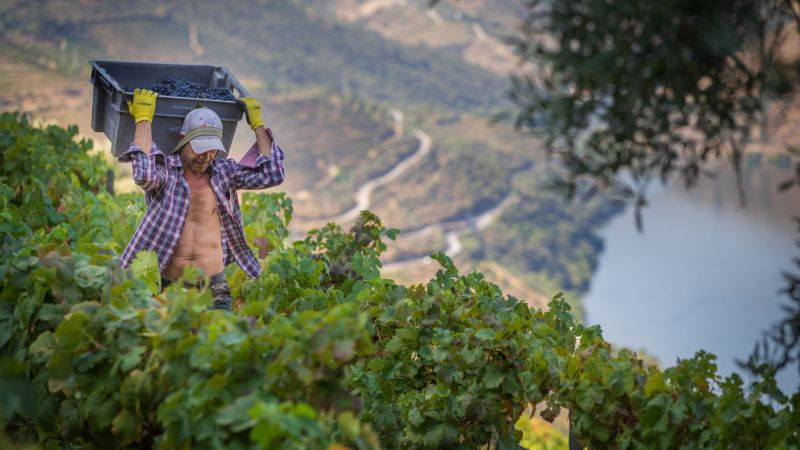
Growers and wine companies in Portugal’s Douro Valley are entering the 2026 harvest with more grapes than the market is expected to absorb, deepening pressure on prices and adding to unsold inventories in one of the country’s most important wine regions.
Industry representatives interviewed by Portuguese news outlet ECO estimate that this year’s harvest will produce about 240,000 pipas of grapes for Port wine and DOC Douro wines, while commercial needs are closer to 180,000 to 190,000 pipas. That points to an excess of 50,000 to 60,000 pipas, a gap large enough to leave part of the crop without buyers if demand does not improve. A pipa, under rules set by the Douro and Port Wines Institute, or IVDP, is a local unit equal to 550 liters of fortified must.
The 240,000-pipa production figure and the estimate of 180,000 to 190,000 pipas in commercial needs are not an official forecast. They are business estimates cited by producers and trade groups. Even so, they have become a central measure of the imbalance facing the Douro as the harvest begins.
The IVDP, in its annual harvest regulation approved on July 17, set the 2026 authorization for producing fortified must for Port wine at 76,000 pipas, equal to 57 million kilograms of grapes. That is 1,000 pipas, or 1.3%, above the 75,000 authorized in 2025. But it remains 28,000 pipas, or 26.9%, below the 104,000 authorized in 2023.
The authorization, known locally as the “benefício,” is a key part of the Douro system. It defines how much grape must from the region can be used for Port wine production in a given year. For many growers, especially smaller ones, that quota is the most reliable outlet for their grapes because Port grapes usually fetch higher prices than grapes destined for still wines under the DOC Douro designation.
The problem this year is that the slight increase in the Port allocation does little to offset weaker wine sales and the amount of fruit expected from the vineyards. According to António Filipe, president of the Association of Port Wine Companies, DOC Douro sales were down by more than 10% at the end of June. He also said the harvest began about 15 days earlier than usual.
That combination is raising fears across the region that some grapes will not be purchased beyond what is already covered by Port allocations and existing contracts. Growers’ representatives told ECO that some farmers have already been informed by major buyers that they do not intend to purchase additional grapes outside previously agreed volumes.
Wine companies say the issue is broader than the behavior of a few large exporters. Filipe told ECO that the inability to absorb more grapes is affecting large, medium and small businesses, as well as cooperatives, because companies cannot keep buying wine they do not believe they can sell. Taking on more fruit without market demand, he said, would strain cash flow and threaten business operations already dealing with payroll, supplier bills, interest costs and bank debt.
The current strain reflects a deeper problem that has been building in the Douro for years. Several producers and trade leaders told ECO that vineyard acreage expanded as the region invested more heavily in DOC Douro still wines, partly to compensate for a long decline in Port sales. Adrian Bridge, chief executive of The Fladgate Partnership, said vineyard area in the Douro has increased by about 25% since 2000. During the same period, he said, Port sales fell by about 34%.
For a time, still wines from the Douro helped absorb grapes that were no longer needed for Port. But that cushion has weakened as global demand slowed and economic uncertainty hit wine consumption more broadly. Producers now say the region is dealing not only with weaker Port demand, but also with a softer market for DOC Douro wines.
The strain is felt most sharply at the farm level. The Douro has about 18,000 winegrowers, and for many of them the harvest is the main source of annual income. Local officials and grower groups say production costs have risen while grape prices have not kept pace. The mayor of São João da Pesqueira, speaking to ECO, said grapes used for Port wine have been selling at around 1,000 euros per pipa for about two decades, even as farming costs increased. Grapes for DOC Douro wines, he said, often sell for far less.
That leaves growers vulnerable when buyers reduce purchases. Representatives of Casa do Douro, the historic growers’ body, warned that some fruit could again be left on the vine, as happened in parts of the region in 2024, because there may be no economic reason to harvest grapes that cannot be sold at a viable price. They say that risk threatens household incomes and could push more families to abandon vineyards in a region recognized by UNESCO for its cultural landscape.
The Agriculture Ministry has acknowledged the imbalance between supply and demand, rising stock levels, pressure on grape prices and the fragmented structure of production, according to ECO. But the sector remains divided over the best response. Growers want stronger support and market protection. Some major operators argue that the region must adapt production more closely to what it can sell.
The wider market is not helping. Industry executives cited by ECO say the Douro’s difficulties mirror a broader global wine surplus. Bridge pointed to data showing world wine consumption fell 2.7% last year to 208 million hectoliters, its lowest level since 1957. He also linked weaker sales to lower consumer purchasing power and economic uncertainty. Companies in the Douro are also facing higher financing costs, tougher competition from other wine regions, new labeling requirements and taxes on alcoholic beverages in some markets.
Export conditions have added to the pressure. Bridge said U.S. wine imports by value fell 26.6% in the first half of 2026, a development he linked to tariffs and delayed purchases by consumers and distributors. He also cited weakness in Dubai because of tensions in the Middle East. For a region that relies heavily on exports, those market shocks make it harder to reduce stockpiles and justify buying more grapes.
Official data released earlier this year showed that in 2025 the Douro generated about 365 million euros in Port wine sales and 235 million euros in DOC Douro wine sales, down 0.2% and 1.5%, respectively, from the previous year, according to figures disclosed by the IVDP and cited by ECO. Those annual declines were modest, but industry leaders say they mask a longer trend of weaker demand and growing inventories.
The IVDP’s 2026 harvest regulation also recommends that grape and must sellers use written contracts with buyers to safeguard transactions. That guidance reflects the level of uncertainty now surrounding the harvest, with growers trying to secure buyers early and merchants trying to avoid commitments beyond what they believe the market can absorb.
As picking begins earlier than usual across the steep terraced vineyards of the Douro, the region is confronting a basic mismatch: more grapes are coming in than wine companies expect to sell. The unresolved question for growers, traders and regulators is how much of this year’s crop can find a market before the next harvest arrives.