Rioja’s A.I. harvest model reached 96% accuracy in vineyards with detailed field data
The system, built from 25 years of records across nearly 66,000 hectares, is expanding to track disease, fertility and abandoned parcels
Tuesday, August 4, 2026
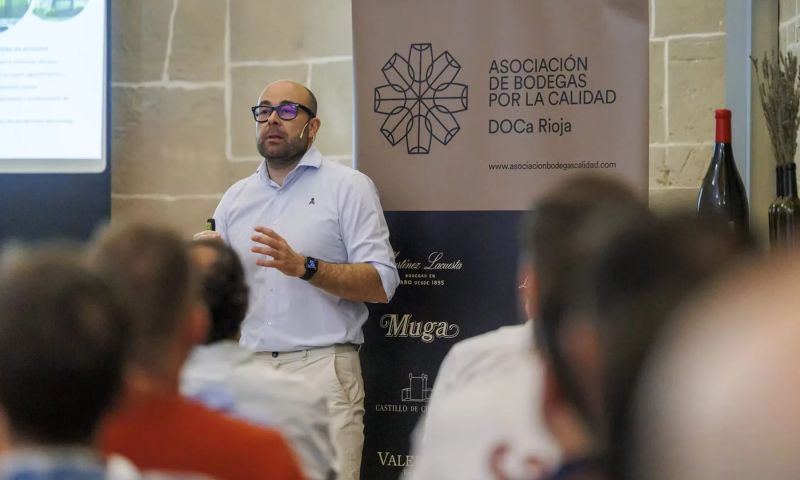
Artificial intelligence is becoming part of vineyard management in Rioja, where the region’s governing council says it has been building predictive models to improve harvest estimates and sharpen agronomic knowledge across nearly 66,000 hectares of vines.
Pablo Franco, director general of the Consejo Regulador of DOCa Rioja, outlined the progress of the project during the first ABC Excellence conference organized by the Asociación de Bodegas por la Calidad. He said the initiative began in 2022 and is designed not only to forecast crop size, but also to support more precise management of the appellation and eventually help growers make decisions in their own vineyards.
Franco said the project draws on more than 25 years of agronomic information collected by the council, including phenology records and production estimates. Before any algorithm could be trained, he said, that material had to be gathered, digitized and organized, then combined with topographic data, climate records, satellite imagery and field observations.
That early work has been one of the main challenges. Franco said Rioja’s traditional vineyard registry is based on alphanumeric references, while artificial intelligence systems need exact geographic positioning for each parcel. He also stressed that data quality is critical to the reliability of the model. Incorrect information, especially from unverified weather stations, can affect the performance of the entire system, he said.
The first model developed in 2023 used about 1,650 input variables. Those included historical records, climate and topographic data, multispectral images and observations from the current growing season. The council trained 170 predictive models and selected those that delivered the best results.
Franco said the first round of results showed that the system could estimate production with high accuracy, but it also revealed agronomic variables that were not yet being captured. That led to the development of auxiliary models designed to identify factors such as cover crops, missing vines, phenological stages and damage caused by frost and hail.
The 2025 growing season became a major test because of severe downy mildew pressure. Franco said the algorithm had not been specifically trained to recognize the disease, yet it still detected a sharp drop in productive potential. According to his presentation, the model lowered expected yields by nearly 2,000 kilograms per hectare without having mildew explicitly coded into its analysis.
Using more than 7,700 field observations, the council then developed a specific model to incorporate that variable and improve predictions in seasons marked by disease pressure.
The system is continuously checked against real field data. Franco said that in 2024 it reached accuracy levels above 91%, rising to 96% in parcels where detailed agronomic information was available. He said those results show that precision improves significantly when growers provide more specific vineyard data.
The project is still expanding. Among the next steps are further digitization of Rioja’s vineyard registry, new models to estimate vineyard fertility and detect abandoned parcels, and a portal that would allow growers to consult agronomic information about their holdings and contribute new data to the system.
For Rioja, one of Spain’s most important wine regions, the effort reflects a broader push to use digital tools in farming while protecting long-established vineyards. Franco said the long-term aim is to better understand and manage Rioja’s vineyard heritage, with particular attention to old and centenarian vines that are central to the region’s identity.