How craft beer is made and what changes at each stage, from malt to package
A clear look at what mashing, boiling, yeast and packaging actually do, and why careful measurement and cleaning can matter just as much as the recipe.

Views › 447
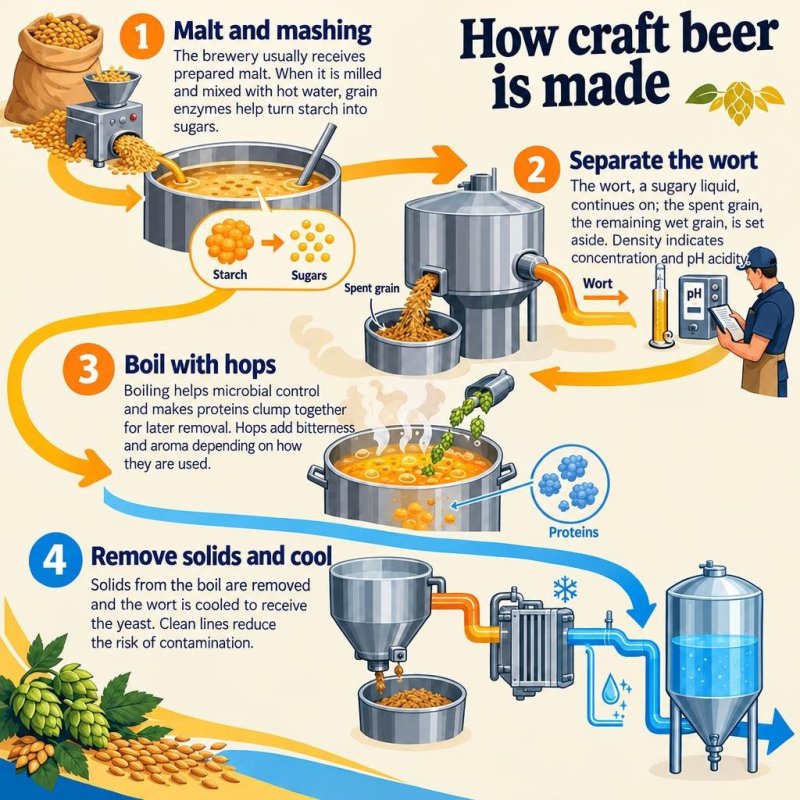
Understanding how beer is made makes it easier to see what lies behind a bottle or a can. In a craft brewery, the result does not depend only on mixing ingredients. What changes at each stage matters, as does how the process is monitored and how far cleanliness protects what has already been achieved.
From malt to package: a representative journey
A craft brewery does not follow one universal recipe, nor does it always use the same batch size, the same equipment or the same finish. What helps the consumer is to see the overall route. First, a fermentable liquid is prepared from malted grain. Then yeast turns it into beer. Finally, that beer is conditioned and packaged in a way that aims to preserve its profile. That map works for many beers, even if the details change from one brewery to another.
It also helps not to imagine craft as meaning entirely manual work. There may be technology, partial automation and instrument-based checks without removing the role of the people making the beer. The decisive part lies in choosing raw materials, adjusting conditions, checking results and correcting deviations. In other words, the craft character can lie as much in decisions and oversight as in the visible gestures of brewing.
The basic route inside the brewery
-
1. Malt enters the process
Brewing usually begins with grain that has already been malted, not with raw grain.
The brewing team decides on raw materials and conditions before wort becomes beer.
-
2. Wort comes from the grain
Milling and mashing prepare fermentable sugars.
The useful wort and the spent grain are then separated.
-
3. Beer comes from the wort
Boiling, removing solids and cooling prepare the liquid for the yeast.
Fermentation turns sugars into alcohol and carbon dioxide.
-
4. The final package comes from the beer
Maturation and carbonation adjust the profile before filling.
Cleaning and oxygen control help preserve the result.
The ingredients and the malt that arrives at the brewery
Beer is commonly built around four elements: water, malted grain, often barley, hops and yeast. Malt provides the material from which sugars will be obtained and also influences colour, flavour and body. Hops contribute bitterness and aroma. Yeast makes fermentation possible. Water, through its composition, also affects both process and result. That list does not rule out other raw materials or ingredients depending on the style and the recipe.
The malt is not necessarily produced inside the brewery. Before it arrives on site, the grain goes through malting, which in simple terms means wetting it, allowing it to germinate in a controlled way and then drying it. That step should not be confused with mashing, which happens later during beer production itself. This is why many breweries begin their work by receiving malt that is ready to use, not raw grain waiting to be transformed there.
Crushing, mashing and separating: from grain to wort
Once at the brewery, the malt is usually milled or crushed to make its interior more accessible. It is then mixed with hot water in the mash. At this stage, enzymes come into play. These are substances that help certain chemical changes happen. Here they help break down the grain’s starch and create sugars that the yeast will use later. The liquid produced along this route is called wort. It is not beer yet, but it is already the base on which the beer will be built.
During this phase, the brewer also checks whether the process is on the right track. Wort gravity shows its concentration, in other words how much dissolved material it contains, and pH gives an idea of its acidity. These measurements do not turn brewing into a laboratory exercise detached from the craft. They help show whether extraction and grain conversion are delivering the expected profile. In a craft brewery, measuring is a way to make better decisions, not to replace the brewer’s judgement.
After mashing, the route splits in two. On one side is the wort, which will continue towards the boil. On the other is spent grain, the wet cereal material left behind after the useful liquid for brewing has been drawn off. At this stage the grain may be rinsed to recover more dissolved material from it, including sugars, but the key point for the reader is another one: this is where the grain solids are separated before work continues with the wort. It is not yet a filtration of finished beer, but an earlier and different stage.
Two different processes that are often confused
Malting
It happens before the grain reaches the brewery.
In simple terms, it means wetting the grain, letting it germinate in a controlled way and then drying it.
Mashing
It takes place during beer production itself.
Milled malt is mixed with hot water so enzymes from the grain can help create sugars in the wort.
Boiling, adding hops, removing solids and cooling
The wort then moves on to the boil. Boiling does more than mix ingredients. It helps control microbes, drives off certain volatile compounds, which can leave with the steam, and causes proteins to coagulate, or clump together, which makes them easier to remove later. Hops also play a particularly visible role here. Depending on the variety chosen and how it is used, bitterness and aroma will change. Even so, not every hop effect has to be decided at one single moment or according to one schedule that fits every beer.
After the boil, solids and precipitated material are removed before the yeast is added. One common solution is to create a whirlpool, a spinning motion that concentrates this material so it can be separated more easily, but there is no need to picture it as a compulsory standalone vessel in every brewery. After that removal, the wort is cooled until it reaches conditions that suit the chosen yeast. That change in temperature marks the move from the hot side of the process to the stage where the central biological transformation begins.
During these transfers, cleanliness stops being an invisible detail and becomes part of the daily job. Equipment, pipes and vessels have to be kept clean to reduce the risk of contamination and to avoid residues from cleaning products. When people talk about CIP, or clean-in-place, they mean cleaning internal surfaces without fully dismantling the system. Not every brewery has to organise it in the same way, but the need for good cleaning follows every transfer and every change of stage.
Yeast turns wort into beer
Fermentation begins when the cooled wort receives the yeast. This is where the change that many drinkers instinctively associate with beer takes place. Yeast consumes fermentable sugars and produces alcohol and carbon dioxide. It also creates other compounds that affect aroma and flavour. That is why the fermenter is not simply a tank where liquid sits and waits. It is the place where wort stops being only a sugary base and truly becomes beer.
How that fermentation develops depends on several decisions. The yeast strain or variant matters, the wort prepared beforehand matters and the temperature at which the process is run matters too. Change those conditions and the result changes with them, so there is no universal timetable that applies to all craft beer. Hygiene is also decisive here. If the equipment is not properly clean, other microorganisms or unwanted residues can interfere with a stage in which the yeast should work under as much control as possible.
Maturation and finishing: adjusting the profile and the bubbles
When the main fermentation slows down, the work does not end automatically. Maturation and conditioning allow certain compounds produced by the yeast itself to be reduced and the beer’s profile to be adjusted before packaging. This helps explain why it is not enough to say that beer is simply left to rest so it can improve. What matters is what the brewer wants to refine and how each beer responds. Some beer families, such as lager, illustrate this point well, but their handling should not be taken as a universal rule for every brewery or every style.
This stage can also define how the bubbles will form. Carbonation is the presence of dissolved carbon dioxide in the beer. That gas may be retained from fermentation itself, created again through fermentative activity in the package, or added in a controlled way. These are finishing options, not an automatic ranking of quality.
| Option | Where the CO2 comes from | Key idea |
|---|---|---|
| Retaining fermentation gas | From the carbon dioxide produced by the yeast itself | The beer can keep part of that gas as part of its final finish. |
| Fermentative activity in the package | From a fermentation that continues or starts again in the package | The bubbles form inside the final container. |
| Controlled CO2 addition | From gas added in a controlled way before or during finishing | It is another way to adjust carbonation without that alone determining quality. |
Packaging also protects the beer
The final stretch is not only about filling bottles, cans or other containers. Good packaging means trying to preserve the profile achieved in the earlier stages. One sensitive point is oxygen entering during final operations and filling, because limiting it helps preserve flavour stability. For that reason, oxygen control can be one of the important checks at the end of the process, even though not every brewery has the same tools or measures it in exactly the same way.
Cleaning becomes essential again just before the route comes to an end. In filling lines, pipework and containers, poor hygiene can undo careful work in milling, boiling, fermentation and maturation. That is why brewing in a craft brewery is easier to understand as a chain of connected decisions: choosing ingredients, turning grain into wort, guiding the yeast, adjusting the finish, checking data such as gravity, pH or oxygen, and keeping the system clean so the beer reaches the package with as little alteration as possible.