When the first glass raises a flag: how to tell a different wine from a faulty one
A practical guide to the obvious warning signs when you open a bottle, how to give the wine a quick second check, and how to avoid common false alarms.
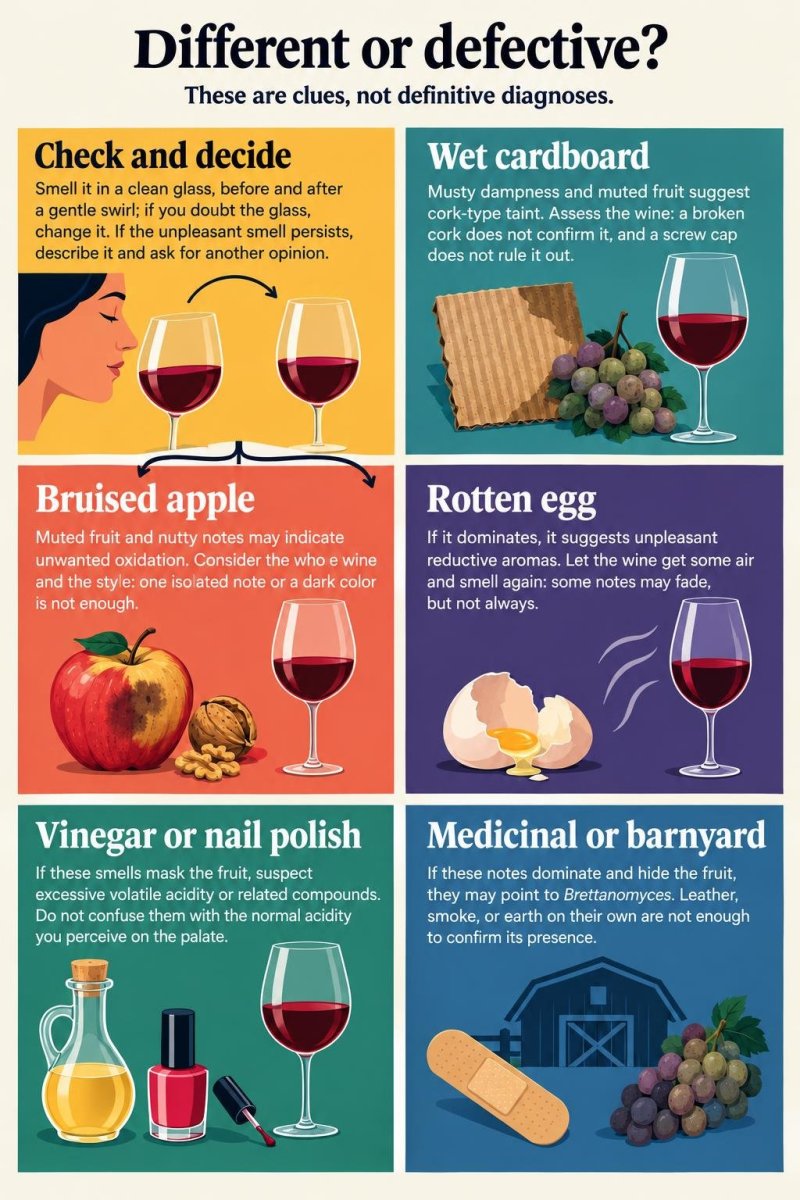
When you open a bottle, some signs can make you suspect a problem from the very first glass. This guide helps you recognise those clues through everyday references, do a simple check at home, and decide whether you may be facing a fault or just a style you were not expecting.
What you can spot from the first glass
Spotting a possible fault “at once” does not mean knowing with certainty, within seconds, everything that is wrong with a wine. It does mean that, from the first smell and sometimes even before tasting, clear signs can appear: musty dampness, rotten egg, strongly dominant vinegar, or fruit that seems strangely muted. Even so, wine style, bottle age and personal sensitivity all matter, so it helps to separate three things: the clue you notice, the likely cause, and the confirmation, which would need a more technical assessment.
Not everything you dislike is a fault, either. Some wines are more restrained, more evolved or less fruit-driven, and can seem odd if you expected something else. That is why it is more useful to focus on a few problem families that often come up in sensory wine education: cork taint, unwanted oxidation, unpleasant reductive aromas, excessive volatile acidity, Brettanomyces character, and possible heat damage. This is a practical selection, not a universal list ranked by frequency.
First things first: one sign is not a verdict
An unusual smell can be a clear clue, not a technical confirmation of the problem.
Wine style and personal sensitivity matter; disliking it is not enough to call it faulty.
Before you dismiss the wine, check the glass and smell again
Start with something very simple: use a clean glass with no lingering smells, and step away from strong perfume, air fresheners or cleaning products. Outside odours can confuse you more than you might think. Pour a small amount of wine, look at it without rushing to conclusions, and smell it first while the glass is still.
Then give the glass a gentle swirl and smell again. That small change helps you see whether the aroma opens up, improves, or whether the problem becomes more obvious. If you suspect the glass itself may be adding a different smell, repeat the check with another clean one. Tasting the wine can add information, but you do not need to take a sip to get your bearings: many signs show up through sight and, above all, smell.
Quick check when you open the bottle
- Pour the wine into a clean glass with no stray smells.
- Step away from strong perfume, air fresheners or cleaning products.
- Look at the wine without rushing to conclusions, and smell it first while still.
- Give the glass a gentle swirl and smell again.
- If you doubt the glass, repeat the check with another clean one.
- A sip can help, but you do not need one to get your bearings.
Wet cardboard or musty dampness: suspect cork taint
If the first thing you notice reminds you of wet cardboard, a damp cloth, a musty cellar or a dull damp smell, you may be dealing with cork taint. This can also mute the fruit: the wine not only smells different, it also seems less expressive than it should. That combination of mustiness and dulled fruit is a more useful clue than staring at the cork.
The usual culprit behind that impression is TCA, but you do not need to know the name to recognise the sign. What matters is avoiding false conclusions: the problem is judged in the wine, not by the look of the cork. A broken cork proves nothing, and a screwcap does not automatically rule this kind of taint out, because it does not come only from natural cork.
Bruised apple and muted fruit: check whether it fits the style
When a wine has lost aromatic brightness and starts to suggest bruised apple, faded fruit or nuts, unwanted oxidation may be the issue. Sometimes the colour also looks more evolved or browner than expected. The key is the whole picture: less fresh fruit, a dulled impression, and notes that point to excessive development.
That set of signs should not be confused with a deliberately oxidative style or with normal bottle development in certain wines. A nutty note on its own, or a deeper colour than you imagined, is not enough to condemn the bottle. Before you reject it, ask whether the wine feels coherent as a whole or whether it seems to have lost freshness and definition.
Rotten egg: see whether a little air changes it
If a clear smell of rotten egg, drain or unpleasant gas appears as soon as you bring the glass to your nose, the suspicion points to volatile sulfur compounds, including hydrogen sulfide. These are unpleasant reductive aromas. You do not need the chemistry to know something is off if they clearly dominate the glass.
Here a very simple check can help: let the wine take in a little air and smell it again. Some notes may lessen, but do not assume that will happen or expect a miracle. It is also worth not calling every sulfur smell “sulfites”: a rotten egg aroma is not the same as other acrid or irritating sensations. And a faint note like a freshly struck match does not automatically confirm a fault.
Vinegar or nail polish: not simply an acidic wine
A wine can be fresh and acidic without having any problem at all. Something different is happening when the smell strongly suggests vinegar, nail polish, glue or solvent. When that impression overrides the fruit and the rest of the aromas, the suspicion shifts toward excessive volatile acidity or related compounds that reinforce it. A vinegar smell is associated with acetic acid, while nail polish or glue points to ethyl acetate: they are different substances, and the latter is not a volatile acid.
It helps here not to confuse taste with smell. Normal acidity is felt mainly on the palate; the issue this guide is looking for shows up as a nose that is clearly vinegary or solvent-like. You do not need to measure anything or think about thresholds: if you have to force the comparison, it is probably not a clear sign. If the wine immediately brings vinegar or nail polish remover to mind, caution is justified.
| Situation | What you usually notice | What it does not prove on its own |
|---|---|---|
| Fresh, high-acid wine | Acidity is felt mainly on the palate | It does not point to a fault |
| Dominant smell of vinegar | The nose becomes clearly vinegary | You do not need to measure anything to be suspicious |
| Smell of nail polish or glue | A solvent-like note covers the fruit | It is not simply an acidic wine |
Medicinal or stable: judge how much it dominates
Some wines show medicinal, adhesive bandage, stable or animal notes. When those sensations dominate and cover the fruit, one possible explanation is Brettanomyces character, often shortened to “brett”. The name may sound technical, but for the drinker the important point is simpler: if the wine seems less fruity and more medicinal or animal, the suspicion becomes stronger.
It is worth not overdiagnosing. Notes such as leather, smoke or earth, on their own and at low intensity, do not confirm Brettanomyces by themselves. Acceptance also varies from person to person: one drinker may tolerate certain notes better than another. What guides you is not a single word, but how much those aromas dominate and whether they displace the profile the wine ought to show.
Cooked fruit and low freshness: heat is one possibility
If the wine seems tired, low in freshness, and recalls cooked fruit, overcooked jam or toasted sugar, heat is one possibility to consider. This may be damage linked to poor storage or transport, but it is better treated as a suspicion based on several clues, not as a certain reconstruction of what happened.
If the bottle has a cork, one that is slightly pushed out can strengthen the doubt, but it is not proof on its own. Nor is a ripe-fruit aroma enough to blame heat, because some styles are naturally riper and other problems can overlap. The sensible approach is to judge the whole picture: loss of freshness, a cooked profile and a general sense of fatigue.
Crystals, sediment and small bubbles do not decide the case
Not everything unusual you see in the glass points to a fault. Pieces of cork do not prove cork taint. Tartrate crystals, which can look like small transparent shards, do not mean the wine is spoiled. And sediment can appear in unfined or unfiltered wines without signalling any aromatic problem.
Bubbles and cloudiness need the same approach. A slight spritz can be deliberate in some still wines, meaning non-sparkling wines, although in other cases it could point to an unwanted change. Haze does not identify one single cause, either. These are observations that need context, not automatic verdicts. The signs described here do not confirm an aromatic fault on their own or identify unknown particles.
What you see can guide you, but it does not condemn the bottle
Can be normal
Tartrate crystals and sediment do not mean spoilage.
Pieces of cork do not prove cork taint.
Needs context
A slight spritz may be deliberate or may reflect a problem.
Haze does not point to a single cause.
If the unpleasant impression stays, describe what you notice
If, after these checks, the wine still seems clearly unpleasant, there is no need to keep pushing through it or to hunt for a perfect chemical explanation. Simple words are enough: “it smells like wet cardboard”, “it reminds me of vinegar”, “there is a rotten egg smell”, or “the fruit seems very muted and cooked”. That kind of description is usually more useful than trying to force technical language.
If the wine was served or sold to you and you want to mention it, that clear description is the best starting point for asking for a second opinion. Checking is not the same as fixing: airing can change some reductive notes, but it is not a general solution for every fault. And this guide is meant to help you judge what your senses are telling you, not to certify that a wine is safe or to guarantee any particular commercial outcome.