Riccardo Cotarella backs a Georgian winery project in Kakheti
The Nimbi estate, built with 100% Italian technology, is cultivating seven native grape varieties as a model for wider cooperation.
Thursday, October 15, 2026
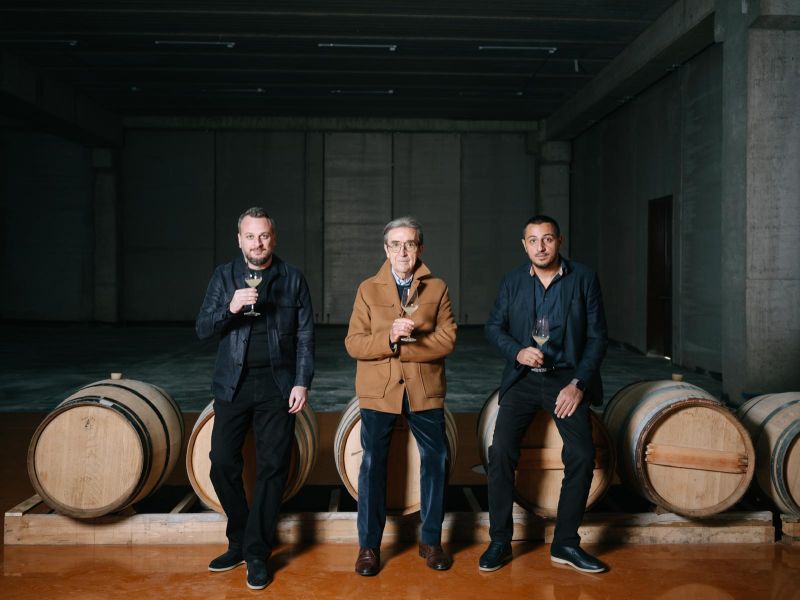
Georgia’s wine sector is drawing new attention from Italy through a project in Kakheti that brings together one of the world’s oldest winemaking traditions and modern Italian wine expertise.
The link centers on Nimbi winery in the village of Khashmi, about 25 miles from Tbilisi, in eastern Georgia’s main wine region. The winery was founded by Bacho Bughdgiashvili and Vato Otkhmezuri, and its winemaking is being overseen by Riccardo Cotarella, one of Italy’s best-known enologists and the president of Assoenologi, the Italian association of enologists.
The project comes at a time when Georgia is presenting itself as both an ancient wine country and a growing modern producer. According to Wines of Georgia, the country has 49,000 hectares of vineyards, more than 3,000 wineries, 525 native grape varieties and 30 recognized appellations. Georgia also traces its winemaking history back 8,000 years, a claim that has helped shape its international image as a birthplace of viticulture.
One of the strongest symbols of that identity is the qvevri method, in which wine is made in large clay vessels buried in the ground. UNESCO has recognized the traditional Georgian qvevri winemaking method as intangible cultural heritage, and it remains central to the country’s wine culture even as producers invest in newer equipment and export strategies.
Cotarella said the Georgian project began when the two founders of Nimbi contacted him while the winery still existed only on paper. He said he agreed to join quickly because of their enthusiasm and because he sees Georgia as both a historic wine territory and a place with room for experimentation and growth.
He said a new winery was built with 100% Italian technology. The estate is now cultivating seven historic grape varieties. Two of them, Rkatsiteli, a white grape, and Saperavi, a red grape, are among the country’s most widely known and planted varieties. Cotarella said those grapes are already producing wines of notable quality.
He also pointed to five older but less internationally known varieties that he believes have strong potential. They are the white grapes Khikhvi, Kakhuri Mtsvane, Kisi and Goruli Mtsvane, and the red grape Shavkapito. Cotarella said those varieties could be important not only for still wines but also for sparkling wines made with the traditional bottle-fermented method known in Italy as Metodo Classico.
His comments suggest that the project is intended to do more than launch a single winery. Cotarella described it as a pilot effort that has attracted attention in Georgia beyond the private sector. He said the initiative has been well received by Georgian political leaders and by Agriculture Minister David Songulashvili in particular.
That official interest was visible during a recent meeting at the residence of Italy’s ambassador to Georgia, Massimiliano D’Antuono. According to a statement from the Italian Embassy in Georgia, Cotarella met Songulashvili there and received a traditional Georgian tastevin from the minister. The embassy said the meeting provided an opportunity to exchange experience, opinions and good practices in wine production, also in light of Cotarella’s collaborations with Georgian entrepreneurs.
The embassy framed the event as part of a broader relationship between the two countries, where wine has become a practical field for economic and cultural cooperation. Italy is one of the world’s leading wine producers and exporters, with a strong global reputation in both traditional regional wines and modern production methods. Georgia, while much smaller in scale, has placed increasing value on promoting its indigenous grapes and its long historical record in order to distinguish itself in international markets.
Ambassador D’Antuono said wine is one of the clearest areas of shared excellence between Italy and Georgia, describing both as countries with ancient winemaking traditions and a strong capacity to connect territory, culture and innovation. He said that shared heritage continues to create opportunities for dialogue, cooperation and exchange of expertise.
The Nimbi project reflects that idea in practical terms. It combines Georgian land, grape varieties and historical identity with Italian winery design, technical equipment and outside consulting. In a market where many wine countries are trying to stand out through local grapes and distinctive production methods, that mix may help Georgian producers reach a wider audience while keeping a strong local identity.
The focus on native grapes is especially important for Georgia. While international varieties are grown in many parts of the world, Georgia’s wine sector has increasingly promoted its own vineyard heritage as a competitive advantage. The figures from Wines of Georgia underline the scale of that biodiversity. With 525 indigenous grape varieties, the country has one of the richest reserves of native vine material anywhere, even though only a smaller number are used regularly in commercial production.
Kakheti, where Nimbi is based, remains the center of that industry. The region is home to many of Georgia’s best-known vineyards and wineries and plays a major role in both traditional qvevri wines and more conventional styles aimed at export markets. Its proximity to Tbilisi also makes it a natural place for foreign-backed projects and official visits tied to economic promotion.
For Georgia, partnerships with figures such as Cotarella can provide technical support, visibility and outside validation at a time when the country is trying to strengthen its presence in competitive wine markets. For Italian wine professionals, Georgia offers something different: a chance to work in a country with a wine history older than most others, with native varieties that remain unfamiliar to many consumers abroad.
The result is a collaboration that links two wine cultures that are different in scale and structure but closely aligned in how they present wine as part of national identity, agriculture and heritage. In Khashmi, that connection is now taking shape through a winery that its backers hope can serve both as a business and as a model for wider exchange between the Georgian and Italian wine sectors.