The 4 sacred ingredients of beer and how they shape flavour
A clear guide to how water, malt, hops and yeast shape a beer’s profile, and what sensory clues they can leave behind without revealing the recipe.
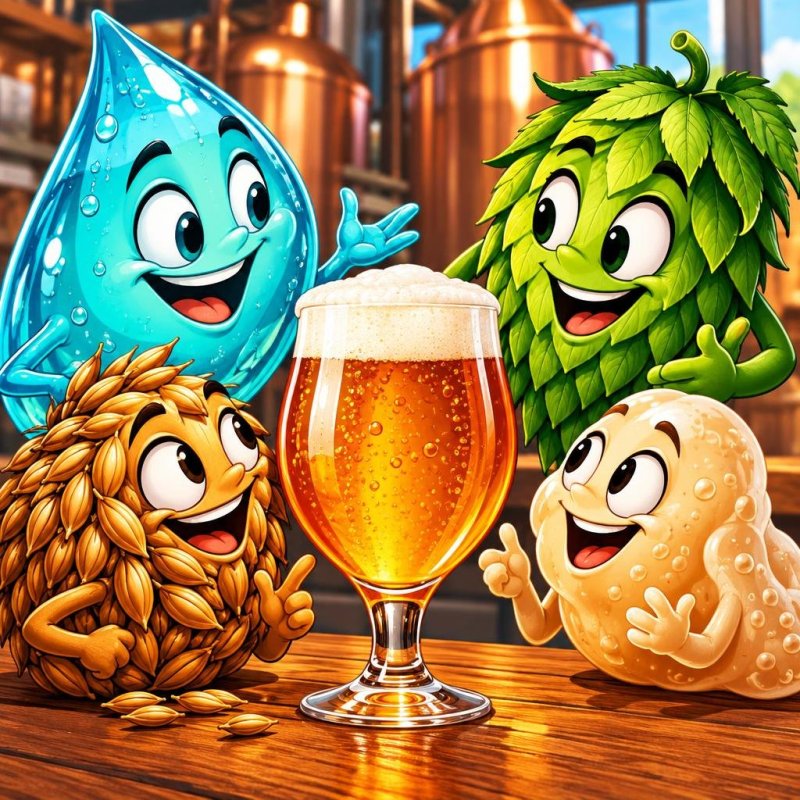
Water, malt, hops and yeast are a very useful way to start understanding why two beers can taste so different. You do not need technical knowledge or to guess the exact recipe: it is enough to know what each ingredient can contribute, and how that changes when it interacts with the others and with the brewing process.
Four basic ingredients, many different beers
When people talk about beer’s four “sacred” ingredients, the point is not to take the word literally. It is simply a classic starting point for explaining how flavour is built. Water, malt, hops and yeast offer a very useful framework for consumers, even if they are not the only ingredients used in every recipe.
Some beers also include other grains, fruit, spices or other fermentable materials. That does not automatically make them better or worse. It simply broadens the range of possible results.
It also helps to avoid an overly simple idea: each ingredient does not have one fixed, unchanging role. Beer is not a mechanical sum in which one ingredient gives colour, another bitterness, another alcohol and nothing more. The amounts used, the moment they are added and the brewing conditions can all change the final result.
Key idea for reading a beer
These four ingredients are a useful basis for understanding flavour, not a rule of authenticity or a guarantee of quality.
The combination, the proportions and the process can change the result dramatically, even when the ingredient lists look similar.
Water: how it shifts the balance
Water makes up most of the beer, so it is not just a neutral medium where the other ingredients are mixed together. Its mineral composition can influence how we perceive the whole, even when that effect is not obvious at first.
As a general guide, sulfates can sharpen the impression of bitterness and a certain dryness, while chlorides can enhance a sense of softness or sweetness. This is not an automatic switch between two opposite flavours, because everything depends on concentration, the recipe and how the other elements fit together.
A trial with a Kölsch-style beer found sensory differences when the sulfate-to-chloride ratio was changed, which supports the idea that water matters. Even so, that kind of result does not provide a universal formula or an ideal composition for every beer.
So for the adult consumer, focusing on the water’s geographic origin is not enough to predict flavour. Brewers can adjust water during production, so the useful idea is not whether the water was “better”, but that it also plays a part in the overall balance of bitterness, sweetness and final impression.
Malt: from grain to notes of bread, caramel or coffee
Malt is grain that has gone through controlled germination and then drying. Barley is the most common raw material, but it is not the only one. This treatment prepares the grain so that later it can provide the sugars yeast will use during fermentation.
During mashing, the malted grain is mixed with water and its enzymes help turn starches into sugars. The result is a sugary liquid called wort, which will then ferment. Put simply, yeast does not turn grain directly into alcohol. It works on sugars that have already been released.
From a sensory point of view, malt is often behind many of the associations drinkers recognise easily: grain, bread, biscuit, caramel, chocolate or coffee. The differences depend, among other things, on how the grain was dried or roasted. The more that treatment changes, the more the aromatic and flavour profile can change with it.
This is where a couple of ideas are worth separating. An aroma that suggests caramel does not necessarily mean the beer is very sweet, because aroma and taste are not the same thing. And a darker colour does not by itself prove higher alcohol or more body: some dark beers are light, and some pale beers feel fuller on the palate.
Those associations should not be read as a list of added ingredients either. If a beer brings coffee or chocolate to mind, that impression often comes from the malt and how it was roasted, not from coffee or cocoa being added to the recipe.
Useful terms before you go on
Malt
Grain that has gone through controlled germination and drying.
It usually provides fermentable material and much of the cereal or roasted profile.
Wort
Sugary liquid obtained before fermentation.
This is the liquid the yeast will work on later.
Body
The sense of how light or full a beer feels in the mouth.
It cannot be worked out from the beer’s colour alone.
Finish
The sensations that remain after the sip.
They may recall bitterness, toasted notes or a fruity echo.
Hops: separating aroma from bitterness
Hops are a plant ingredient that bring two very important things to beer: bitter compounds and aromatic compounds. That is why it helps to separate two questions when tasting: what aroma do I notice, and how much bitterness do I perceive? They may seem linked, but they are not the same thing.
On the aromatic side, hops can suggest floral, herbal, citrus, resinous or spicy notes, among others. These are useful families of descriptors, not a promise that everyone will find exactly the same sensations in the glass.
When wort is boiled, it encourages the formation of bitter compounds, while later additions or additions made without boiling are often used to bring more aroma or preserve certain aromatic compounds. Even so, it would be too simple to reduce this to “heat gives bitterness and cold gives aroma”, because the reality can be more nuanced.
In fact, trials on dry hopping, meaning the use of hops without boiling them in the wort, show that it can also change perceived bitterness. So the most aromatic beer is not necessarily the bitterest one, and a bitter beer will not always be the one with the strongest hop aroma.
A profile that suggests citrus or resin also does not prove that fruit or specific aromatic plants were added. Very often that impression comes from the hops themselves and the way they were used.
Two very common confusions about hops
Intense aroma
It may suggest flowers, herbs, citrus or resin.
On its own, it does not tell you how bitter the beer will be.
Perceived bitterness
It can increase through compounds formed during the boil.
It can also change depending on how hops are added, without following a rigid rule.
Yeast: fermentation also creates aroma
Yeast is a microorganism, and its basic role is to transform the sugars in wort into alcohol and carbon dioxide during fermentation. Without that step, we would not have beer as we know it.
But its work does not stop there. Yeast also creates compounds that influence a beer’s aromatic character, so it does not just produce alcohol: it can leave its own sensory signature as well.
Some yeasts can encourage fruity notes such as banana, while others can create spicy notes reminiscent of clove. These are well-known and useful examples, but they do not appear all the time or with the same intensity. They depend on the strain, meaning the yeast variant used, and on the fermentation conditions.
This helps clear up a very common confusion. If a beer suggests fruit or spice, that does not prove those foods were added. That register may come from yeast, hops, extra ingredients or a combination of several factors.
Fermentation, then, is not just a technical stage hidden away in production. It is a decisive part of the beer’s final personality, and it helps explain why a similar ingredient list can lead to quite different results.
How to recognise these contributions without guessing the recipe
A simple way to approach a beer is to start with the aroma and then move to taste and texture. First, ask what kinds of associations appear: grain, bread, toasted notes, floral, citrus, herbal, fruity or spicy. That first step is not about solving a puzzle, but about naming what each person perceives.
It then helps to separate four basic ideas. Sweetness is the taste linked to sugars. Bitterness is a different taste. Body is the sense of how light or full the beer feels in the mouth. And the finish is what stays after the sip, whether that is bitterness, freshness, toasted notes or a fruity echo.
With that small map in mind, it becomes easier to understand how the ingredients interact. Malt may suggest bread or caramel. Hops may push the beer toward floral, herbal or citrus notes. Yeast may reinforce fruity or spicy profiles. And water may tilt the sensory balance in a less visible, but still important, way.
The important thing is not to turn those clues into absolute diagnoses. A coffee-like impression does not force you to assume added coffee. A fruity touch does not automatically point to one specific fruit. Intense hop aroma does not measure bitterness on its own. And a dark colour does not let you deduce either alcohol level or body.
Looking at beer this way makes it easier to enjoy and describe it, even without technical knowledge. It also highlights something essential: flavour does not come from one ingredient alone, but from the dialogue between all four and from how they were handled during production.
A simple way to describe what you notice
- Start with the aroma: grain, bread, toasted notes, floral, citrus, herbal, fruity or spicy.
- Then separate sweetness and bitterness: they are different sensations.
- Notice the body: lighter or fuller in the mouth.
- Observe the finish: what sensation stays after the sip.
- Use those clues to describe the beer, not to assume a recipe or an added ingredient with certainty.