Europe’s 10 most profitable wine regions, ranked by the AAWE
Mapping the ten European wine regions that create the most wealth. The ranking measures the net economic value generated by each hectare of vineyard land.
Wednesday, August 5, 2026
Champagne-Ardenne generated the highest net economic return per vineyard hectare in Europe in the latest regional ranking compiled by the American Association of Wine Economists, far outpacing every other winegrowing area measured in the study.
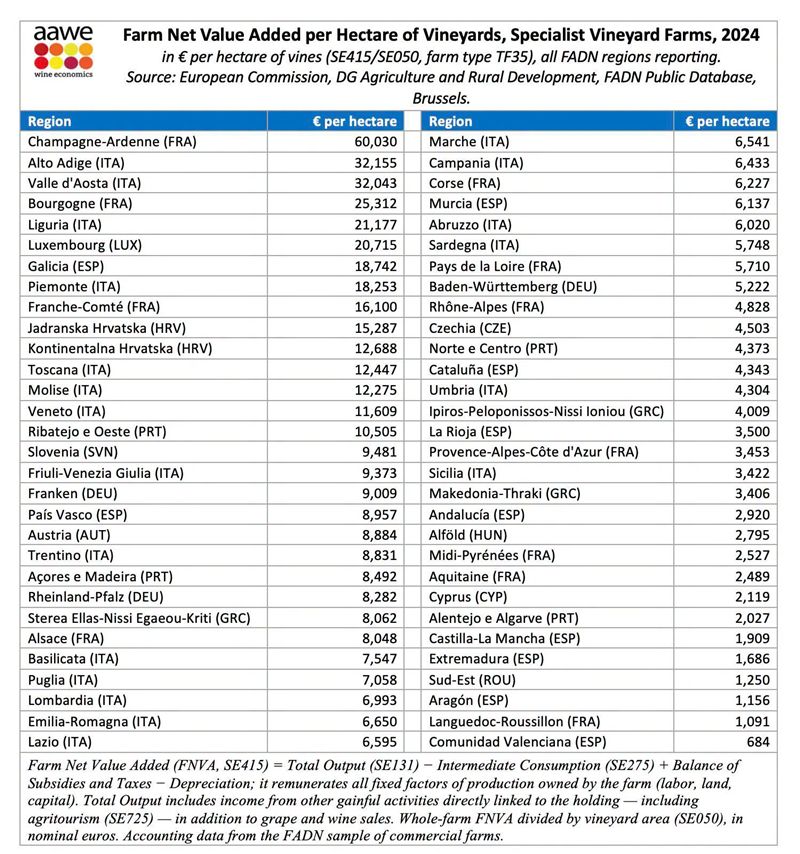
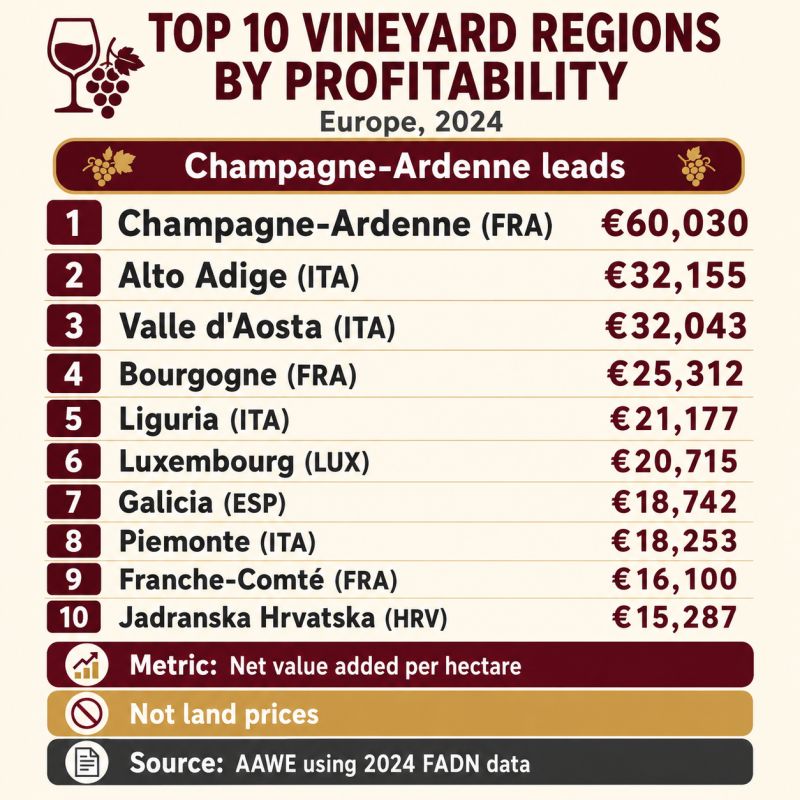
Using 2024 data from the European Union’s Farm Accountancy Data Network, or FADN, the AAWE ranked European regions by net farm value added per hectare of vineyard. Champagne-Ardenne, in France, posted €60,030 per hectare, nearly twice the level of Alto Adige in northern Italy, which came in second at €32,155.
The gap at the top of the table was the defining feature of the ranking. Champagne-Ardenne exceeded Alto Adige by €27,875 per hectare and stood €27,987 ahead of Valle d’Aosta, another Italian region that placed third with €32,043. The difference suggests that the economic model of vineyard farming in Champagne-Ardenne, as captured by the accounting system used in the study, operates on a different scale from the rest of the regions included.
The AAWE ranking does not measure vineyard land prices or the market value of real estate. It is based on a farm accounting indicator that estimates the net value created by each hectare after intermediate consumption and depreciation are deducted, and after subsidies and taxes are taken into account. That figure is meant to reflect what remains to remunerate the farm’s fixed factors, including labor, land and capital.
The production value behind that measure is broader than grape or wine sales alone. It can also include revenue from closely related activities carried out on the farm, such as agritourism. That means the ranking is best read as a comparison of the average net economic value generated by commercial vineyard holdings in each region, not as a simple measure of profit from bottle sales and not as an appraisal of land values.
Even with that caution, the ranking offers a clear map of where vineyard farming is generating the greatest net returns in Europe. After Champagne-Ardenne, Alto Adige and Valle d’Aosta formed a tight cluster in second and third place, separated by just €112 per hectare. Both regions are small, mountain-influenced wine areas with strong identities and high-value production, but their results were still far below the French leader.
Bourgogne, also in France, ranked fourth with €25,312 per hectare. That placed it €6,731 behind Valle d’Aosta and €4,135 ahead of Liguria, the Italian region in fifth place at €21,177. By the top five, France had already placed two regions and Italy three, showing how heavily the upper end of the ranking is concentrated in those two countries.
Luxembourg followed in sixth place with €20,715 per hectare. Its result was just €462 below Liguria and €1,973 above Galicia in northwestern Spain. Luxembourg’s presence in the table is notable because it sits among far larger wine-producing areas and still clears the €20,000 mark.
Galicia ranked seventh with €18,742 per hectare and was the only Spanish region in the top ten. In the context of the FADN database, that figure applies to the region as an accounting unit rather than to any one denomination of origin, province or subzone. The distinction matters because the study compares official regional units in the EU accounting system, not individual appellations.
Piemonte placed eighth at €18,253 per hectare, just €489 behind Galicia. With Piemonte included, Italy accounted for four of the top ten positions, more than any other country in the ranking. The Italian regions in the table were Alto Adige, Valle d’Aosta, Liguria and Piemonte, covering a wide geographic range and different production models.
Franche-Comté, in France, came ninth with €16,100 per hectare. That gave France a third entry in the top ten, alongside Champagne-Ardenne and Bourgogne. Jadranska Hrvatska, the Adriatic region of Croatia, completed the ranking in tenth place at €15,287 per hectare.
From first to tenth, the spread was wide. Champagne-Ardenne’s figure stood €44,743 above Jadranska Hrvatska. Even between neighboring positions, differences shifted sharply. Alto Adige and Valle d’Aosta were almost tied, while the step down from third-place Valle d’Aosta to fourth-place Bourgogne was €6,731. That pattern points to a ranking with a very strong leader, a close pair behind it, and then a broader middle range.
The country breakdown also showed a narrow concentration of economic strength. France and Italy together held seven of the ten positions. Luxembourg, Spain and Croatia supplied one region each. No German, Portuguese, Austrian or Greek region appeared in the top ten based on the set of FADN regions with specialized viticulture data available for 2024.
Because the source is FADN, the ranking reflects commercial farm accounts rather than broad estimates for all vineyards in a territory. FADN is the European system used to collect economic data from agricultural holdings, and it is managed by the European Commission’s Directorate-General for Agriculture and Rural Development. The AAWE used the public database to compare regions that report results for farms specialized in viticulture.
That methodological point is important for interpreting the numbers. The ranking does not show the earnings of every winery in a region, nor does it isolate the financial performance of only the most famous appellations within those regions. It averages the accounting outcome per vineyard hectare across the sample of specialized holdings recorded in the system. In a region with a strong mix of wine sales, grape sales and farm-based tourism, that broader activity can influence the outcome.
For Champagne-Ardenne, the result reinforces the scale of the economic value attached to vineyard farming in the region. The area is home to the vineyards that feed the Champagne industry, one of the most valuable wine categories in the world, and the accounting data suggest that this value translates into a much higher net return per hectare than in other major European vineyard regions covered by the study.
For Italy, the ranking highlighted both consistency and diversity. Alto Adige and Valle d’Aosta, two alpine regions with relatively small vineyard surfaces, ranked just behind the leader. Liguria and Piemonte added further depth, placing Italy in four positions across the table rather than concentrating its strength in a single outlier.
For France, the pattern was more polarized. Champagne-Ardenne dominated the ranking, while Bourgogne and Franche-Comté remained in the top ten at markedly lower levels. Spain’s presence through Galicia showed that a region outside the French and Italian core can still compete in net value added per hectare, even if it does not reach the same range as the leading areas.
The figures are stated in nominal euros and refer to 2024 accounts. They should not be read as a direct measure of owners’ final profit after all possible business-level financial considerations, and they do not indicate what an investor would pay to buy a hectare of vineyard land. They are, instead, a standardized accounting measure of how much net value each hectare generates within the farm business structures captured by the FADN system.