Spanish wine producers set a record with €8.57 billion in revenue in 2024.
An 81% rise in services offset weaker product sales, pushing exports above the domestic market.
Friday, September 25, 2026

Views › 3678
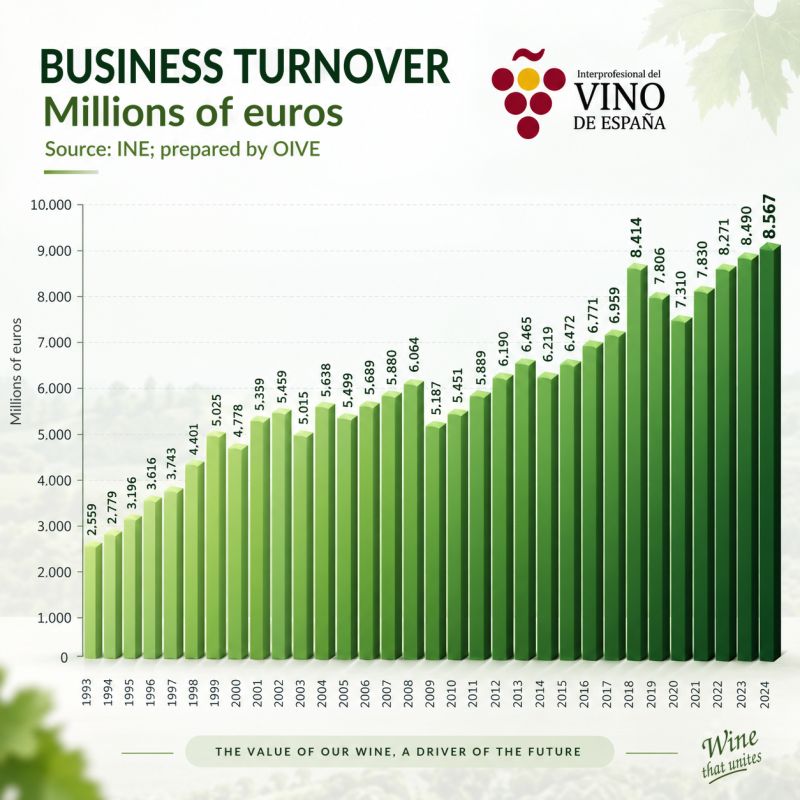
Spanish wine producers posted their highest revenue on record in 2024, even as the number of wineries fell, investment weakened for a second straight year, and product sales slipped. An analysis by the Spanish Wine Interprofessional Organization, or OIVE, based on structural business data from Spain’s National Statistics Institute, or INE, put the sector’s revenue at €8.5668 billion, up 0.9% from 2023.
The increase amounted to €76.6 million from the previous year. At the same time, the sector’s gross operating result, as reported by OIVE without depreciation, rose 29.5% to €941.9 million. Foreign sales also exceeded sales in Spain, making exports the larger market for Spanish wine producers last year.
The new high came after several years of recovery from the pandemic period, but the pace of growth continued to slow. Revenue had fallen from €8.4142 billion in 2018 to €7.8065 billion in 2019 and then to €7.3102 billion in 2020. It later climbed to €7.8295 billion in 2021, €8.271 billion in 2022, €8.4902 billion in 2023, and finally €8.5668 billion in 2024. That means 2024 revenue was 17.2% above the 2020 level, but only 1.8% higher than it was six years earlier in 2018.
The trend also showed a clear loss of momentum. Annual growth slowed from about 7.1% in 2021 to 5.6% in 2022, 2.7% in 2023, and 0.9% in 2024. In absolute terms, each year added less revenue than the one before. The sector gained €519.3 million in 2021, €441.5 million in 2022, €219.2 million in 2023, and only €76.6 million in 2024.
Over a longer period, the industry’s expansion remains significant. OIVE’s historical series begins at €2.5591 billion in 1993. From that point to 2024, business volume more than tripled in nominal terms, which OIVE said reflects an average annual increase of about 4%.
The composition of revenue changed in an important way last year. Product sales fell 0.9%, dropping from €7.7165 billion to €7.6504 billion. Merchandise sales rose only 0.3% to €600.8 million. The strongest change came from services, where revenue jumped 81% from €174.4 million to €315.7 million.
That rise in services added €141.3 million, which was more than the total increase in overall revenue and enough to offset the €66.1 million decline in product sales. Services accounted for about 3.7% of total revenue in 2024. The record turnover therefore did not reflect uniform growth across the core activities of wine-producing companies.
Total operating income, a broader measure than revenue, reached €8.8581 billion, up 0.4%. Operating subsidies increased 1.3% to €124.7 million. Other operating income fell 20.5% to €138.7 million, and work carried out for fixed assets dropped 20.8% to €27.9 million.
The clearest improvement in the industry’s accounts came from lower operating expenses. Total operating costs fell 4% to €8.3994 billion, down from €8.7506 billion in 2023. The reduction of €351.2 million ended a run of three consecutive yearly increases in costs.
Consumption of raw materials and other supplies fell 5.9%, from €4.8659 billion to €4.5782 billion. That was a decline of €287.7 million. This category represented 53.4% of revenue in 2024, compared with 57.3% a year earlier. In other words, wineries billed slightly more while spending less on those inputs.
That drop interrupted three straight annual increases in raw material and supply consumption, which had climbed from €3.9832 billion in 2020 to €4.8659 billion in 2023. Even with revenue now above the 2018 level, this cost item remained 7.2% below the €4.9333 billion recorded that year.
The combined value of consumption and outsourced work fell 8.5% to €5.1393 billion from €5.6178 billion. Within that total, merchandise consumption declined 14% to €385.3 million. Work performed by other companies dropped from €303.7 million to €175.8 million. External services moved in the opposite direction and rose 2.9% to €1.5746 billion.
Inventories also shifted sharply. The variation in product stocks fell from €237.1 million in 2023 to €48.7 million in 2024, a decline of 79.5%. This figure measures the annual change in inventories rather than the total value of stored products. It remained positive, but it was far below the 2023 level and also lower than the €169.4 million recorded in 2022.
Against that backdrop, the sector’s gross operating result improved by €214.3 million, rising from €727.6 million to €941.9 million. The 29.5% increase brought the figure above the levels seen in 2021 and 2022, when it stood at €914.5 million and €915.8 million, respectively, though it remained below the €992.3 million reached in 2018.
The same statistics also showed an operating result of €458.7 million, up from €72.3 million in 2023. OIVE noted that this is a different indicator from the gross operating result and should not be confused with net profit for the year.
The number of wine-producing companies continued to shrink. Spain had 3,988 such businesses in 2024, down 1.2% from 2023, or 50 fewer companies. The sector therefore moved back below the threshold of 4,000 firms after rising above it the year before. Recent years have shown repeated fluctuations, with 4,071 companies in 2019, 3,839 in 2020, 4,038 in 2021, 3,994 in 2022, and 4,038 in 2023.
Even after the latest decline, the industry still had more companies than it did a decade ago. There were 3,709 producers in 2015. Dividing the sector’s total revenue by the number of wineries puts average business volume at about €2.15 million per company in 2024, up from roughly €2.10 million in 2023.
Employment was almost unchanged. Total staffing stood at 32,144 people in 2024, compared with 32,183 a year earlier, a decline of 39 workers, or 0.1%. But the flat result masked two opposite moves. Paid staff increased 2.2% to 30,210 people, or 655 more workers, while unpaid staff fell 26.4% to 1,934, a drop of 694.
Hours worked by paid employees rose 2.1% to 51.062 million. Compared with 2015, the sector employed far more people. At that time, it counted 24,413 workers, including 22,574 paid employees. By 2024, total employment was 7,731 higher than nine years earlier.
Labor costs continued to rise. Personnel expenses reached €1.1862 billion, up 4.9% from 2023, or €55.2 million more. Wages and salaries rose 4.6% to €927.1 million, and social contributions increased 5.9% to €258.6 million.
That line item has increased every year since 2015, when labor costs stood at €762.5 million. The cumulative increase through 2024 was about 55.6%. The progression included €932.2 million in 2018, €998.6 million in 2021, €1.0394 billion in 2022, and €1.131 billion in 2023 before reaching the latest level. That means staffing costs kept growing even as overall operating expenses fell.
Exports were a central driver of revenue. Foreign sales totaled €4.3482 billion in 2024, up 2% from the previous year, an increase of €85.6 million. Domestic sales slipped slightly to €4.2186 billion, down 0.2%. Based on total revenue, exports represented about 50.8% of the business, compared with 49.2% for sales in Spain.
The domestic market had recovered in 2023, when sales in Spain reached €4.2276 billion, up from €3.8088 billion in 2022. The 2024 figure preserved most of that rebound but did not extend it. It also remained well below the peak level of about €5.387 billion shown in the historical series, leaving domestic revenue roughly 21.7% under that earlier high.
Within exports, sales to European Union countries posted the strongest percentage increase. They rose 5% to €1.3322 billion, up by €63 million from 2023, and accounted for around 15.6% of total revenue. The EU market has now grown for three straight years, from €1.1748 billion in 2021 to €1.2481 billion in 2022, €1.2692 billion in 2023, and the 2024 total. Even so, it remained well below the €1.6585 billion recorded in 2019. OIVE said earlier swings may have been linked to one-off increases in bulk wine exports to EU partners.
Sales to non-EU countries reached €3.0161 billion, up 0.8% from €2.9933 billion in 2023. Those markets accounted for about 35.2% of revenue and remained much larger than the EU export segment. The longer trend outside the bloc has been more volatile. Revenue from third countries jumped from €1.5319 billion in 2020 to €2.6429 billion in 2021 and €3.2141 billion in 2022, before falling 6.9% in 2023 and recovering only partly in 2024.
OIVE said the performance in non-EU destinations points to a broader diversification of export markets by Spanish wineries. In 2024, growth in both EU and non-EU sales lifted total exports to a level €129.6 million higher than revenue generated inside Spain.
The improvement in results was not matched by investment. Net investment in tangible assets fell 7.2% to €444.1 million, down from €478.5 million in 2023 and €524 million in 2022. Over two years, that represented a cumulative decline of about 15.2%.
Measured against revenue, tangible investment represented about 5.2% of turnover, compared with 5.6% in 2023. On a longer view, the €444.1 million invested in 2024 was 30.7% below the €641.2 million recorded in 2015.
Several categories posted declines. Net investment in land fell 45.4% to €21.4 million. Investment in machinery dropped 12.7% to €90.4 million. Spending on technical installations, including acquisitions, improvements, and self-produced assets, declined 4.1% to €97.3 million.
Investment in other tangible assets decreased 7.1% to €132.8 million. Construction was the main exception, rising 11.8% to €102.3 million. While physical investment weakened overall, intangible investment moved sharply higher, increasing from €12.5 million to €33.7 million, a jump of 169.4%.