A Swiss Dentist Opened 118 Champagne Bottles in 60 Seconds
Organizers called the Neuchâtel sabrage attempt a world record, with proceeds going to an anti-food-waste charity.
2026-08-26
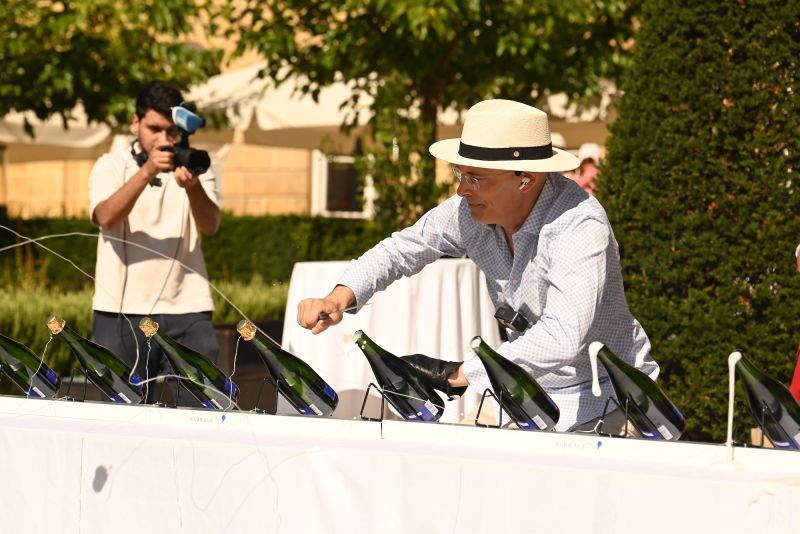
A Swiss dentist has set a new benchmark in sabrage, the ceremonial practice of opening a Champagne bottle with a saber, after uncorking 118 bottles in one minute at an event in Neuchâtel, Switzerland.
The man behind the feat, Mirko Bozin, used a saber to strike the necks of 118 bottles of Champagne Pommery in 60 seconds, according to organizers of the event. The attempt was designed as both a public spectacle and a fundraiser. Bozin had said beforehand that he hoped to reach 150 bottles, but the final total of 118 still established what organizers described as a new world record in the discipline.
The event also had a charitable purpose. Bozin directed all proceeds to Free Go, a group that works against food waste by collecting unsold products and redistributing them through refrigerators that are open to the public. People attending the event were able to support the fundraiser by buying glasses of Champagne or by symbolically adopting a bottle in exchange for a tasting package.
Organizers said the wine opened during the attempt was not wasted. The Champagne was either consumed on site or recovered afterward, an important point for an event built around an anti-waste cause. That detail helped frame the record attempt as more than a display of speed and technique, especially at a time when public events tied to luxury products can face scrutiny over excess and waste.
Two notaries recorded the attempt, giving it formal documentation. Even so, the record will not be submitted to Guinness World Records. According to the organizers, Bozin chose not to pay the registration costs required for a Guinness application and instead preferred to preserve the full proceeds for charity.
Bozin prepared for the attempt by focusing on both technique and equipment. He used a saber made to his specifications that was lighter than a traditional one, a change intended to help him move faster from bottle to bottle. In sabrage, the blade is not sharpened for cutting in the usual sense. The top of the bottle breaks away when the saber hits the seam at the neck with enough force, while the internal pressure of the sparkling wine helps eject the glass ring and cork together.
That mechanical detail is central to the practice and to its risks. Sabrage is a controlled strike rather than a slicing motion, and it depends on precision. The bottle must be chilled, held at the correct angle, and struck cleanly along the seam. In public demonstrations, practitioners usually stress that the technique should only be attempted by trained people using proper safety precautions.
The ritual has deep historical roots. Sabrage is commonly associated with the Napoleonic era, when it was said to be used by cavalry officers to celebrate victories, and sometimes to lift spirits after defeat. Over time it moved from military lore into hospitality, luxury dining, and wine service, where it became a dramatic symbol of celebration. In recent years, it has also turned into a niche field for competitive demonstrations built around speed, repetition, and accuracy.
Bozin’s performance in Neuchâtel reflects that shift. What was once mainly a ceremonial flourish is now also treated by some enthusiasts as a test of disciplined movement under time pressure. The result in Switzerland places Bozin at the center of that small but visible world, even without an official Guinness listing, and links the achievement to a fundraising drive rather than to a commercial promotion alone.
The attempt drew attention not only because of the number of bottles opened in a minute, but because it combined a highly theatrical wine tradition with a local charitable effort. In that setting, the image of a dentist using a specially designed saber to open 118 bottles of Champagne in rapid succession became both a spectacle for the crowd and a vehicle for raising money for food redistribution work.
