Les exportations espagnoles de vin chutent de 46,5 millions d'euros en neuf mois en raison de l'effondrement des ventes de produits conditionnés
Les expéditions en vrac n'offrent qu'un soulagement limité, tandis que les catégories premium telles que le Cava et les vins tranquilles DOP sont confrontées à de fortes baisses sur les marchés clés.
01-12-2025
Les exportations de vin espagnol ont connu une période difficile en septembre 2025, les données officielles faisant état d'une baisse de 10,3 % en valeur et de 7,3 % en volume par rapport au même mois de l'année précédente. Selon les chiffres de l'agence fiscale espagnole, analysés par l'Organisation interprofessionnelle du vin espagnol (OIVE), le pays a exporté du vin pour une valeur de 214,2 millions d'euros et expédié 131,4 millions de litres au cours du mois de septembre. Cela représente une perte de 24,5 millions d'euros et de 10,3 millions de litres par rapport à septembre 2024.
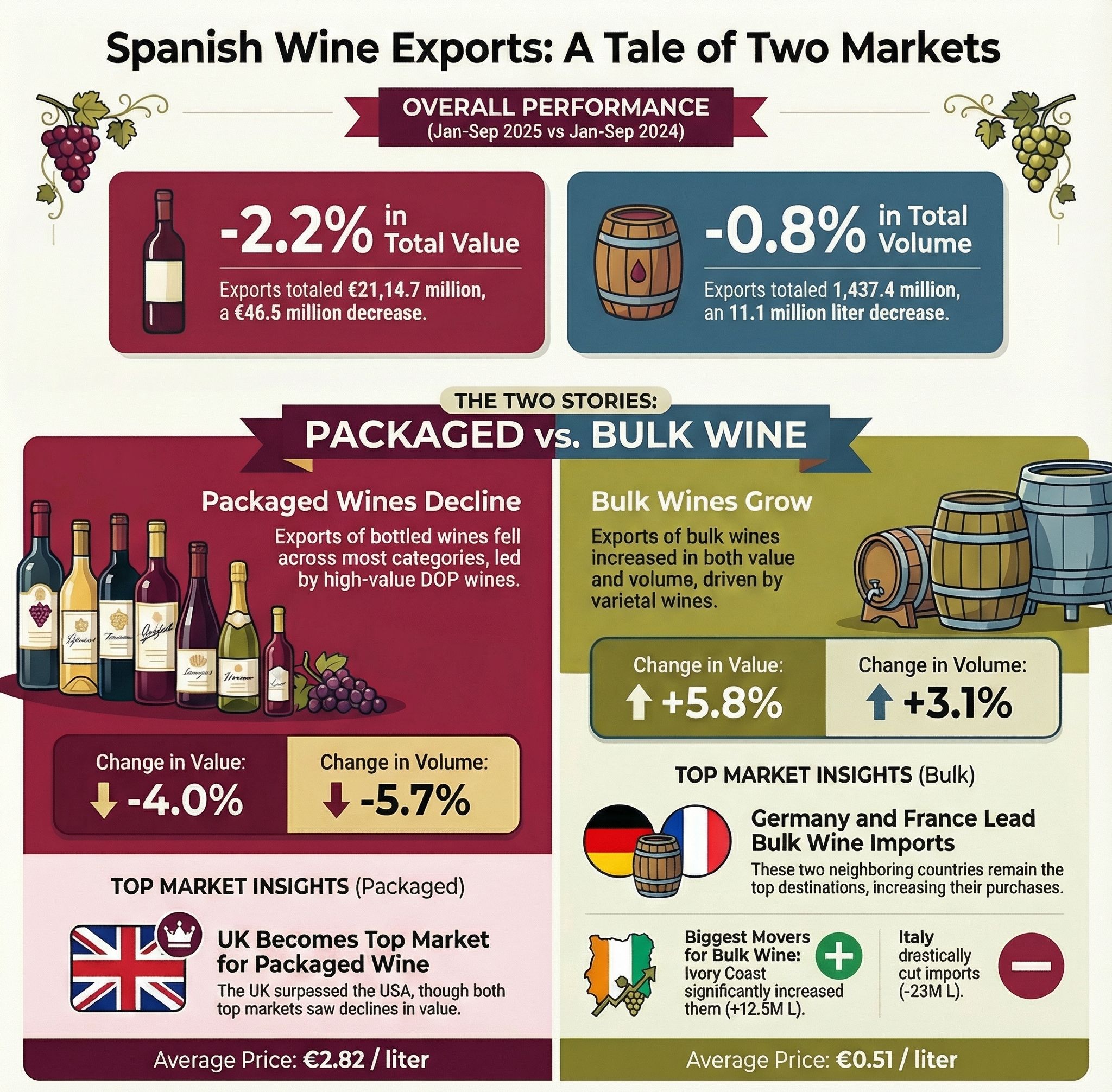
Les résultats négatifs de septembre ont contribué à une baisse globale pour les neuf premiers mois de 2025. De janvier à septembre, les exportations espagnoles de vin ont totalisé 2,11 milliards d'euros, soit une baisse de 2,2 % par rapport à la même période en 2024, tandis que le volume total a diminué de 0,8 % pour atteindre 1,44 milliard de litres. En termes absolus, cela signifie que l'Espagne a exporté 46,5 millions d'euros de vin en moins et expédié 11,1 millions de litres de moins qu'au cours des trois premiers trimestres de l'année dernière.
Les données révèlent une nette séparation entre les exportations de vin conditionné et de vin en vrac. Les vins conditionnés - qui comprennent les vins tranquilles, les vins mousseux, les vins de liqueur, les vins frizzante ("aguja") et les formats Bag-in-Box - ont enregistré des baisses en valeur et en volume, tandis que les vins en vrac (vendus dans des contenants de plus de 10 litres) ont enregistré une croissance sur les deux fronts.
Les exportations de vins conditionnés ont diminué de 4 % en valeur pour atteindre 1,69 milliard d'euros et de 5,7 % en volume pour atteindre 599,4 millions de litres au cours de la période de neuf mois. Le prix moyen des vins conditionnés a légèrement augmenté de 1,8 % pour atteindre 2,82 euros par litre, mais cela n'a pas suffi à compenser la baisse globale.
Parmi les vins conditionnés, les vins mousseux ont connu des résultats mitigés. Les exportations totales de vins mousseux ont diminué de 0,6 % en valeur pour atteindre 363,9 millions d'euros et de 3,5 % en volume pour atteindre 106,5 millions de litres, bien que le prix moyen ait augmenté de 3 %. Le principal facteur de ce déclin est le Cava, le vin mousseux phare de l'Espagne, qui bénéficie de sa propre appellation d'origine protégée (AOP). Les exportations de Cava ont fortement chuté : la valeur a baissé de 6,1 % et le volume de 13 %. Le Cava représentait environ deux tiers de toutes les exportations de vins mousseux espagnols en volume et près de trois quarts en valeur au cours de cette période.
Les autres types de vins mousseux espagnols se sont mieux comportés, leurs exportations ayant augmenté de près de 17 % en valeur et de plus de 20 % en volume par rapport à l'année dernière, bien que leur prix moyen ait légèrement baissé.
Les États-Unis sont restés le premier marché pour les vins mousseux espagnols, avec des importations d'une valeur de 56,7 millions d'euros (+1,1 %) et de 15,8 millions de litres (+0,3 %) au cours des neuf premiers mois de l'année. La Belgique a suivi en tant que deuxième marché le plus important, tandis que l'Allemagne a connu un fort déclin, passant de la quatrième à la septième place en valeur et de la troisième à la septième place en volume.
Les vins tranquilles conditionnés ont également connu des difficultés dans toutes les sous-catégories, les exportations totales ayant chuté de 5,2 % en valeur pour atteindre 1,2 milliard d'euros et de 6,6 % en volume pour s'établir à un peu moins de 420 millions de litres ; les prix moyens ont connu une hausse modeste de 1,5 %. Les vins avec DOP ont dominé cette catégorie mais ont subi un revers important : la valeur de leurs exportations a chuté de 40,7 millions d'euros (-4,6%) et leur volume a diminué de près de 14 millions de litres (-7,6%). Malgré ces pertes, les vins tranquilles DOP ont conservé le prix moyen le plus élevé de toutes les catégories, soit un peu plus de 5 euros par litre.
Les vins tranquilles de cépage ont vu la valeur de leurs exportations chuter de près de 10 %, tandis que les volumes ont baissé de moins de 2 %. Les vins avec indication géographique protégée (IGP) ont connu une baisse encore plus marquée, de plus de 10 % en valeur et de plus de 13 % en volume.
Les vins de liqueur ont été l'un des rares points positifs parmi les produits conditionnés, la valeur des exportations ayant augmenté de près de 5 % pour atteindre 36,9 millions d'euros et les volumes de 7,5 millions de litres ; les prix sont restés stables à un peu moins de 4,90 euros par litre.
Les vins Bag-in-Box (BiB), vendus principalement dans des contenants de deux à dix litres, ont également enregistré des résultats négatifs : la valeur des exportations a chuté de près de 3 %, tandis que les volumes ont baissé d'un peu plus de 5 %. La France est devenue la première destination des vins BiB espagnols au cours de cette période, avec une forte croissance tant en valeur (+50%) qu'en volume (+74%).
Pour l'ensemble des vins conditionnés non pétillants (y compris les vins tranquilles, les vins de liqueur et les vins frizzante), le Royaume-Uni a dépassé les États-Unis en tant que premier marché d'exportation de l'Espagne en valeur au cours des neuf premiers mois de l'année, malgré une légère baisse (-3,5 %). Le Royaume-Uni a importé 165 millions d'euros de ces vins, contre 159 millions de dollars pour les États-Unis (-13,9 %). En termes de volume, le Royaume-Uni est également en tête avec près de 55 millions de litres importés (-6,6 %), suivi de près par l'Allemagne.
Les exportations de vin en vrac ont soulagé les producteurs espagnols dans un contexte de baisse des ventes de produits conditionnés de plus grande valeur. Les expéditions en vrac ont augmenté de près de 6 % en valeur pour atteindre 423,5 millions d'euros et d'un peu plus de 3 % en volume pour atteindre 838 millions de litres ; les prix moyens ont légèrement augmenté pour atteindre 0,51 euro par litre.
Au sein des catégories de vin en vrac, c'est le vin de cépage en vrac qui s'est le mieux comporté : la valeur des exportations a augmenté de plus de 11 %, tandis que les volumes ont progressé de plus de 11 %. Les vins en vrac sans indication ont également connu une croissance modeste, tant en valeur (+4,6 %) qu'en volume (+0,4 %). En revanche, les vins IGP en vrac ont connu une forte baisse, d'un cinquième en valeur et de plus d'un quart en volume.
L'Allemagne est restée le principal marché de l'Espagne pour le vin en vrac, représentant près d'un tiers du volume total des exportations et presque autant du revenu total ; les importations allemandes ont légèrement augmenté à la fois en valeur (+4%) et en volume (+1%). Les importations allemandes ont légèrement augmenté en valeur (+4 %) et en volume (+1 %). La France suit de près en tant que deuxième plus grand acheteur ; les importations françaises ont augmenté de plus de 3 % en volume et de 16 % en valeur par rapport à l'année dernière.
Les achats de vin en vrac espagnol par l'Italie ont fortement chuté - près de vingt-deux pour cent en volume et douze pour cent en valeur - bien que l'Italie soit restée le troisième marché de l'Espagne pour les expéditions en vrac.
D'autres marchés ont connu des changements notables : Le Portugal est redevenu le quatrième client de l'Espagne pour le vin en vrac, avec une croissance modeste ; la Côte d'Ivoire est devenue une destination importante, avec des augmentations de plus de 40 % tant en valeur qu'en volume ; la Roumanie a également augmenté ses importations de manière significative.
L'examen des chiffres sur douze mois glissants jusqu'en septembre confirme ces tendances : les exportations totales de vin espagnol ont légèrement diminué (-0,5 %) pour atteindre 2,93 milliards d'euros au cours de cette période, tandis que les volumes ont baissé plus fortement (-1,7 %) pour s'établir à un peu moins de deux milliards de litres.
Les données suggèrent que si l'Espagne reste l'un des principaux exportateurs de vin au monde, tant en valeur qu'en volume, elle est confrontée à des défis permanents liés à l'évolution de la demande mondiale - en particulier pour les produits conditionnés de plus grande valeur - et à la concurrence accrue d'autres pays producteurs sur des marchés clés tels que l'Amérique du Nord et l'Europe.
Les analystes du secteur soulignent que la hausse des coûts tout au long de la chaîne d'approvisionnement peut contribuer à l'augmentation des prix moyens, mais qu'elle ne compense pas entièrement la perte de volumes de vente ou les baisses dans les catégories haut de gamme telles que les vins tranquilles DOP ou le Cava.
Les producteurs suivent de près l'évolution de ces tendances à la fin de l'automne et en hiver, car ils planifient leurs stratégies pour les récoltes de l'année prochaine et les campagnes de marketing internationales, dans un contexte d'incertitude persistante sur les marchés mondiaux des boissons.

Fondée en 2007, Vinetur® est une marque déposée de VGSC S.L. qui a une longue histoire dans le secteur du vin.
VGSC, S.L., dont le numéro de TVA est ESB70255591, est une entité inscrite au registre du commerce de Saint-Jacques-de-Compostelle, Spagna.
Email: [email protected]
Sede e uffici a Vilagarcia de Arousa, Galice.