Trump Orders Immediate Halt to U.S. Trade With Spain
The threat opened a new clash over NATO spending and Spain’s refusal to back U.S. military operations against Iran.
2026-07-08
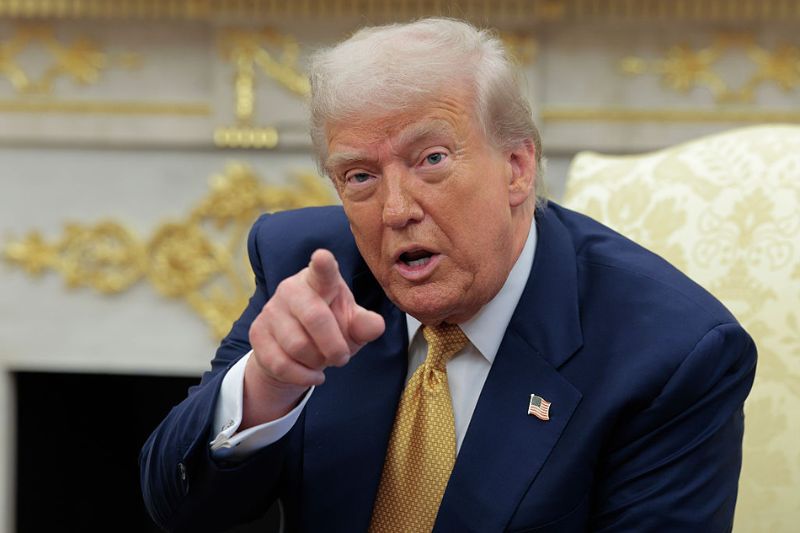
President Trump said on Wednesday that he had ordered an immediate halt to all U.S. trade with Spain, opening a new dispute with a NATO ally over defense spending and Spain’s refusal to support U.S. military operations against Iran.
Trump made the remarks during a NATO summit in Ankara, where alliance leaders had hoped to contain internal tensions. Instead, he publicly attacked Spain, calling it a poor partner and telling Treasury Secretary Scott Bessent to stop commerce with the country. “I don’t want to do any trade with them,” Trump said, according to Reuters. Bessent replied, “Yes, sir.”
The threat is the second time Trump has said he wanted to cut off trade with Spain because Prime Minister Pedro Sánchez has not committed to NATO’s new defense spending target of 5% of gross domestic product. Reuters reported that after a similar warning in March, trade between the two countries continued without interruption.
Trump also tied his anger to Spain’s position on the war with Iran. He has repeatedly criticized Sánchez for refusing to allow the United States to use Spanish airspace or military bases for that conflict. During the summit, Trump told NATO Secretary General Mark Rutte that Spain “doesn’t agree to anything.” He later softened his broader tone about the alliance, saying there had been love and unity at the meeting.
Sánchez sought to minimize the clash. He told reporters that he had a “very cordial” conversation with Trump and said they discussed the soccer World Cup and golf, but not military spending. He insisted that Spain remained a reliable NATO ally and announced a new deployment of Spanish troops to Finland for NATO’s Arctic Sentry mission.
The Spanish leader said Spain had sharply increased military spending in recent years and argued that the country’s economic growth gave it room to meet its commitments. Rutte also tried to calm the dispute, saying Spain had made a major step by raising defense spending to 2%, while acknowledging that unresolved issues remained.
Spain’s government pushed back on Trump’s trade threat by stressing both legal and economic limits. Sánchez’s office said Spain runs a trade deficit with the United States and argued that commercial ties are built by private companies, not directed by governments. It also noted that European Union customs and trade policy are handled at the bloc level, which means Washington cannot simply negotiate or punish one member state through normal trade channels as if it were acting alone.
That legal obstacle could make any attempt to single out Spain difficult. Jennifer Hillman, an expert in economic law and former member of the World Trade Organization’s Appellate Body, said earlier this year that Trump would likely need to declare a national emergency and show that Spain posed a threat to U.S. national security, foreign policy or the economy in order to justify such action.
The United States and Spain also share strategic military ties beyond NATO politics. The two countries jointly operate key naval and air bases in southern Spain. Spanish officials said they were not aware of any U.S. plan to reduce forces or assets there and added that investment at both facilities was increasing.
For food and beverage companies, the threat matters because Spain is an important supplier of wine and other products to the American market. Spain exports olive oil, auto parts, steel, chemicals and wine to the United States, but wine is especially exposed to sudden trade disruption because importers, distributors and retailers depend on steady shipments and predictable pricing. Any real interruption could affect supply schedules, purchasing decisions and margins across the U.S. drinks business.
That risk comes at a time when Spanish wine was already under pressure in the United States. Reuters reported that Spanish wine exports to the U.S. fell by 4.3% in value and 2.6% in volume in 2025, citing Spain’s wine industry group OIVE through consultancy ERA Group. A new trade barrier or administrative freeze could deepen those losses if importers delay orders or shift toward other origins.
Even so, analysts cited by Reuters said Spain is less exposed to U.S. trade than some other European economies. At the same time, major American investors have continued to show confidence in Spain despite Trump’s rhetoric. BlackRock said in its midyear report that Spain was its preferred country for equity exposure because its economy has grown faster than most developed markets. A spokesperson said the firm holds €104 billion, or about $119 billion, in Spanish equities, debt and other assets, making Spain its main global investment bet for the next six months.
Still, official data from Spain’s Economy Ministry showed that net overall U.S. investment in Spain fell by €1.9 billion in the first quarter.
Whether Trump’s latest order leads to concrete restrictions remains unclear. His March threat did not produce an actual break in trade flows, and both legal barriers inside the European Union and practical limits inside the U.S. system could slow or block any immediate action. But his comments added fresh uncertainty for companies on both sides of the Atlantic at a moment when defense policy, Middle East strategy and commercial ties are becoming more tightly linked.
