Spain’s 10 Most Profitable Wine Regions, Ranked by the AAWE
Galicia tops the list at €18,742 in net value added per vineyard hectare
2026-08-11
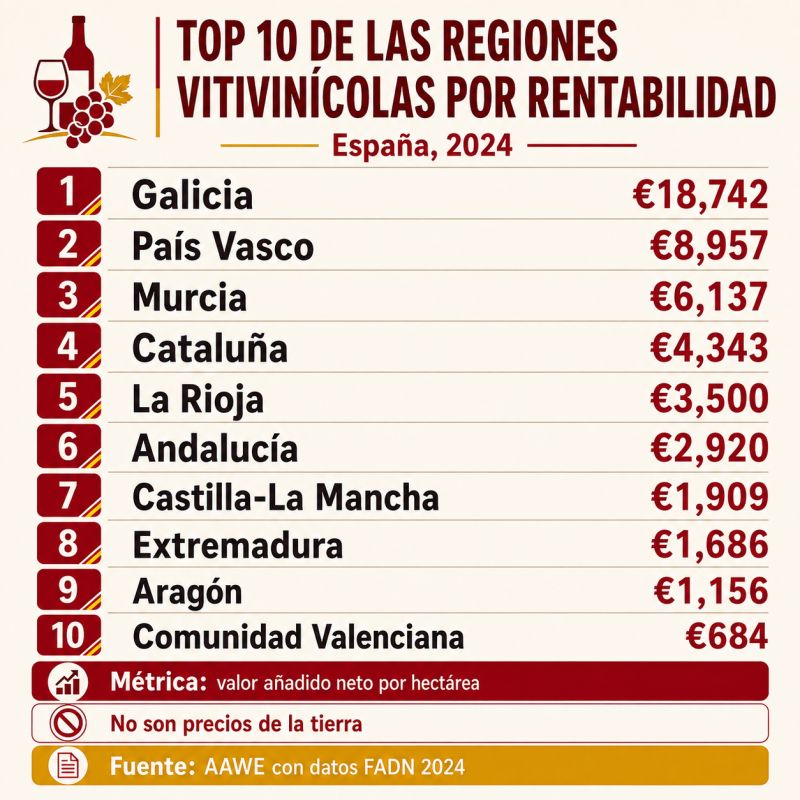
Galicia generated the highest net economic value per hectare of vineyard in Spain in 2024, widening its lead over every other Spanish wine region and placing itself as the only one from the country in Europe’s top 10, according to a ranking published by the American Association of Wine Economists.
The northwestern region posted €18,742 in net value added per hectare, more than double the figure for the Basque Country, which ranked second in Spain with €8,957. The gap between the two regions was €9,785 per hectare. In the broader European table, Galicia placed seventh, while the Basque Country came in 19th, 12 places lower.
The figures come from the European Union’s Farm Accountancy Data Network, known as FADN, and measure what the AAWE describes as farm net value added per hectare. The indicator does not reflect the market price of vineyard land or the sale value of a property. It is an accounting measure based on total output minus intermediate consumption and depreciation, with the balance of subsidies and taxes added in. The result is meant to show the amount available to pay fixed factors such as labor, land and capital.
That distinction matters in a country where wine regions are often judged by bottle prices, land values or the prestige of appellations. The AAWE ranking is based instead on the average economic value generated by commercial farms specialized in viticulture. It also relies on FADN territorial divisions, not on appellations, provinces or local wine districts. In practical terms, the ranking compares broad regions on how much net value vineyard activity produces per hectare, not how much profit a single grower takes home.
Galicia’s position stands out both nationally and at the European level. It was the only Spanish region to break into the top 10 in Europe, a list dominated by more intensive and higher-value vineyard areas elsewhere on the continent. Within Spain, its lead over the Basque Country was large enough to make Galicia’s figure slightly more than twice as high as that of the second-place region.
After Galicia and the Basque Country, Murcia ranked third in Spain with €6,137 per hectare. It was followed by Catalonia at €4,343. Murcia held 34th place in Europe, while Catalonia ranked 42nd. The spread between the two Spanish regions was €1,794 per hectare, and Murcia’s result was €2,820 below that of the Basque Country.
La Rioja placed fifth in Spain with €3,500 per hectare. The published figure refers to the territorial unit used by FADN, not to the Rioja Denominación de Origen Calificada as a wine appellation. Andalusia ranked sixth with €2,920, trailing La Rioja by €580.
The lower half of the Spanish ranking showed a much sharper drop. Castilla-La Mancha, the country’s largest vineyard area by far, ranked seventh with €1,909 per hectare. Extremadura followed with €1,686, a difference of €223. Aragon came ninth with €1,156, and the Valencia region closed the Spanish table at €684 per hectare.
Those last four regions also clustered near the bottom of the European ranking. Castilla-La Mancha was 55th, Extremadura 56th, Aragon 58th and Valencia 60th. The gap between Galicia, Spain’s top performer, and Valencia, its lowest-ranked region in the table, reached €18,058 per hectare.
The ranking covered 10 Spanish regions in total. Their inclusion reflects the regional breakdown available in the FADN database rather than the structure of Spain’s wine appellation system. That means well-known protected designations are not the unit of comparison here. Instead, the data aggregates commercial vineyard farms within each accounting region and divides the economic result by vineyard area.
The calculation can also include revenue tied to activities connected to the farm, not only grape growing in a narrow sense. According to the methodology cited by the AAWE, total output may include income from related operations such as agritourism. In some regions, that can help lift the economic value recorded per hectare, especially where vineyard businesses are more diversified.
The AAWE’s use of net value added also means the ranking should not be read as a simple margin table. It does not represent the final profit of each owner or estate, and it does not capture differences in debt levels, financing costs or the private financial situation of individual wineries and growers. What it does provide is a standardized way to compare how much net economic value specialized vineyard farms generate from the land they use.
For Spain’s wine sector, the results show a wide internal divide. Galicia and the Basque Country sit well above the rest of the country on this measure, while several larger producing regions remain far lower in net value generated per hectare. The figures suggest that scale alone does not determine the economic performance captured by the ranking, and that regional production models, grape values, linked activities and cost structures can produce very different outcomes even within the same national industry.
Galicia’s first-place finish in Spain comes at a time when its wines have gained wider attention in export markets and in wine tourism, but the ranking itself remains tied to accounting performance at the farm level. The data is for 2024, and the comparison is built on average results across specialized commercial holdings rather than standout estates. Even so, the scale of Galicia’s lead makes it the clearest Spanish outlier in the table published by the AAWE, with a result that set it apart from every other wine region in the country under the same methodology.
