Turkish Airlines earned $197 million in second-quarter profit despite higher fuel costs.
A 58% rise in cargo revenue helped lift quarterly sales 20.5% to $7.2 billion after regional conflict pushed up jet fuel prices.
2026-08-10
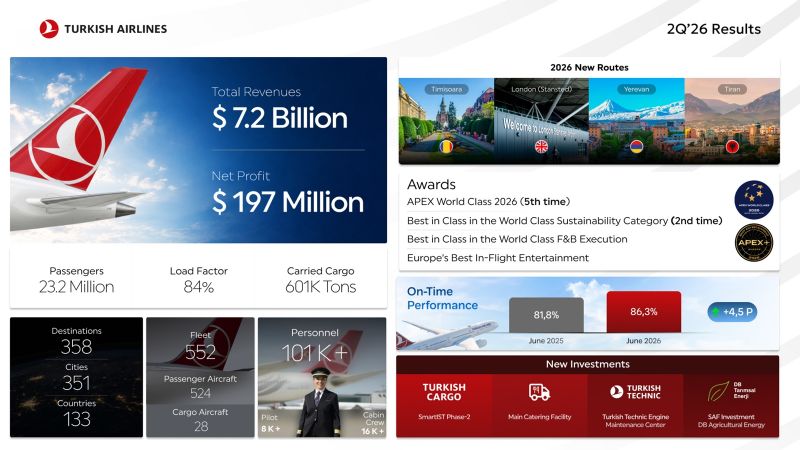
Turkish Airlines said Monday that it earned a net profit of $197 million in the second quarter of 2026, as higher passenger and cargo revenue helped offset the financial impact of renewed conflict in the Middle East and a sharp rise in jet fuel costs.
The Istanbul-based carrier reported total revenue of $7.2 billion for the April-to-June period, up 20.5% from a year earlier. Cargo revenue rose 58% from the same quarter of 2025 to nearly $1.3 billion, while cargo volume increased 11.3%, according to the company.
The airline said its second-quarter results were shaped by an unstable operating environment. Fighting in the Middle East disrupted parts of the global aviation market and pushed up fuel prices, which raised costs with a lag during the quarter. Turkish Airlines said it responded by adjusting capacity across its network and by leaning on stronger unit revenue from both passenger traffic and freight.
Its EBITDAR, a measure of earnings before interest, taxes, depreciation, amortization and rent, topped $900 million in the quarter. The EBITDAR margin reached 12.6%, above the 8% level the company had previously forecast.
Passenger demand remained strong, especially from Asia and from markets in Europe and Africa, the airline said. Its load factor rose by 1.8 points to 84.0%, which Turkish Airlines described as the highest second-quarter load factor in its history.
The company continued to expand even as aircraft production delays and regional instability added pressure to the broader industry. Turkish Airlines said its fleet grew 14% from a year earlier to 552 aircraft by the end of June. In the first six months of 2026, it invested a total of $3.1 billion in what it called selective projects tied to strategic priorities.
The airline also said its consolidated assets reached $51 billion and that its total workforce, including subsidiaries, exceeded 101,000 employees.
The stronger cargo performance was one of the clearest signs of resilience in the quarter. Turkish Airlines said geopolitical events in the Middle East put significant pressure on global air cargo capacity, but its cargo division benefited from its infrastructure and from Turkey’s geographic position between major trade regions. That allowed it to capture demand at a time when shippers faced tighter capacity and higher rates in parts of the market.
The results offered a mixed picture of the airline industry’s current conditions. Passenger demand is holding up on many long-haul and connecting routes, and cargo has strengthened in some lanes, but fuel prices remain a major risk for airlines with large international networks. Turkish Airlines said it expects strong demand for both passenger travel and freight to limit the negative effect of higher fuel costs in the months ahead.
For the third quarter, the carrier forecast an EBITDAR margin of 20%-25%. That guidance suggests the airline expects the peak summer season to support earnings despite geopolitical tensions and higher operating costs.
Murat Şeker, chairman of the board and executive committee, said in the company’s statement that Turkish Airlines had managed a difficult period through the breadth of its flight network, its diversified business model and tight cost control. He said the airline also continued to pursue company-wide efficiency measures while keeping its focus on flight safety and customer satisfaction.
The second-quarter report comes at a time when Turkish Airlines is trying to balance growth with operational risks outside its control. The airline has been adding aircraft and expanding service as it pursues long-term growth targets, but the pace of that expansion is occurring against a backdrop of delayed aircraft deliveries, political tension across parts of its region and volatile fuel markets.
Those pressures are especially important for Turkish Airlines because of its role as a global connecting carrier. Its hub in Istanbul places it in a strong position to link Europe, Asia, Africa and the Middle East, helping it draw transfer traffic and cargo flows that can shift quickly when disruptions hit other markets. At the same time, that geography also leaves the airline exposed to regional conflict and to sudden changes in airspace access and operating costs.
The company did not provide a full breakdown of passenger yields or route-by-route performance in the statement, but it said higher unit revenue from both passengers and cargo helped balance the cost shock from fuel. That emphasis on profitability, rather than growth alone, appears to have been central to its capacity decisions during the quarter.
Turkish Airlines issued the results from Istanbul and framed them as evidence that its current strategy can withstand market shocks. The quarter’s profit was modest relative to total revenue, but the airline’s stronger margin, record second-quarter load factor and growth in cargo revenue point to continued demand across key parts of its network, even as the conflict in the Middle East reshapes costs and traffic patterns for airlines operating across the region.
