Nolan’s “The Odyssey” turns Homer’s feasts into the film’s sharpest source of drama.
Soup, cheese, wine and scraps become tests of memory, hospitality and power across the director’s retelling of the epic.
Monday, August 10, 2026
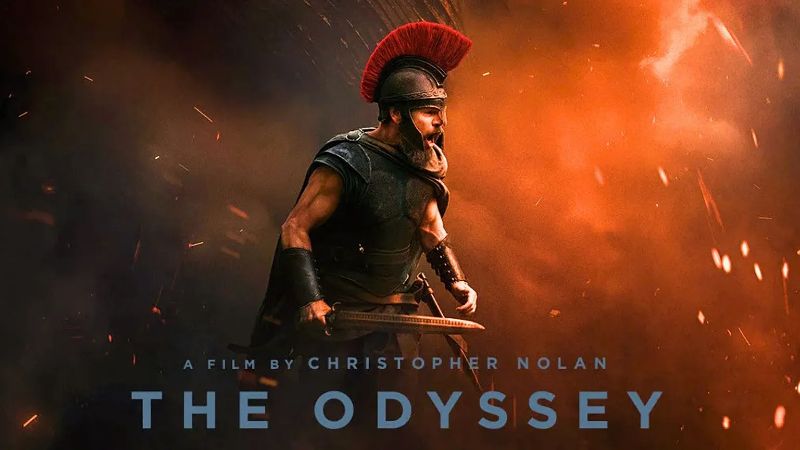
Christopher Nolan’s “The Odyssey,” now playing in theaters around the world, gives food and wine an unusually large role in its retelling of Homer’s epic, using meals not as decoration but as a way to show temptation, memory, power and social order.
That choice follows the logic of the poem itself. In Homer’s “Odyssey,” eating and drinking are constant acts. Classicists have counted nearly 200 meals across the poem’s 24 books. Feasts, guest gifts, shared wine and stolen livestock help define who belongs to the civilized world and who stands outside it. Nolan does not try to reproduce every banquet in Homer. Instead, he narrows the focus to a handful of scenes and turns them into major dramatic markers.
The strongest example comes on Aeaea, the island of Circe, played in the film by Samantha Morton. In Homer, Odysseus’s men are welcomed with food and drink, then tricked by a potion that turns them into pigs. Nolan changes the meal into a ritual soup served in a setting that mixes welcome with threat. The men eat greedily, unaware that the food carries their ruin. As their bodies begin to change, the scene suggests that Circe is not simply casting a spell but exposing something already inside them. Appetite becomes evidence. The moment also flips one of the central rules of Greek life: hospitality. What should be an act of protection becomes a trap.
A second food image runs through the film’s treatment of forgetfulness. In Homer, the Lotus-Eaters offer a plant that makes travelers lose the desire to return home. The episode is brief in the poem, but its meaning is clear: oblivion can be more dangerous than death because it strips away purpose. Nolan folds that idea into the section involving Calypso, turning the lotus into part of a longer atmosphere of suspended memory. The threat facing Odysseus is no longer only physical survival. It is the risk of losing his name, his past and the will to go back to Ithaca. In that sense, the act of eating becomes a border. Whoever accepts the lotus stops being a traveler and becomes someone cut off from himself.
The Cyclops sequence shifts the focus again. In Homer, Odysseus carries wine as a guest gift, a sign that he expects the rules of hospitality to apply even in unknown territory. Nolan places more weight on the cheese in Polyphemus’s cave. The giant’s baskets, filled with curds made from the milk of his sheep and goats, become the first object that attracts the intruders. Odysseus and his men taste the food before they understand whose home they have entered. When Polyphemus returns and begins to eat the men, the scene turns the language of the table into raw violence. The later escape, hidden beneath the sheep and goats after the blinding of the Cyclops, keeps the animals and the products of the cave at the center of the story.
In the human world of Ithaca, wine carries a different kind of tension. The palace is occupied by Penelope’s suitors, who consume the resources of Odysseus’s household while they wait for her to choose a new husband. Their banquets are loud, public displays of waste. Roasted meat and flowing wine show not refinement but abuse of privilege. Nolan also uses those meals to point to the social role of drink in the Greek world. During the feasts, a singer played by Travis Scott performs stories about Troy and Odysseus, turning the banquet hall into a place where memory is circulated, disputed and kept alive.
That makes the disguised return of Odysseus even sharper. Entering his own house as a beggar, unrecognized by most of the people around him, he moves near the feast and asks for scraps from the very men who are consuming his estate. Food again becomes a test of character. Telemachus knows who he is. The old dog Argos recognizes him. The suitors do not. Their refusal to respect a stranger confirms what their eating and drinking have already shown: they break the moral rules that Homer ties to the table.
The film’s cast helps give those moments weight. Matt Damon leads the production, with Tom Holland, Anne Hathaway, Zendaya, Robert Pattinson and Charlize Theron among the prominent names in Nolan’s ensemble. But for all the scale of the production, some of its clearest ideas come through bread, wine, cheese, roasted meat and a bowl of soup.
The emphasis also opens a wider question about the distance between epic storytelling and actual ancient diets. Historians describe daily food in ancient Greece as much plainer than the lavish spreads associated with heroic poetry and modern screen spectacle. Grains formed the base of the diet and are estimated to have supplied roughly 66% of daily calories. Barley was the common staple, while wheat was more prized. Those grains were turned into many kinds of bread and flat cakes. One of the basic foods for ordinary people was maza, a barley preparation often mixed with oil and sometimes seasoned simply with salt or herbs.
Olive oil and wine stood beside grain as core elements of the diet. Wine accompanied meals, but it was typically diluted with water. To drink it undiluted was widely seen in Greek culture as a sign of excess or barbarism. Legumes such as lentils, chickpeas and fava beans supplied much of the protein for people who could not regularly afford meat. Near the coast, fish and shellfish expanded the diet, often preserved with salt or smoke. Meat itself was less common and often tied to sacrifice, feast days or the wealth of elite households.
That gap matters because Homer’s banquets were already selective visions of the world, not neutral records of ordinary life. The men of the “Iliad” and the “Odyssey” eat as aristocratic warriors. Heavy meat consumption and abundant wine signal rank, strength and status. The common table was simpler. Nolan’s film keeps that code intact. In his version, every major food scene marks a line between restraint and greed, memory and forgetting, hospitality and predation, the household and the intruder.