What soju really is and how to read a bottle to understand its style
Not all soju tastes the same or is made in the same way. The key lies in where the alcohol comes from, the ABV and the details the label actually explains.

Views › 371
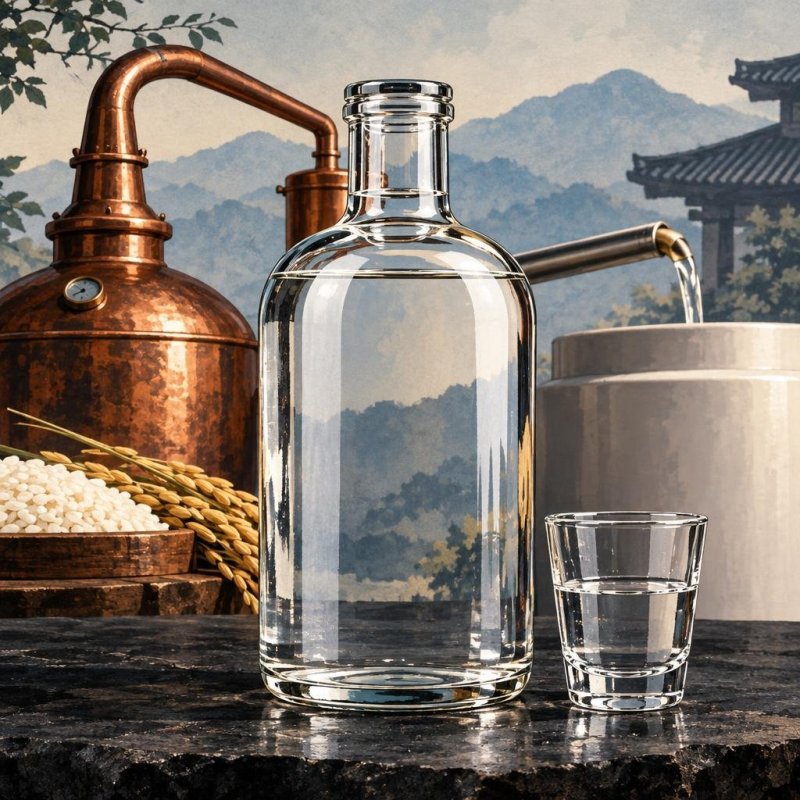
Soju is often presented in overly simple terms, but it is not a drink with one single flavour, one fixed strength or one single way of being made. Understanding where its alcohol comes from and what the bottle actually tells you is far more useful than judging it by the colour of the glass or loosely comparing it with better-known drinks.
What soju is and why it does not have a single profile
Soju is a distilled drink from the Korean tradition. That basic idea matters because it sets it apart from drinks that are only fermented: soju includes a distillation step, even though the route to that point and the final result can vary greatly from one bottle to another.
Its history is linked to the spread of distillation techniques in Korea during the Goryeo period, and many explanations mention historical contact with the Mongol world. Even so, the sources do not support one single, undisputed story about a specific inventor or an exact birth date, so it is better understood as a tradition that developed over time rather than a one-off invention.
That tradition has produced very different styles. So it makes little sense to define soju as if it were always neutral, always soft or always made from rice. To understand it properly, the useful question is not just what the label says in large print, but how the alcohol inside the bottle was obtained.
Key idea
Soju is a distilled drink from the Korean tradition.
Its style changes according to the origin of the alcohol, the ABV and the final formulation.
Two main ways of making it: both include distillation
Before getting into styles, it helps to separate three ideas. First, when grains are used, their starch has to be turned into sugars that microorganisms can use. Then comes fermentation, the process that turns those sugars into alcohol. Only after that comes distillation, which separates and concentrates components from the fermented liquid. These are not different words for the same thing, and they are not interchangeable stages.
In many traditional soju methods, the starting point is a fermented rice or grain base that is then distilled, often by batch distillation, which processes one charge of fermented liquid at a time. In this context you may also see nuruk, a traditional Korean fermentation starter that brings both microorganisms and enzymes. A soju made this way is not automatically handmade, superior or tied to one fixed ABV.
The other major route is what is often called diluted soju. In this case, high-strength alcohol obtained by continuous distillation, with liquid going in and distillate coming out continuously, is later adjusted with water. Depending on the product, other ingredients may also be used to shape the final profile. The key point is that this alcohol also comes from distillation. Adding water does not turn the drink into an undistilled fermented beverage, and it is not enough on its own to separate categories in any universal way.
When comparing these two routes, the most useful approach is to think about the origin of the alcohol and the final formulation. Traditional production and diluted production describe common technical paths, not an automatic scale of authenticity or quality. Two bottles may both be called soju and look similar at first glance, yet follow very different production logics.
What it can be made from and what it can taste like
Although many people immediately associate soju with rice, it is not limited to that raw material. The documentation reviewed includes examples made from rice, barley, wheat, sorghum and corn, as well as references to alcohol for soju produced from sweet potato and other grains. Saying that all soju is a rice distillate leaves out a real part of the category.
That diversity of raw materials does not let you predict the flavour with certainty. Analytical and sensory studies show distinct profiles across samples, with notes that may recall grain, fermentation or fruit, among others. But those notes do not depend only on the main ingredient: fermentation, distillation and other process choices also play an important role.
That is why it helps to be wary of two opposite simplifications: assuming that all soju tastes of almost nothing, or assuming that one particular grain guarantees one particular flavour. The raw material can point you in a direction, but it does not replace the information on the bottle or fully explain what will be in the glass.
ABV, aromas and flavoured versions: three different things
Alcohol strength tells you how much alcohol a drink contains by volume. On the label it may appear as % vol. or as ABV, meaning alcohol by volume. It is useful information, but it is not a foolproof key to style: there are diluted versions around 17–20% and distilled sojus that go above 40%, along with other examples in between. These are reference points, not universal borders.
It also makes little sense to treat apparent smoothness as a measure of quality. A lower-ABV bottle may seem easier to drink, while a stronger one may offer a different profile, but neither trait is enough on its own to say which soju is better. The label and the producer’s description are more helpful than any quick rule based only on the alcohol level.
Another important point is to separate aroma, ingredient and flavoured version. A soju may show fruity notes created during production without that meaning fruit has been added. A flavoured version is marketed with a specific flavour; aromatic notes described by the producer or a declared raw material are not the same thing. There are products sold in flavours such as grape, plum, strawberry or lemon, but their existence does not tell you the exact composition of every bottle.
In practice, an aromatic note you perceive, a declared ingredient and a product sold with a flavour are three different things. Keeping them separate avoids two common mistakes: confusing any fruity impression with added fruit, and assuming that every easy-going soju belongs to the same commercial family.
A fruity aroma and flavoured soju are not the same thing
Aromatic note
It may develop during fermentation or distillation.
On its own, it does not prove that fruit has been added.
Flavoured version
It is sold commercially with a specific flavour.
It is worth looking for that indication on the bottle or on the producer’s product page.
How to tell it apart from sake, shochu, makgeolli and vodka
The most useful comparison with sake starts with the process. Sake is made by fermenting rice, water and koji, a preparation that helps turn starch into fermentable sugars. It is not defined as a distilled drink in the way soju is. Some styles of sake include added distilled alcohol during production, but that does not change the central point: sake is not identified by distilling the fermented base.
With shochu, the distinction is less straightforward, because it too is a Japanese distilled tradition. In honkaku shochu, one type of shochu, koji plays a role and raw materials can include rice, barley or sweet potato. That means it shares ingredients and production steps with some sojus. For that reason, it is not helpful to look for an infallible dividing line based only on flavour or on one isolated raw material: the declared identity and the production method matter more than surface resemblance.
Against makgeolli, the distinction becomes clear again: it is a Korean fermented drink, not a distilled one, and it is usually cloudy. Its connection to rice or to Korea does not make it a version of soju. This is also where a useful clarification comes in: cheongju and yakju are clarified Korean fermented drinks, so clarity on its own does not prove that a drink has been distilled.
The comparison with vodka works only as a partial guide. Both are distilled drinks, and some diluted sojus may feel relatively neutral in a way that reminds many people of what they expect from vodka. But calling soju ‘Korean vodka’ oversimplifies it: the phrase does not explain its different production routes, its range of raw materials or the true breadth of its profiles.
| Drink | How it is made | Useful clue for telling it apart |
|---|---|---|
| Soju | A distilled drink from the Korean tradition, made through different production routes. | The key point is how the alcohol was obtained and how the bottle is formulated. |
| Sake | A fermented rice drink made with koji; it is not defined by distillation. | Sharing rice does not make it soju. |
| Shochu | A Japanese distilled drink; in honkaku shochu, koji plays a role. | It may resemble some sojus in ingredients or process, so the declared identity matters. |
| Makgeolli | A Korean fermented drink that is not distilled, usually cloudy. | Cloudiness can help, but clarity does not prove distillation either: cheongju and yakju are clarified fermented drinks. |
| Vodka | A distilled drink that can serve as a partial comparison. | Calling soju ‘Korean vodka’ oversimplifies it. |
What to check on a bottle of soju
A simple way to read a bottle is to follow four steps. First, identify what the drink is called and how the producer describes it. Second, check the ABV. Third, look for any mention of raw materials or clues about production. Fourth, distinguish whether it is presented as an unflavoured version or one with added flavour. This sequence does not rely on one single set of rules and is useful precisely because labels do not provide the same information in every market.
If the bottle gives you very little information, the producer’s product page may help fill in some gaps, though it will not always answer everything. What matters is using that reading to connect the product with your own preferences. If you want a lighter profile, the ABV and the final formulation will matter a lot. If you are more interested in grain expression or process, it can help to watch for references to distillation and raw materials when they appear.
This method also helps you avoid unreliable shortcuts. The colour of the bottle does not define the category, a clear bottle does not guarantee one specific style, and a high or low ABV does not by itself establish authenticity, tradition or quality. With a drink this varied, concrete information is worth more than stereotype.
Quick guide to reading a bottle of soju
- Read how the drink is named and how the producer describes it.
- Check the ABV: it helps orient you, but it does not separate styles on its own.
- Look for raw materials or production clues when they are provided.
- Distinguish between an unflavoured version, an aromatic note and an added flavour.
How to approach serving it without rigid rules
One documented practice is to serve soju neat and chilled in small glasses. It can be a good starting point, especially if you want to get to know the drink without mixing it with other ingredients. But that custom does not mean it has to be swallowed in one go, and it does not set one ideal temperature for every style: a particular soju may be more expressive or simply more comfortable to drink depending on how it is made and on personal taste.
Soju is also often mentioned in food settings alongside dishes such as grilled meats. That association helps explain its cultural place, but it should not turn into an exclusive pairing or a rule for every table. If soju makes one thing clear, it is that you are better off looking at the specific bottle and your own preferences than repeating fixed formulas about how it ought to be drunk.