San Gimignano Celebrates Vernaccia’s 750-Year Legacy
The Tuscan white wine faces climate pressure and a shrinking field of producers as demand for whites grows.
Tuesday, June 2, 2026
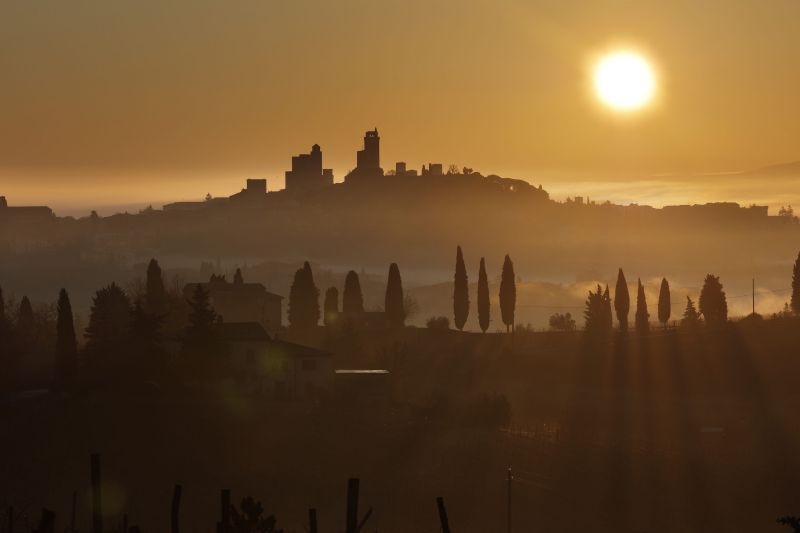
San Gimignano is marking 750 years of references to Vernaccia, the white wine that has long defined the Tuscan hill town and now faces a changing climate, a smaller pool of producers and a market that is increasingly open to white wines. The anniversary was at the center of the fourth edition of Regina Ribelle - Vernaccia di San Gimignano Wine Fest, organized by the local consortium in the medieval town known for its towers, where growers, journalists, sommeliers and wine buyers gathered in recent days to taste new releases and discuss the future of one of Italy’s oldest named wines.
The celebration comes in a year that also marks 60 years since Vernaccia di San Gimignano received DOC status. The denomination was later elevated to DOCG in 1993. The wine’s formal history is only part of the story. Its reputation reaches back to the Middle Ages and has been reinforced over centuries by poets, physicians, papal cellars and travelers who wrote about it as a wine with a distinct identity and a strong link to place.
That identity remains central to the denomination’s message today. The consortium says Vernaccia di San Gimignano is grown entirely within the municipality’s borders, on soils formed in the Pliocene era and at elevations ranging from about 70 to 500 meters. The town covers 13,880 hectares, including 5,600 hectares of agricultural land. Vineyards occupy about 2,000 hectares in total. Of those, 750 hectares are planted to Vernaccia registered under DOCG rules. Another 450 hectares are used for San Gimignano DOC wines, including Rosato, Rosso and Vin Santo. A further 800 hectares fall under Chianti DOCG, Chianti Colli Senesi DOCG and Toscana IGT.
The denomination’s potential annual production is about 4.84 million liters, but actual output has varied sharply in recent years because of weather and vineyard decisions aimed at quality. Production reached 2.27 million liters in 2023, rose to 4.07 million liters in 2024 and then fell to 3.85 million liters in 2025, a decline of 5.58% from the previous year. In 2025, 147 wineries declared production under the denomination, including 81 consortium members. They placed about 4.21 million bottles of Vernaccia di San Gimignano on the market.
The festival also highlighted a drop in participation among wineries presenting new vintages at the annual preview tastings. There were 41 participating producers in 2023, 34 in 2025 and just 25 this year, according to consortium figures cited during the event. Organizers said that smaller turnout reflects broader pressures on small denominations that must compete for attention in a crowded market while also dealing with rising costs and climate volatility.
Those pressures were discussed alongside a long list of historical references that have helped keep Vernaccia visible far beyond Tuscany. Dante Alighieri mentioned it in the Divine Comedy when describing Pope Martin IV’s punishment for gluttony. Boccaccio wrote of it in the Decameron as part of his imagined land of plenty. Cecco Angiolieri referred to it in verse as one of the few pleasures he still allowed himself. In later centuries, Sante Lancerio, papal bottler to Pope Paul III, praised it as “a perfect drink for gentlemen” while lamenting that San Gimignano did not make enough of it.
The wine also appears in art and literature tied to Florence and Tuscany. Giorgio Vasari identified Vernaccia in his description of an allegorical scene painted for Palazzo Vecchio. Michelangelo Buonarroti the Younger offered one of the earliest sensory descriptions of the wine in verse in the 17th century. Francesco Redi praised it with unusual force in his writings on Tuscan wine culture. In the modern era, Mario Soldati helped frame Vernaccia as a wine worth seeking out on its own terms rather than as an accessory to food or fashion.
At this year’s festival, those historical references were paired with current commentary from Italian and international writers and wine professionals who see Vernaccia as both traditional and adaptable. Filippo Bartolotta, a wine coach who led part of the discussion, described it through themes of memory, soil, identity and rebellion: memory before scores and guides; soil shaped by yellow sands, marine fossils and light; identity rooted in an indigenous grape that expresses itself best in San Gimignano; and rebellion in its ability to age while staying true to itself.
Stefano Tesi said Vernaccia’s identity gives it “a lifeline” in an unstable global market. Andrea Gori said salinity rather than acidity is what defines it now and called it a modern white that still struggles to command its full value. Luigi Salvo described it as ancient and modern at once, simple and complex, linear yet rebellious. Marco Bechi pointed to growers’ work as key to making it more versatile at table, especially through Riserva bottlings.
Several foreign commentators said they see room for growth abroad as consumers continue shifting toward white wines. Blake Gray said Vernaccia may never have been better than it is now and argued that it is well positioned for the future because white wines are gaining ground with drinkers worldwide. Michal Setka said quality is clearly rising as producers focus more on place-driven expression. Per Karlsson compared the wines to San Gimignano’s towers: slender, well built and elegant.
Others focused on aging potential and price accessibility. Carlo Macchi said Vernaccia may increasingly be seen as a wine that can improve over six to eight years and suggested that a “Superiore” designation could help clarify its position. Matthew Horkey called it a contemporary wine suited to modern consumers and noted that its relative affordability remains an advantage even if it is still not widely known in the United States.
The tasting itself centered on new vintages from difficult growing seasons shaped by heat spikes, rain swings and disease pressure. Consortium technicians said the 2025 season began with regular rainfall through spring before turning hot in June, when temperatures reached as high as 40 degrees Celsius during some periods. July was cooler than average by about 2.5 degrees Celsius, which helped preserve acidity and pH levels after early heat stress. A hailstorm in early July damaged some vineyards while other areas benefited from water relief after dry spells.
Rain returned at the end of August and again in early September, complicating harvest timing but helping vines recover from summer heat. Disease pressure remained limited overall except for some botrytis later in September where rain fell during picking. Harvest was staggered across multiple passes through each vineyard so growers could select grapes at optimal ripeness.
The result was fruit described by technicians as healthy and balanced, producing wines with good freshness and slightly lower alcohol than recent vintages.
The 2024 season followed a different pattern: a mild winter without severe cold was followed by a cool spring with average rainfall that slowed budbreak after an early start caused by warm winter weather. Rain alternated with dry periods through June before an African high-pressure system brought intense heat from July onward, with daytime peaks reaching 41 degrees Celsius for several consecutive days and warm nights that slowed ripening. A strong storm on Aug. 20 began a long unstable period that brought repeated rain through September and pushed harvest later than usual.
That year saw no major water stress because rainfall between Aug. 20 and Oct. 2 totaled about 330 millimeters compared with a long-term average near 100 millimeters for that stretch. But mildew pressure increased along with powdery mildew, grape moth damage and botrytis linked to September rain. Harvest again had to be done selectively according to ripeness levels.
The difficult conditions did not prevent producers from showing wines that ranged from fresh young bottlings to more structured Riservas with clear aging potential.
Among the standout wines tasted at the preview were Abbazia Monte Oliveto Vernaccia di San Gimignano 2025; Cappellasantandrea Vernaccia di San Gimignano Clara Stella 2025; Cesani Vernaccia di San Gimignano 2025; Collemucioli Vernaccia di San Gimignano Madreterra 2025; Fattoria Poggio Alloro Vernaccia di San Gimignano Il Nicchiaio 2025; Podere Le Volute Vernaccia di San Gimignano Vigna del Sole 2025; Signano Vernaccia di San Gimignano 2025; Tenuta Guardastelle Vernaccia di San Gimignano Consesta 2025; Il Colombaio di Santa Chiara Vernaccia di San Gimignano Campo della Pieve 2024; Tenuta Sovestro Vernaccia di San Gimignano Donna Lucia 2024; La Lastra Vernaccia di San Gimignano Riserva 2024; La Roccaia Vernaccia di San Gimignano Faeta Riserva 2024; Pietraserena Vernaccia di San Gimignano Cretula Riserva 2024; Poderi Arcangelo Vernaccia di San Gimignano Per Bruno Riserva 2024; and Teruzzi Vernaccia di San Gimignano Sant’Elena Riserva 2022.
The wines showed recurring notes of white flowers, citrus peel, stone fruit, herbs, saline tension and mineral edges tied by tasters to the denomination’s sandy soils and marine origins.
San Gimignano continues to draw about 3 million visitors each year, many of whom leave with bottles tucked into their luggage after visiting the tower-lined town center above the surrounding vineyards. For producers here, that tourism matters because it links tasting room sales with place-based storytelling at a time when smaller denominations need both visibility and loyalty from consumers who may know Tuscany mainly through red wines but are increasingly open to whites with character