Archaeologists discover a Roman shipwreck off Sicily with up to 1,500 intact wine amphorae
The unusually preserved cargo could clarify how Roman wine reached North Africa more than 2,000 years ago
Monday, November 9, 2026
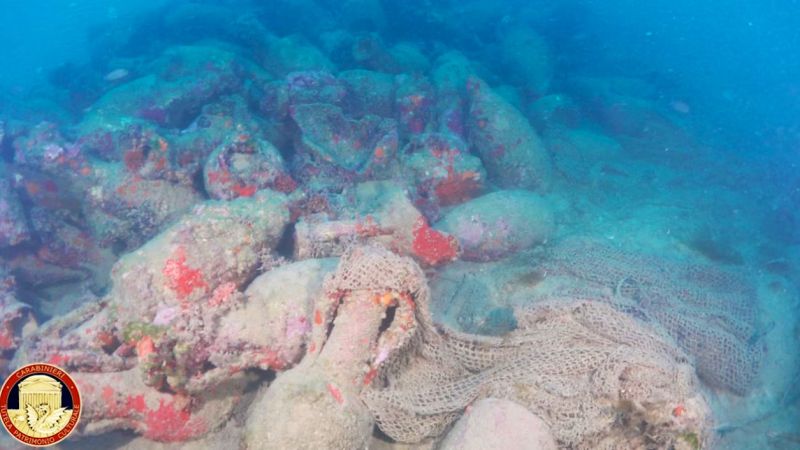
A Roman shipwreck carrying a large cargo of wine amphorae has been discovered off southwestern Sicily, a find that archaeologists say could sharpen understanding of Mediterranean trade in the late Roman Republic and provide a rare look at how wine was packed and shipped more than 2,000 years ago.
Sicilian authorities announced the discovery in August after an initial investigation of the site near Mazara del Vallo, a fishing town on the island’s southwestern coast. The wreck lies roughly 3 miles offshore at a depth of about 150 feet. Archaeologists say the cargo includes at least 500 terra-cotta amphorae and possibly 1,500 or more, many of them still intact and stacked in place.
The site was found by chance in June by Giacomo De Mola and Igor Bisulli, two experienced spear fishers who were scanning the seabed before a competition. De Mola said sonar had shown an unusually large structure about 3 to 4 miles from Mazara del Vallo, unlike the rocky formations the pair had been searching for.
De Mola, a former free-diving champion, descended to the seabed with a mask and camera and found what he described as a field of amphorae about 70 feet long and 20 feet wide, rising roughly 8 feet above the sand. He later passed the information to contacts connected to technical divers and Sicilian officials, leading to a formal archaeological response.
Researchers say the wreck is important not because it is the largest Roman vessel ever found in the Mediterranean, but because of its size relative to other discoveries around Sicily and because of the unusual state of preservation. Roberto La Rocca, a maritime archaeologist with Sicily’s department of cultural heritage and the Superintendency of the Sea, said it is one of the largest wrecks by dimensions ever found in Sicilian waters.
The ship’s wooden hull has long since decomposed, though archaeologists believe remains of it may still be buried under the seabed. The cargo, however, appears to have survived in exceptional condition. La Rocca said the arrangement of the amphorae suggests the site has not been looted, an uncommon outcome for an ancient wreck in relatively shallow water and so close to shore.
That point matters because looting has damaged many underwater archaeological sites around Sicily. Fabio Portella, an independent underwater explorer who carried out the first 3D survey of the wreck in July, said motivated relic hunters have long been capable of reaching depths beyond standard recreational diving limits. He noted that Sicilian divers were retrieving artifacts from deep sites as far back as the 1960s.
Ancient amphorae were valuable targets because they are portable and have a strong market appeal. These clay containers often held nearly six gallons of wine and could weigh about 50 pounds even when empty. Archaeologists say a wreck could be stripped over time, one or two amphorae at a time, and that fishing nets often caused additional destruction by breaking containers and scattering artifacts across the seabed.
Researchers believe several factors may have protected the Mazara del Vallo site. Portella said the wreck is ringed by rocks that probably shielded it from bottom-trawling nets. On sonar, the formation may also have resembled a large rock rather than a cargo site worth investigating. He added that the local area has a strong fishing tradition but a weaker diving culture than places such as Syracuse, Catania and Palermo, in part because the water is often murky and visibility is poor.
Archaeologists also think the way the ship sank helped preserve it. La Rocca said the vessel most likely went down quickly during a storm before the crew could deploy all of its anchors. The remains of two lead anchors are still associated with the wreck. A rapid sinking may have allowed the ship to descend upright, helping keep the cargo in orderly stacks instead of scattering it across the seafloor.
The wreck may also have wider historical importance. Justin Leidwanger, a Stanford University archaeologist, said most of the amphorae appear to be Dressel 1A, a common form used in the second and first centuries B.C. Those amphorae are frequently found in shipwrecks near Spain, France and much of mainland Italy, but their presence off southwestern Sicily raises questions about the ship’s route and destination.
Because of the wreck’s location, archaeologists think the ship may have been sailing toward North Africa. If the estimated age of the vessel is confirmed, Leidwanger said, it could suggest that Roman wine exports to North Africa were expanding earlier than many scholars have thought. That would fit with a period in which Roman commercial networks were growing rapidly and aristocratic landowners in Italy were investing more heavily in agriculture and trade.
Leidwanger said the cargo probably came from central Italy, but researchers are not treating that as settled. The arrangement of the amphorae may help determine whether the shipment came from a single large estate or from several producers combining goods for transport. Any surviving seals or inscriptions on the containers could add more precise evidence, though archaeologists say such finds are rare.
There is also a chance, however small, that residue or markings could point to a different origin. Franca Cibecchini, a maritime archaeologist with France’s Ministry of Culture who oversees underwater archaeology in Corsica, said evidence that the wine was produced in Sicily would be a major development because scholars know relatively little about Sicilian wine production in that period.
The contents themselves are gone or degraded, but specialists say the containers can still reveal much about ancient wine. Lorenzo Lepri, an archaeologist with the Lungarotti Foundation in Umbria, said Roman wine was typically made from very ripe grapes and was often too dense or strong to drink directly from the amphora. Romans commonly diluted it with water and could flavor it with fruit, spices or honey. The inside of the amphorae was usually sealed with pine resin, which also affected taste.
Authorities plan to recover and study a limited number of amphorae, including residue that may still be trapped inside some vessels. But officials do not intend to raise the entire wreck. Instead, the site is expected to remain largely in place after the investigation, both to preserve its archaeological context and to allow for possible supervised dives by approved operators.
That approach reflects a broader policy used in parts of the Mediterranean, where officials say it is impossible to physically remove and store every underwater site. La Rocca said publicizing important discoveries and turning them into controlled cultural attractions can strengthen protection by giving local communities an economic reason to value preservation over illegal salvage.
For now, archaeologists are continuing surveys and analysis of the Mazara del Vallo wreck, which they say could provide one of the clearest Sicilian examples of an ancient wine cargo still arranged much as it was when the ship went down.