Not icy, not lukewarm: the quick guide to serving wine better
A few degrees can change aromas, texture and balance in the glass. With a clear reference point, it is much easier to get it right before the first sip.
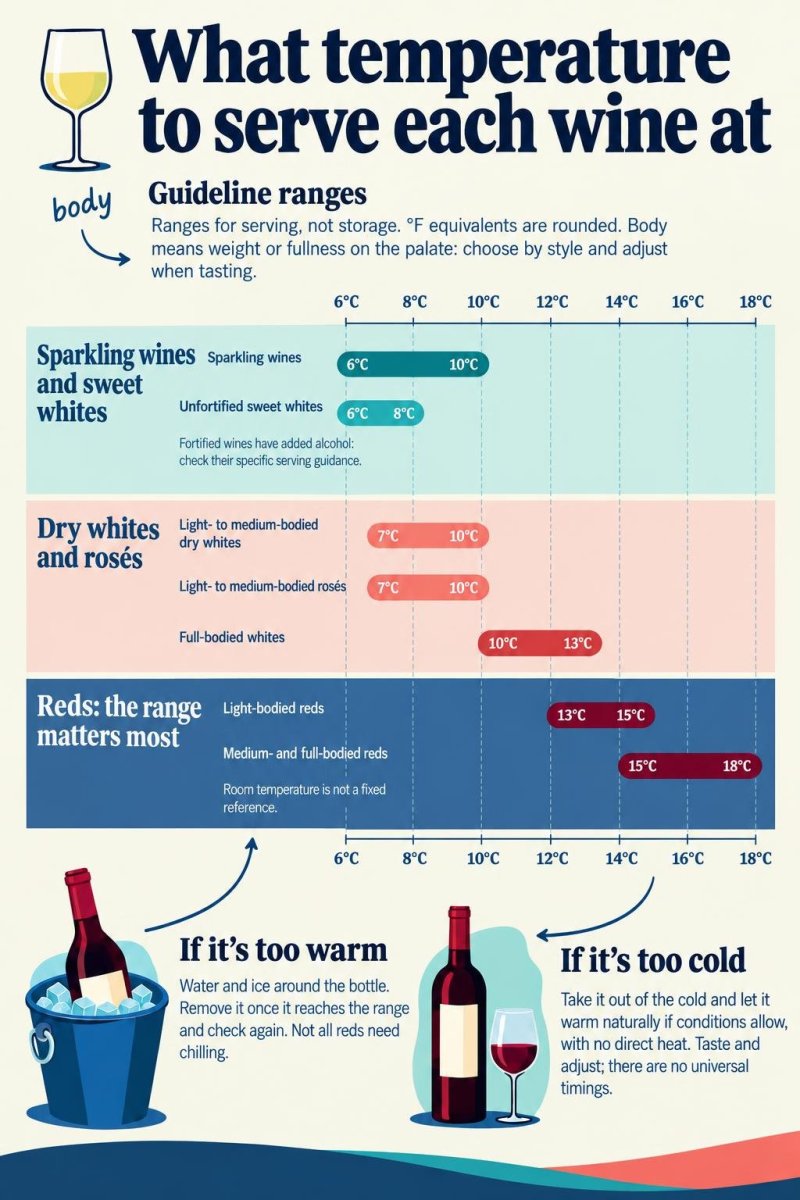
Temperature changes far more than it seems in a glass of wine. This guide is designed to settle the question in seconds: pick a sensible range for the style, then fix a bottle that is too cold or too warm with simple methods.
Quick reference: what temperature to serve each style at
Start here: these temperatures are guidelines for serving wine, meaning the moment you drink it, not for storing it over days or months. Treat them as a practical summary of professional advice, not as exact and indisputable temperatures for every bottle.
Sparkling wines: 6–10°C / 43–50°F Light- and medium-bodied dry whites: 7–10°C / 45–50°F Light- and medium-bodied rosés: 7–10°C / 45–50°F Full-bodied whites: 10–13°C / 50–55°F Sweet unfortified whites: 6–8°C / 43–46°F Light-bodied reds: 13–15°C / 55–59°F Medium- and full-bodied reds: 15–18°C / 59–64°F
If you are unsure between two rows, look at body. Here, body means the sense of weight or fullness the wine has in your mouth: a light wine feels more delicate, while a fuller-bodied one feels broader and more enveloping. You do not need to know chemistry or tasting theory to use the table. If you do not know the style, check the bottle description or the producer’s notes, choose the closest category and then adjust after tasting. What matters is not turning a single grape or origin into a fixed serving temperature on its own.
The reason to use ranges rather than one exact figure is simple: temperature changes how we perceive aromas and flavours. A wine that is too cold can show less expression, and a red served too warm can lose freshness and definition. At the same time, professional guides do not always agree to the degree, and personal taste matters too. Sensory research supports the idea that perception changes with temperature, but it does not prove that there is one perfect universal degree for every wine and every drinker.
| Style | Serve at °C | Serve at °F |
|---|---|---|
| Sparkling wines | 6–10°C | 43–50°F |
| Light- and medium-bodied dry whites | 7–10°C | 45–50°F |
| Light- and medium-bodied rosés | 7–10°C | 45–50°F |
| Full-bodied whites | 10–13°C | 50–55°F |
| Sweet unfortified whites | 6–8°C | 43–46°F |
Reds: go by the degrees, not by the room
The phrase "room temperature" is too vague because a room is not always at the same temperature. It may be warmer or cooler than the wine really needs, so it is not a very useful rule. For red wine, first compare the bottle with its range: if it is light-bodied, think 13–15°C / 55–59°F; if it is medium- or full-bodied, think 15–18°C / 59–64°F.
That does not mean every red should go into the fridge, or that every home is too warm. It means something more practical: if the wine is above its range, cool it a little; if it is already within it, pour and taste. A light red often benefits from more freshness than a fuller one, but the best approach is still to start with the style and adjust in the glass, not to follow a habit with no degrees attached.
For reds, the useful reference is the actual temperature
"Room temperature" does not mean one specific number.
If the bottle is above its range, cool it slightly; if it is already within it, pour and taste.
How to fix a wine that is too warm or too cold
If the wine is too warm, place it in a container with water and ice so the bottle is well surrounded. That contact cools it better than using ice on its own around the bottle. The idea is not to leave it there by default, but to take it out once it gets close to the range you want and then check how it develops. There is no set number of minutes that works for every bottle, because the starting temperature, the amount of wine, the container and the surroundings all vary.
If the wine is too cold, do the opposite: take it out of the cold and let it warm up naturally in an environment that can bring it into the chosen range. Avoid direct heat, such as placing it near a radiator or another intense heat source. The aim is to let it rise gradually into the serving range, checking how it changes, without forcing it and without assuming it will always take the same amount of time.
To check it, a food thermometer can help, but it is not essential. If you want to measure, a small sample is enough to guide you. If you do not have a thermometer, work approximately: pour a little, taste and correct in short steps. Also remember that wine in the glass does not stay still: a small amount can move quickly towards the surrounding temperature. That is why it makes sense to check again during service and adjust if needed, rather than applying a fixed correction of several degrees as if every situation were the same.
Simple home adjustment
- If the bottle is warm, use a container with water and ice so it is well surrounded.
- Take it out when it gets close to the target range; do not leave it submerged out of habit.
- If it is too cold, remove it from the cold and let it warm up gradually.
- Avoid direct heat and check again in the glass, or with a thermometer if you have one.
Sweet and fortified wines: check the style before using the table
The 6–8°C / 43–46°F row does not apply to every sweet wine. In this guide, it refers to sweet unfortified whites. A fortified wine is a wine with added alcohol, and that detail changes both its style and how it is served. So it is not a good idea to put all sweet wines or all fortified wines under the same rule.
Three examples are enough to show why: white Port may be served at 6–10°C / 43–50°F, ruby Port at 12–16°C / 54–61°F, and Pedro Ximénez de Jerez at 12–14°C / 54–57°F. Those are clear differences within sweet or fortified wines, so if your bottle does not fit comfortably into the main table, the safest option is to look for the specific guidance for that style and use it as your starting point. The table solves most common cases, but it does not replace more precise recommendations for special styles.
Sweet and fortified wines do not follow one single rule
Sweet unfortified whites
The 6–8°C / 43–46°F row applies only to this group.
Use it as a starting point, not as a rule for every sweet wine.
Fortified wines
These are wines with added alcohol, and they may need different serving temperatures.
Examples: white Port 6–10°C / 43–50°F, ruby Port 12–16°C / 54–61°F, and Pedro Ximénez de Jerez 12–14°C / 54–57°F.