French winemakers flee southern vineyards for cooler regions
Repeated drought, extreme heat and a commercial slump are pushing some producers to restart farther north or higher up.
2026-08-10
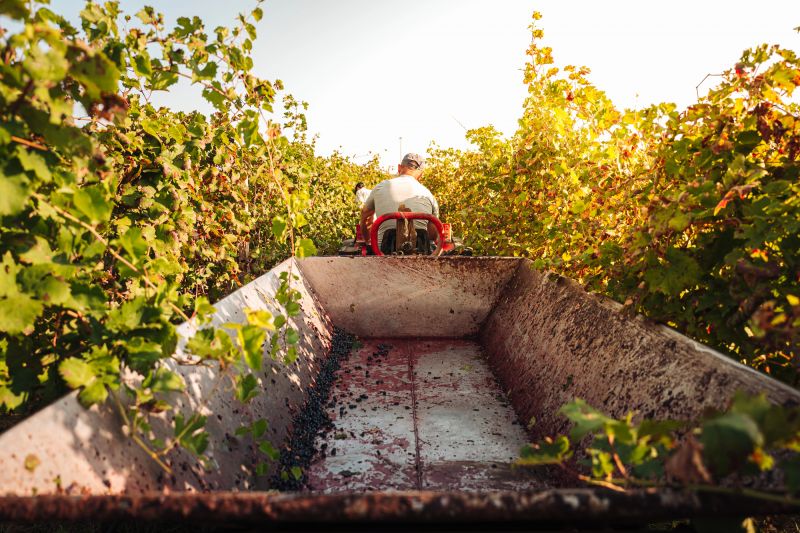
Some French winemakers are leaving vineyards in the country’s hottest areas and starting over farther north or at higher altitude, saying repeated drought, extreme heat and weak sales have made it too risky to keep producing where they began.
An investigation published Aug. 9 by the French outlet Vinofutur follows several of those moves, including that of Lucile Fouet, who arrived in Berrie, south of Saumur in the Loire Valley, in November 2025 after spending two years looking for land. She had worked in Latour-de-France, in the Pyrénées-Orientales, where a severe drought from 2021 through 2025 reshaped daily life in the vineyards and, in some places, access to water itself.
Ms. Fouet told Vinofutur that she had been looking for a place where land was still affordable, water was available and rain could be expected for at least part of the next two decades. She also wanted to avoid working in isolation and sought a community of growers. In Berrie, she found 3 hectares, or about 7.4 acres, of Cabernet Franc, Cabernet Sauvignon and Chenin Blanc that had been farmed conventionally. She said it would take about five years to convert the vines to her preferred approach. Her new estate is called Les Fruits de la Raison.
What drew her to the area, she said, was not the landscape but the practical conditions for making wine. Berrie is known for its troglodyte caves, old underground cellars where temperatures stay relatively stable in both winter and summer. In a period of hotter summers, that kind of natural temperature control can reduce stress during fermentation and storage.
Her reason for leaving the south was more direct. In Latour-de-France, she said, friends in the trade had told her there was no future for wine there. The problem was not a single bad harvest but the accumulation of shocks. During the drought, she described a river that was drying up, soils that had turned powdery and vines that stopped feeding their own wood after bud break. Some villages, she said, had to be supplied with water by tanker truck. At the same time, the region faced a commercial slump. Growers were producing less wine and selling less of what they made.
For the wine business, cases like hers matter beyond their personal drama. Even if the number of growers relocating remains small, they point to a broader reshuffling that could affect where French wine is produced, which family operations stay alive and how the market adjusts its supply, investment and style of production over time.
Vinofutur said there are no official figures showing how many growers have left one vineyard region to establish themselves in another, and that the phenomenon still appears marginal. By all indications, more winemakers may be leaving the profession altogether than moving and starting over. Still, each relocation offers a concrete sign of the pressure climate change is placing on French viticulture.
The investigation cites other recent departures. Angela Weidner and Maxime Aerts left the Gard after a day in 2019 when temperatures hit 46 degrees Celsius, about 115 degrees Fahrenheit, and vines were burned in the field. They later created Domaine des Raisins Suspendus in the Hautes-Alpes, between Gap and Briançon, at about 900 meters, or nearly 3,000 feet, above sea level. They took over some existing vines, planted more and continued trading in wines from the south while trying to stabilize their new operation.
Mr. Aerts told Vinofutur that the couple decided to move when they realized they still could, provided they did not wait too long. Staying, he said, would have meant committing to decades of struggle against the elements. Their move was not framed as a permanent solution so much as a reprieve.
Even there, climate pressure has followed them. During a heat wave in June 2026, temperatures in their vineyards rose to 36 degrees Celsius, or nearly 97 degrees Fahrenheit. Mr. Aerts said that was still about 10 degrees Celsius lower than what they had experienced in the Gard, but it showed that no area was fully protected. The main difference, he said, is that nights remain cooler, allowing both vines and workers to recover.
Another grower, Patrice Delthil, left Latour-de-France after producing wine there for 20 years. In 2025, he and his wife sold their estate to Swedish investors and moved to Brittany, where he has been looking at the region’s emerging vineyard scene for a new project. He told Vinofutur he had felt he had to decide between enduring conditions that no longer looked viable to him or leaving before it was too late.
The pressure behind those decisions is supported by climate research cited in the investigation. Vinofutur points to projections based on the Winkler index, a long-used system that classifies wine-growing areas by heat accumulation. Under a high-emissions scenario that would bring roughly 4 degrees Celsius of warming by 2100, much of the Mediterranean vineyard area would no longer fit within the index’s traditional categories. The southwest and the Rhône Valley would also reach critical conditions, according to the analysis cited, while by the end of the century the areas most favorable to producing quality wine would lie north of the Loire.
The article also refers to a 2024 study published in Nature that found about 90% of coastal and low-altitude wine regions in Spain, Italy and Greece, as well as Southern California and central Australia, would no longer be able to produce quality wine with economically viable yields if global warming rises above 2 degrees Celsius. The central issue in that research is not whether grapevines can survive in a hotter climate, but whether growers can still make a living and maintain a functioning wine sector.
That distinction is becoming clearer inside France. In the Pyrénées-Orientales and other southern areas, growers are dealing with repeated water stress and harvest losses. In parts of the Loire or Brittany, climate risk may still be discussed first in terms of spring frost, disease pressure or changing ripeness patterns rather than outright desertification. For people arriving from the south, that difference can be jarring.
Ms. Fouet told Vinofutur that the contrast between her old and new working environments is striking. In Latour-de-France, she said, fermentation moved quickly and often had to be calmed down. In Berrie’s underground cellars, fermentation is slower, can pause during winter and barrels remain more stable. She also said she was surprised to find growers in the Loire leaving grass in the vineyard to restrain yields, an idea that would have made little sense in the drought-stricken conditions she had known.
The source article stresses that climate projections are not destiny and that growers still have options, including changing grape varieties, adjusting vineyard practices and diversifying business models. But for some young winemakers, the adaptation now underway is not just technical. It is geographic. They are choosing where to bet the next decades of their working lives, and in some cases that means leaving a historic vineyard behind to keep making wine at all.
