Oregon Scientists Develop Spray-On Coating to Shield Wine Grapes from Wildfire Smoke
Researchers test plant-based and chitosan formulas as wine industry seeks solutions to protect crops and preserve quality during fire seasons
2026-02-18
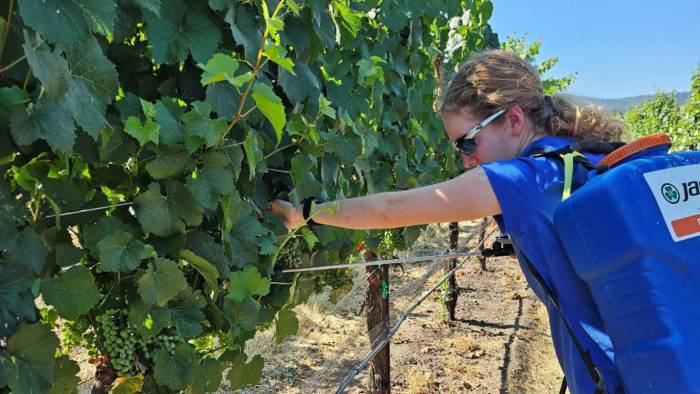
Oregon’s wine industry faces a growing threat from wildfire smoke, which can damage grape crops and affect the flavor and aroma of wine. In recent years, wildfires across the West have sent smoke into vineyards during critical periods near harvest. When this happens, grapes can absorb smoke compounds that later show up in finished wines as unwanted flavors. The uncertainty about whether a crop is tainted can lead to major financial losses for growers and wineries, with ripple effects on rural communities that depend on the wine sector.
Researchers at Oregon State University’s College of Agricultural Sciences and the Oregon Agricultural Experiment Station are working to address this problem. Their approach involves developing a spray-on coating that acts as a protective barrier for grapes before smoke arrives. The goal is to create a thin layer on the grape skin that blocks or reduces the absorption of smoke compounds.
In 2023, the research team published a study in the Journal of Agricultural and Food Chemistry. They tested several coating formulas made from plant-based fibers and chitosan, a natural compound derived from shellfish. Using a custom device, they measured how well these coatings could prevent three key smoke-related compounds from passing through to the grape. The results showed that coatings containing chitosan were more effective at blocking two of these compounds, while all coatings helped trap a third compound. Field tests on Pinot noir grapes showed that the coatings did not affect berry size or weight. One chitosan-based formula was also linked to higher levels of natural color compounds in the grapes. However, because wildfire smoke was light during that season, researchers could not fully assess how well the coatings would work under heavy smoke conditions.
A follow-up study in 2025, published in the Journal of Food Science, tested updated versions of the coatings and examined how timing affected their performance. The team compared different mixes of plant fibers and chitosan and conducted controlled tests on table grapes. In some cases, certain coatings were associated with higher levels of smoke compounds inside the grapes, suggesting that some formulas might actually absorb smoke and allow it to move into the fruit—an outcome growers want to avoid.
The 2025 study also included field trials with Pinot noir grapes exposed to varying levels of smoke at different times in the growing season. When grapes were exposed earlier in the season, some coatings reduced two smoke markers by a few parts per billion. When exposure happened closer to harvest, another marker dropped by about 1 to 2 parts per billion, and one “bound” marker fell by up to 8 parts per billion. Across all trials, the coatings did not change basic fruit qualities such as sugar content or acidity.
Despite these promising results, researchers found that natural variation in both smoke exposure and grape response made it difficult to draw firm conclusions about effectiveness. They recommended further work to improve how well the coatings cover grapes and to test them under more consistent smoke conditions.
For Oregon’s wine industry, this research represents progress toward managing an unpredictable risk. While spray-on coatings may help reduce smoke taint in some situations, they are not yet reliable enough for widespread use. The studies also highlight that simply blocking smoke is preferable; if a coating absorbs smoke compounds but does not keep them out of the grape, it may not solve the problem.
The stakes are high for Oregon’s wine sector, which supports jobs, tourism, and rural economies across the state. Better tools for managing wildfire smoke could help stabilize this high-value industry and reduce uncertainty for growers during severe fire seasons.
This research was funded by grants from the Oregon Department of Agriculture Specialty Crop Block Grant program and the U.S. Department of Agriculture National Institute of Food and Agriculture’s Specialty Crop Research Initiative.
