Why a sweet wine is not always fortified, and what to look for to understand its style
This article explains where sweetness comes from, when added alcohol is involved, and which clues can help you read labels and descriptions with better judgement.

Views › 333
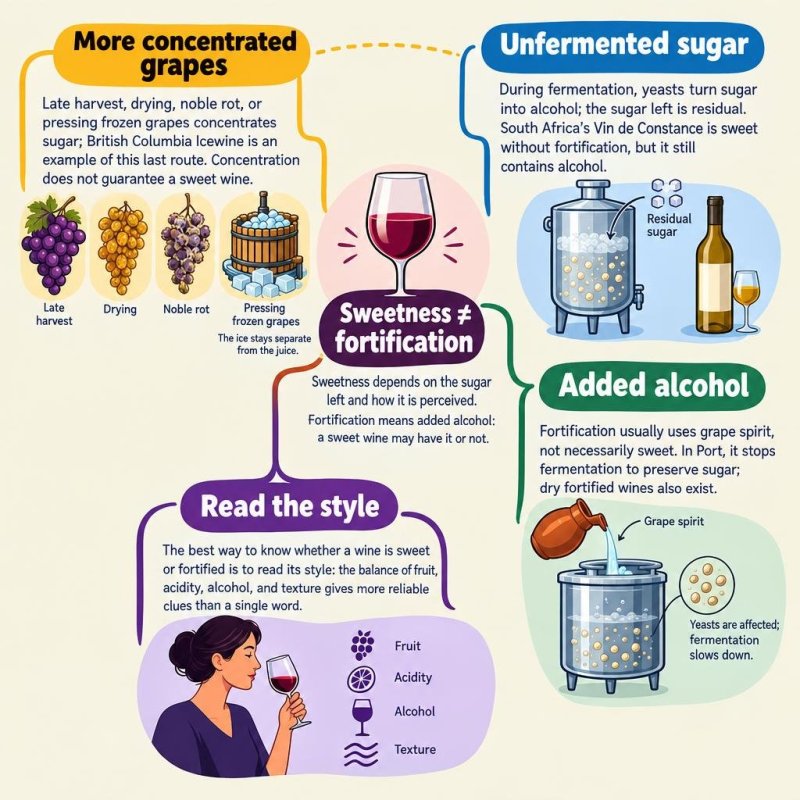
A wine can taste sweet for several reasons, and not all of them involve adding alcohol. Understanding that difference is far more useful than memorising region names: it helps you read a label or description with better judgement and spot which style may suit what you are looking for.
Sweet and fortified: two things worth keeping separate
The first question is where the sweetness comes from. The second is whether alcohol was added during production. They are not the same thing. Must, the grape juice that is going to ferment, contains natural sugars. During fermentation, yeast turns part of those sugars into alcohol. If some sugar is left unfermented, the wine can retain sweetness: how sweet it seems depends on how much sugar remains and how it balances with acidity. That sugar left in the finished wine is usually called residual sugar.
It also helps not to confuse sugar content with the sensation of sweetness. Two wines may contain different amounts of sugar and still seem more or less sweet depending on their acidity, aromas or ageing. That is why colour, alcohol level or origin on their own are not enough to tell you how a glass will taste.
A fortified wine is one that has alcohol added to it, usually a grape distillate. That added alcohol does not have to be a sweet liqueur. An unfortified wine also contains alcohol, but in that case the alcohol comes only from fermentation. Adding alcohol can be used to stop fermentation and preserve sugar, but that does not mean all fortified wines are sweet, or that all sweet wines need fortification.
Two separate questions for understanding a sweet wine
Where the sweetness comes from
Must provides natural sugars.
If some of that sugar does not ferment, residual sugar remains.
The sensation of sweetness changes with acidity and aromas.
Whether alcohol was added
A fortified wine has alcohol added, usually a grape distillate.
An unfortified wine gets its alcohol only from fermentation.
Fortified and sweet are not synonyms.
How sweetness remains without adding alcohol
One way to keep sugar is to stop fermentation before the yeast has consumed all the sugar in the must. That can be done without any spirit, for example by removing the yeast through filtration. There are also wines in which a sweet component, such as unfermented must or a sweet wine, is added to shape the final result. These routes exist, but they should not be treated as universal practices accepted in exactly the same way across all styles and origins.
For the reader, the key is to separate the result from the method. If a wine is sweet, that may be because the grapes were very concentrated, because fermentation did not consume all the sugars, or because several steps were combined. Once you understand that, it becomes easier to move past the simplistic idea that there are only naturally sweet wines on one side and wines with added alcohol on the other.
More concentrated grapes: ripeness, drying, noble rot and ice
Another major family of sweet wines starts with grapes whose sugar has become more concentrated. That can happen through late harvest, when picking is delayed so the grapes ripen further, or through drying, when the grapes lose water. But concentrating sugar on its own does not guarantee that the finished wine will be sweet: what happens later in fermentation matters too. The contrast between Recioto della Valpolicella, a sweet red from Italy, and Amarone makes the point clearly: both start with dried grapes, but Recioto keeps sweetness while Amarone ferments on to a dry profile.
Vin de Constance in South Africa helps explain another useful nuance. It is a sweet unfortified wine made from Muscat de Frontignan. In the production method described in its technical sheet, Klein Constantia combines parcels of grapes with different levels of concentration and the fermentation ends naturally. The example is a reminder that a sweet wine without added alcohol does not always depend on a single technique or on a single mental image, such as grapes that are almost raisins.
Concentration can also come through more specific routes. Noble rot is the action of the fungus Botrytis cinerea under particular conditions: it helps concentrate the grapes and changes their aromatic profile. Sauternes in France is one example. Very different is freezing on the vine: in Icewine from British Columbia in Canada, when the frozen grapes are pressed, part of the water stays behind as ice and the juice comes out more concentrated. These are different methods, and neither should be turned into a rule for every wine made with fungus or cold.
| Route | What happens | Example from the article |
|---|---|---|
| Late harvest or drying | The grapes concentrate sugar by losing water or ripening further, but fermentation can still leave the wine sweet or dry. | Recioto della Valpolicella versus Amarone |
| Blending different parcels | A sweet unfortified wine can bring together grapes with different levels of concentration and finish fermentation naturally. | Vin de Constance |
| Noble rot | Botrytis cinerea concentrates the grapes and changes their aromatic profile under particular conditions. | Sauternes |
| Freezing on the vine | When frozen grapes are pressed, part of the water stays as ice and the juice comes out more concentrated. | Icewine from British Columbia |
What changes when alcohol is added
When alcohol is added during fermentation, the rise in alcohol can slow or stop yeast activity. That preserves part of the grape’s original sugar. Port from Portugal is the classic example for understanding this mechanism: grape spirit is added while fermentation is still under way. Even so, talking about Port does not mean talking about one single level of sweetness or one single flavour profile.
Muscat de Rutherglen in Australia also shows that techniques can be combined. It starts with grapes of very high sugar concentration, has a short fermentation and is fortified early. It does not fit neatly into one simple box, and that is exactly why it is useful: the final sweetness can depend on several cumulative steps, not on one isolated decision.
Another simplification is worth avoiding: not every sweet fortified wine gets its sweetness because alcohol is added in the middle of active fermentation. In the production of a sweet Pedro Ximénez from Jerez, Spain, described by González Byass, the grapes are dried in the sun, fermentation stops naturally, and only afterwards is wine spirit added. That detail does not define all Pedro Ximénez or all wines from Jerez, but it does help dismantle the idea that there is only one possible sequence.
Why natural sweet does not necessarily mean unfortified
One of the most confusing expressions is vin doux naturel. In French it sounds like natural sweet wine, but that does not mean it is made without added alcohol. Muscat de Rivesaltes in France is an example of a sweet fortified wine: alcohol is added during fermentation. If you see the term mutage, it refers precisely to that addition used to stop fermentation and preserve sugar.
The practical lesson here is very simple: the word natural on its own does not let you deduce the method. With sweet wines, it is always better to look for how the sugar was preserved and whether alcohol was added, rather than rely on a word whose meaning changes with context.
Natural sweet does not mean without added alcohol
In vin doux naturel, the word natural does not by itself describe the method.
Muscat de Rivesaltes is made with alcohol added during fermentation.
Sugar does not tell the whole flavour story
Two sweet wines can offer very different experiences even if both contain a fair amount of sugar. Acidity can make the whole wine feel livelier and less heavy. Aromas matter too: a wine with lots of ripe fruit character may seem sweeter than the analytical figure suggests. That is why a fruity aroma on its own does not prove there is a lot of sugar.
Ageing is another separate axis. Within Port, ruby styles usually focus more on fruit and colour, while tawny styles develop different profiles through time in wood. Both can be fortified and sweet, but they do not taste the same. Fortification explains part of the production method; it does not by itself determine the aromatic character or let you rank bottles by quality.
How to recognise a profile and start enjoying it
If you want to get your bearings without technical knowledge, look for three things in the wine description: how sweet it seems or says it is, how it was made, and what aromatic or ageing profile is mentioned. If one of those is missing, ask the producer or retailer. If residual sugar and alcohol level appear, read them separately: they answer different questions. Residual sugar tells you how much sugar is left; alcohol level tells you how much alcohol it contains, not whether you will like it more.
For food pairing, a good starting point with desserts is for the wine to taste at least as sweet as the dish. If not, the wine may seem drier, less fruity or harsher than expected. That does not stop many sweet wines from working well with cheese too. Recioto della Valpolicella is often mentioned with this kind of pairing, but it is best taken as guidance rather than an automatic promise for every cheese.
Temperature works in a similar way: there is no single figure that suits all sweet wines. The best clue is to check the specific recommendation from the producer or specialist retailer and relate it to the style of the wine. Understanding the method and the profile helps far more than looking for a universal rule.
Three useful clues before you choose
- Look separately at sweetness, production method, and aromatic or ageing profile.
- If residual sugar and alcohol appear, read them as different pieces of information.
- With desserts, start with a wine that tastes at least as sweet as the dish.
- If you cannot see the method or serving advice, ask the producer or retailer.