Porter and stout: two dark beers, with more clues than you might think
They share a history and a dark colour, but a few practical clues can help you understand what each name usually signals before you choose.

Views › 304
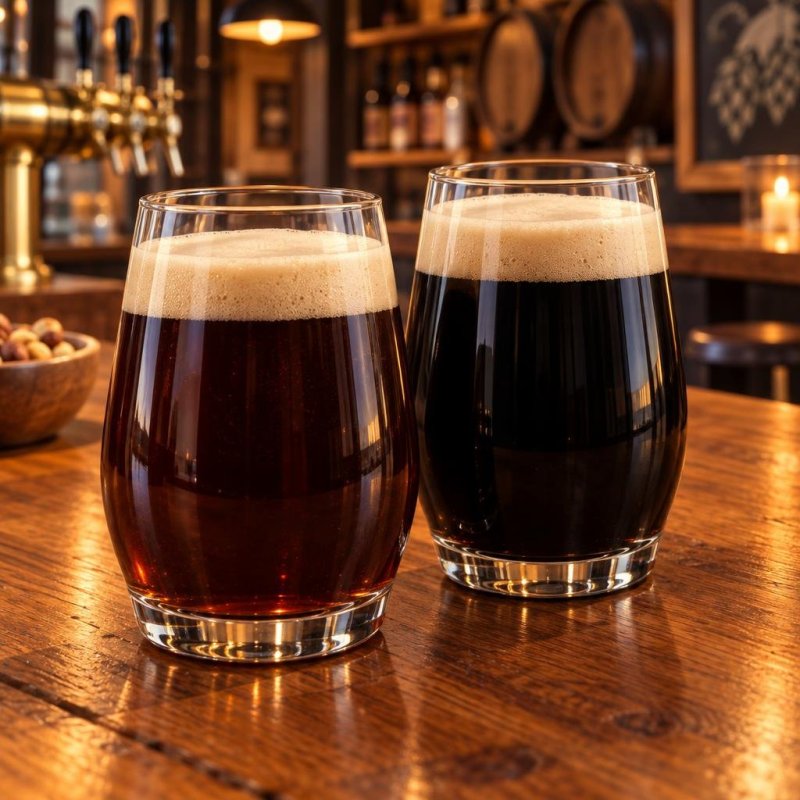
Porter and stout share a history, a dark colour and part of their roasted character, so it is easy to mix them up. The key is not to hunt for an absolute dividing line, but to understand what each name usually suggests and which details matter when choosing for flavour, texture and ABV.
Porter and stout: useful names, not fixed recipes
The practical question is not which one is “better”, but what you can expect from each name. Porter and stout are related families with plenty of overlap, yet they still work as a first clue: they help you picture a general profile, even if the name alone cannot tell you exactly how a particular beer will taste. Style guides themselves stress that they describe common traits, not rigid specifications every producer must follow.
To compare them without getting lost, it helps to separate a few ideas. Malt is grain that has been germinated and then dried. Roasting malt and other grains involves heat, which adds colour and can create aromas and flavours that recall toast, coffee or cocoa. Body is the sense of lightness or weight in the mouth; a beer can feel leaner or fuller without necessarily having a high alcohol level. Dry describes a finish with little sweetness. And ABV is the percentage of alcohol by volume. That is why calling a beer “strong” says very little unless you explain whether you mean alcohol, bitterness, roasted intensity or weight on the palate.
It also helps to drop a misleading expectation: neither a dark colour nor the style name guarantees that you will always be able to tell a porter from a stout at a glance or in a blind tasting. There is enough overlap for both names to be treated as guidance, not as foolproof proof.
Four words that make the comparison clearer
Malt
Grain that has been germinated and then dried, a common base for many of beer’s flavours.
Roast
Heating malt or grains to add colour and notes that recall toast, coffee or cocoa.
Body
The sense of lightness or density in the mouth; it is not the same as having more alcohol.
ABV
The percentage of alcohol by volume in a specific beer.
A shared history explains the resemblance
The similarity has a historical reason. Porter developed in London in the 18th century and, over time, the term stout porter was used for more robust versions within that same family. That link helps explain why porter and stout share so much in colour, roast and structure.
What matters is not to apply that old relationship too mechanically today. The fact that stout began as a stronger porter does not mean that every stout now has more alcohol than every porter. History explains where the names came from, but it does not impose a universal hierarchy on modern beers.
What differences you may find in the glass
The clearest comparison to start with is this one: a traditional English porter versus a dry Irish-style stout. These are two useful reference points, not compulsory definitions for entire families. Seen that way, porter usually ranges from dark brown to very dark brown, sometimes with reddish highlights, while dry stout often appears closer to black. Even so, colour alone will not settle the question, because the two can look very similar in the glass.
In aroma and flavour, an English porter often suggests chocolate, caramel, toast and sometimes nuts. A dry Irish-style stout usually pushes the roast further towards notes many people associate with coffee. The helpful difference is not to think of one as mild and the other as intense, but to notice that porter roast often feels rounder or more malty, while dry stout can come across as more direct and more sharply defined.
The finish brings more nuance. A porter may end quite dry or leave a slightly sweeter impression, while a dry stout is defined by a finish with little sweetness. That still does not justify reducing the real world to sweet porter versus bitter stout. There are dry porters, and there are stouts that move well away from that profile. The sensible approach is to understand the tendency and leave room for variation.
Bitterness works in a similar way. In a dry stout it may seem more prominent because it supports that firm roast and that dry finish. In a porter it may feel more integrated with dark malt, cocoa or caramel notes. But the main family name is not enough to rank two specific bottles by bitterness, because the balance changes a great deal depending on substyle and recipe.
| Feature | English porter | Irish Stout |
|---|---|---|
| Typical colour | Very dark, sometimes with brown or reddish highlights | Very dark, often closer to black |
| Common aromas | Chocolate, caramel, toast, nuts | A more direct roast, often associated with coffee |
| Finish | Can be dry or leave a little more sweetness | Usually aims for little sweetness in the finish |
| Bitterness | More integrated with the dark malt | May feel more prominent |
| Useful limit | Colour and name are not enough to identify every beer | Substyle and description sharpen the expectation more effectively |
Roast explains flavours, not a checklist of added ingredients
Much of this difference comes from the use of roasted malts and grains. Both porter and stout can be brewed with dark ingredients that provide colour and roasted flavours. That is why a simplistic dividing line such as porter uses malt and stout uses unmalted barley does not hold up well. In practice, both families allow for different combinations, and there is no single password that always separates them.
This also clears up another common confusion: picking up coffee, cocoa or chocolate notes does not mean the beer contains those ingredients. Those impressions can arise naturally from roasted malts. So-called chocolate malt, for example, is described precisely in those aromatic and flavour terms, without implying that chocolate has been added to the finished beer.
If what you want to know is whether a specific beer includes coffee, cocoa, vanilla or another added ingredient, the reliable clue is not flavour alone. It is better to check the ingredients list or the producer’s information. The sensory profile points you in a direction, but it does not replace the product details.
Alcohol, sweetness and body: what changes with the substyle
One of the most common mistakes is to assume that dark beer automatically means high alcohol. It does not. As a useful reference, the BJCP guide places Irish Stout in an indicative 3.8–5% ABV range, while Baltic Porter sits at 6.5–9.5%. These are not universal limits for the market, but they are enough to dismantle the idea that stout always means more alcohol than porter. If alcohol matters to your choice, the figure that counts is the ABV of that specific beer.
Body is not attached to the style name either. One dark beer can be relatively light-bodied, while another may feel dense and enveloping. Some porters reach a full body, and the creamy texture many people associate with certain stouts does not always come from the recipe alone: nitrogen dispense can also play a part. That is why texture, alcohol and colour are better read as separate clues, not as one single package.
Substyles help explain the most useful exceptions. A sweet stout, and in many cases a milk stout, breaks the image of stout as always dry because it brings in more sweetness; many milk stouts also contain lactose, the sugar found in milk. That detail matters for that substyle, not for all stouts.
Oatmeal stout often aims for a silkier texture thanks to the use of oats, but it does not guarantee a fixed level of sweetness: some versions are drier, others gentler. And if someone links porter with lightness and stout with intensity, it is worth remembering that both families include powerful examples. Baltic porter and imperial stout show that the world of dark beer runs along a broad scale, not inside two sealed boxes.
Two figures that dismantle an easy assumption
3.8–5%
Indicative Irish Stout range in the BJCP guide.
Useful as a style reference, not as a universal market limit.
6.5–9.5%
Indicative Baltic Porter range in the BJCP guide.
Enough to show that porter does not necessarily mean less alcohol than stout.
How to choose according to what you feel like drinking
If you want a first approach with moderate roast and notes that recall chocolate, caramel or toast, a traditional English porter can be a good starting point. It often offers a recognisably dark profile without pushing the roast to the limit.
If you prefer little sweetness in the finish and a more marked roast character, a dry stout is a more direct reference point. Terms such as dry stout usually match that expectation, although it is still wise to check the product description rather than assume every stout will behave the same way.
If what appeals to you is exploring specific nuances, the substyle helps more than the broad family name. A sweet stout or milk stout may suit you better if you want a sweeter impression. An oatmeal stout can be a useful clue if a silkier texture sounds appealing. None of those labels guarantees that you will like it, but they sharpen the expectation much better.
The most useful way to decide is to look at three things together: substyle, description and ABV. Porter or stout gives you a first orientation; the description helps you anticipate roast, sweetness, bitterness and texture; and the alcohol percentage tells you the strength in alcohol terms. That method does not remove all surprises, but it avoids two very common mistakes: thinking porter and stout are identical, and believing that one word on the label tells you everything.
What to check before choosing
- Start with the substyle: Irish Stout, Sweet Stout, Milk Stout, Oatmeal Stout, Baltic Porter or Imperial Stout can change the expectation quite a lot.
- Read the description to place the roast, the final sweetness, the bitterness and the texture.
- Check the ABV if alcohol level matters in your choice.
- If you want to know whether coffee, cocoa or lactose has been added, confirm it in the ingredients or the producer’s information.