Brandy and whisky in the cask: what really changes with ageing
From the starting point to the cask, a clear comparison of what truly changes in each spirit and why some familiar clues can be misleading.

Views › 402
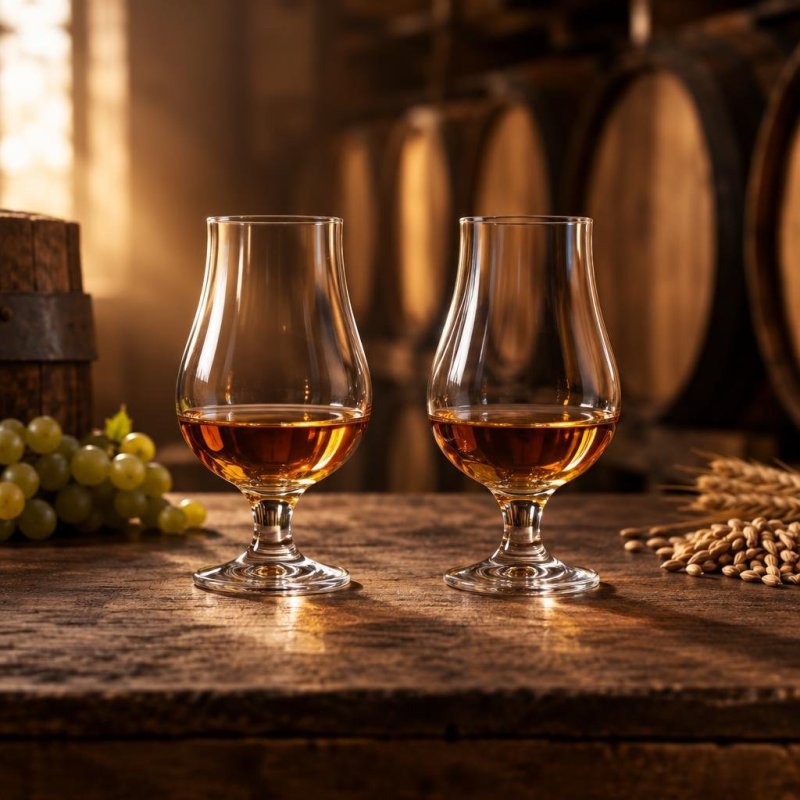
Brandy and whisky are often compared as if one word could separate them: fruit versus grain, softness versus intensity, lighter versus darker colour. The real difference starts before the wood, but many of the most decisive changes come later, during maturation. Following that journey is more useful than trying to pick a winner.
Brandy and whisky: a comparison without a winner
The useful comparison is not about deciding which spirit is nobler, more complex or simply better. It makes more sense to ask where each one begins, what happens when it meets wood, and why two bottles can seem close in some aromas even when they come from different raw materials. In both brandy and whisky, the cask can change the final result dramatically, but it does not work alone, and age is not an automatic score.
It also helps to avoid talking about brandy or whisky as if each were a single, sealed-off category. For this comparison, the main example will be wine brandy, made from wine, alongside whisky made from a fermented grain mash. That starting point makes it easier to follow two clear production paths before maturation, without reducing either family to one country, one rule or one style.
Before the cask: from wine or grain to the spirit
In wine brandy, the path can be summed up like this: grapes, wine, distillation, then maturation in wood. In whisky, the usual route starts with grains, moves on to producing fermentable sugars, then fermentation, then distillation, and finally wood in the case of aged whiskies. The cask appears in both stories, but it does not erase what came before.
It is worth pausing on three basic words. Fermentation is the conversion of sugars into alcohol by yeast. Distillation is a process of separation and concentration by heating and condensing a liquid that has already been fermented. Maturation is the set of later changes that take place during time in wood. Explaining it in that order avoids a common misunderstanding: grapes or grains are not distilled directly. What is distilled is a fermented liquid that already contains alcohol.
That pre-cask difference matters because it shapes the spirit’s starting profile. In wine brandy, that origin is wine. In whisky, it is a fermented grain liquid whose process includes turning starches into fermentable sugars before yeast can do its work. After that, each production can vary in equipment, number of distillations or other decisions, so examples such as Cognac, a wine brandy from France, or Scotch, the whisky of Scotland, help explain the process but do not define everything that exists around the world.
Two paths before the wood
Wine brandy
It starts with grapes turned into wine.
It is then distilled and, if aged, moved into wood.
Whisky
It starts with grains whose starches are turned into fermentable sugars.
It is then fermented, distilled and, in the examples compared here, matured in wood.
During maturation: wood, time and place
Maturation is not just about making a spirit darker. During its time in wood, at least three easy-to-grasp kinds of change can take place. The first is extraction: the liquid takes on compounds from the cask. The second is chemical reactions that transform compounds already present or introduced by the wood. The third is evaporation, which shifts the overall balance over time. That is why the cask affects aroma, flavour, texture and colour, not just appearance.
Nor is it enough to say that a spirit was aged in oak. The wood itself, the cask’s history and the place where it rests all matter. Studies on both brandy and whisky show differences when the vessel changes or when its previous use changes. In the case of Cognac, oak, cellar humidity and the age of the casks are also cited as influences. Time matters, but it works alongside those variables, not separately from them.
This leads to another useful point for drinkers: two spirits can spend years in wood and still evolve differently because they did not begin as the same distillate and did not rest in the same kind of cask or environment. That is why it makes little sense to promise a specific flavour on the basis of a single clue such as maturation time or the name of a wood. The cask points the style in a direction, but it does not dictate the final result on its own.
It is also worth remembering that blending is part of the making of many aged spirits. Combining distillates or whiskies from different origins or ages can be a deliberate choice to build a particular profile. In both Cognac and whisky, that practice is presented as a production tool, not as an automatic sign of inferiority or superiority compared with an unblended product.
What can change in the cask
- Extraction: the spirit takes on compounds from the wood.
- Reactions: some compounds change during time in cask.
- Evaporation: time shifts the balance of the whole.
Aromas that set them apart and aromas they share
When people talk about aroma, the two families overlap more than they sometimes seem to. Cognac is described with floral and fruity profiles, while one study of American whiskies identified descriptors such as vanilla, cherry and bread. The useful lesson is not to memorise a fixed list, but to understand that fruit does not belong only to brandy and that vanilla or woody notes are not the exclusive territory of whisky. They are possibilities, not obligations.
Wood can reinforce that shared ground even further. In whisky, chemical and sensory differences have been observed in casks with different histories, including notes linked to wood, vanilla and spice. In brandy, changes in composition and sensory perception have also been described depending on a cask’s previous use. That helps explain why two spirits from different families can share certain aromatic echoes without ceasing to be different at their core.
Smoke deserves a separate clarification because it is often oversimplified. Some whiskies can take on a smoky character through the use of peat smoke when the barley is dried, but that trait does not define whisky as a whole. Presenting it as the emblem of the entire category erases the real diversity of styles and can lead someone to seek out or reject a bottle for the wrong reason.
Aromas: two common questions
Does fruit belong only to brandy?
No. In the examples cited, fruity profiles also appear in whisky.
It is an aromatic possibility, not a requirement for every bottle.
Is all whisky smoky?
No. Smoke can appear in some whiskies through the use of peat when drying barley.
It does not define the whole category.
Why age and colour do not decide what is better
An age statement can be informative, but on its own it does not allow anyone to conclude that one bottle will be better or more enjoyable. Studies of maturation show changes shaped by several variables at once: the spirit’s initial composition, the type and history of the cask, and storage conditions, among others. Time has an influence, yes, but it does not work as a universal guarantee of quality or as a scale of personal preference.
It is also wise to avoid easy equivalences between categories. The way age is declared depends on the system that applies in each case, so there is no point in transferring a whisky rule to brandy, or the other way round, as if they were interchangeable. For adult drinkers, the important point is that a stated age speaks within a specific framework and cannot be used to create direct ties between bottles from different families.
Something similar happens with colour. In wine-based spirits, research has examined how the extraction of compounds from wood influences colour development, but that does not turn an amber shade into a universal clock. Visual intensity can depend on the wood, its toast, the vessel’s history and other maturation conditions. Looking at two bottles and assuming that the darker one must be older or better is an unreliable shortcut.
There is another common confusion: storing a bottle does not add more cask years. Once a spirit is bottled, it does not go on maturing in wood. That does not require saying that nothing at all can change in bottle over time, but it does prevent a frequent mistake: the maturation discussed in aged brandy and whisky happens before bottling, not later on a shelf at home.
| Clue | It can suggest | It does not prove |
|---|---|---|
| Age statement | It speaks within a specific system and points to a certain maturation. | That a brandy and a whisky with the same number are directly comparable, or that one will be more enjoyable. |
| Colour | It can reflect interaction with wood under certain conditions. | The exact age, or any automatic quality ranking. |
| A stored bottle | It preserves the spirit after bottling. | That it keeps adding cask years at home. |
What information actually helps you read a bottle
If a label or description offers details, three simple questions are more useful than focusing only on colour or age. The first is where it starts: in this comparison, distilled wine in the case of wine brandy, or a fermented grain liquid in the case of whisky. The second is what information is given about maturation: whether there was time in wood and, sometimes, some reference to cask type or duration. The third is what aromatic profile the producer or product sheet describes, keeping in mind that these are pointers, not promises.
Looking at a bottle this way changes the comparison. Instead of asking which one is better because it belongs to one family or the other, the question becomes what path it followed before the cask, how wood may have reshaped it, and what sensory clues it offers without any guarantee that everyone will like it. That approach does not turn the choice into a contest. It makes it better informed and more realistic.