The calculation that clarifies a mixed drink’s alcohol strength
Working out how much alcohol is in a mixed drink takes more than checking the main bottle: the crucial detail is which liquid actually counts in the calculation.
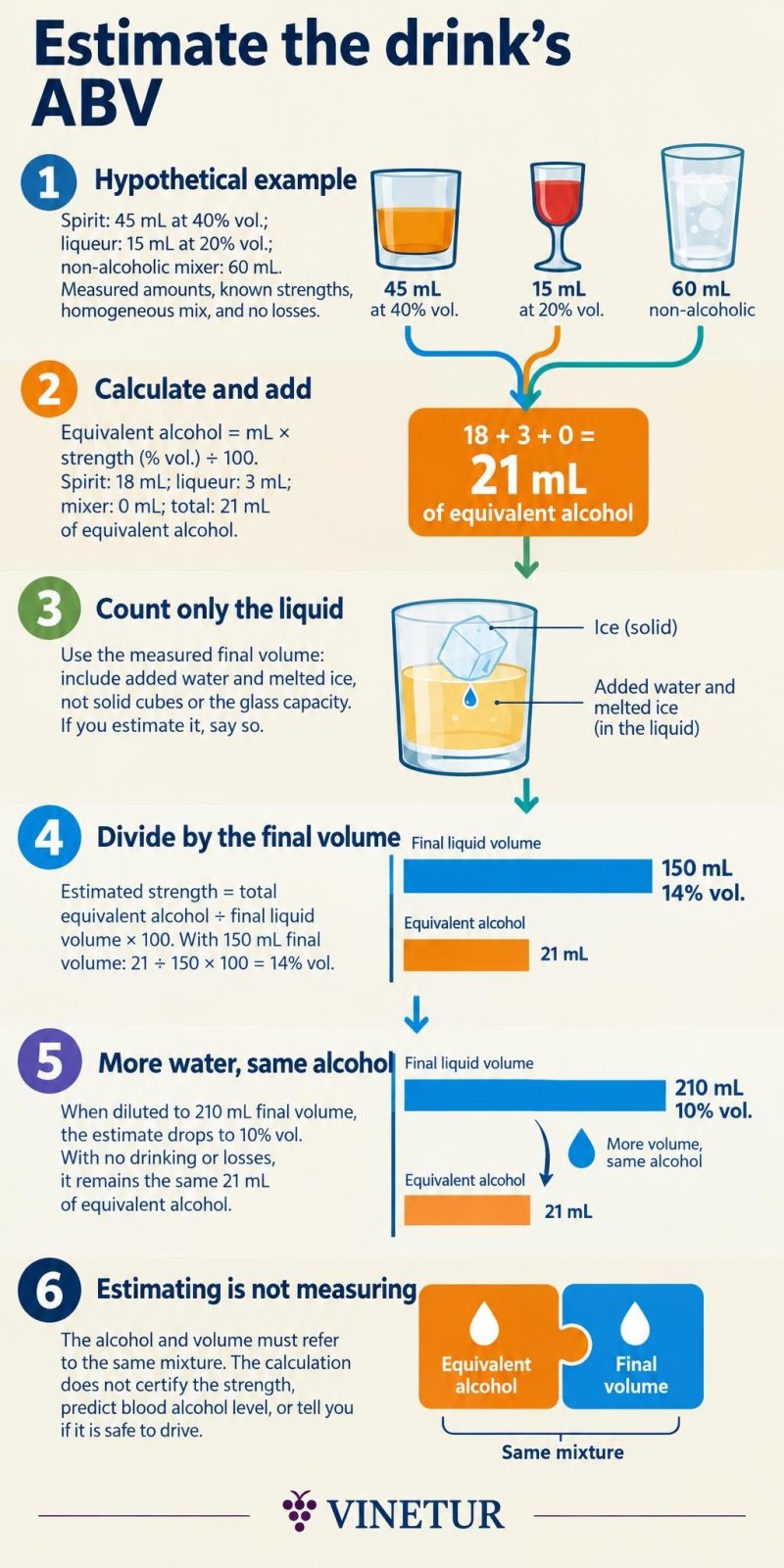
You cannot work out a mixed drink’s alcohol strength just by looking at the main bottle. For a useful estimate, you need to add up the alcohol contributed by every ingredient and divide it by the final liquid volume, including dilution. That home calculation can come quite close to the drink in the glass, but it is still an estimate, not a certified analytical measurement.
What the alcohol percentage of a mixed drink really means
When a drink says 14% vol., that percentage expresses a proportion: roughly 14mL of alcohol equivalent in every 100mL of drink. On its own, it does not tell you how much alcohol is in the whole glass, because that total also depends on the volume served. A small drink and a large one can have the same strength and still contain different amounts of alcohol.
This matters a great deal in cocktails. The strength shown on the bottle is not automatically the strength of the mixed drink, because other liquids are part of the blend: liqueurs, vermouths or other alcoholic ingredients, as well as juices, soft drinks, water and any ice that has already melted. So if you want to talk about the “actual” strength of a mixed drink, you need to look at the final composition of the drink, not just the main spirit.
From the start, it helps to separate two ideas that often get mixed up. Alcohol strength is concentration. Total alcohol is something else: it depends on how many millilitres of alcohol equivalent are present in all the liquid served. Adding water can lower the percentage without removing that alcohol.
Write down the amounts and the strength of each ingredient
Before you do any calculation, gather four pieces of information about the drink you want to estimate: how many millilitres of each alcoholic ingredient you used, the strength of each one, how many millilitres of non-alcoholic mixers you added, and the final liquid volume of the drink. If you do not know that final volume, you will at least need to approximate it and say that the result depends on that assumption.
Knowing the cocktail’s name or identifying the main spirit is not enough. Two drinks with the same name may be made in different proportions, with different brands or with different supporting liqueurs. And alcohol does not come only from the base spirit: other alcoholic ingredients matter too, even when they are easy to overlook.
The practical rule is simple: use the figure for the product that was actually used. Do not assign a strength by category, as if all liqueurs or all spirits were the same. If that figure is missing, you can only offer an estimate based on clear assumptions, not a number that reliably describes the drink served.
Before you calculate
- Millilitres of each alcoholic ingredient
- Actual strength of each one (% vol.)
- Millilitres of the non-alcoholic mixers
- Final liquid volume of the drink
The calculation in three steps: work it out, add it up and divide
The method comes directly from the definition of percentage by volume. First, calculate the alcohol equivalent contributed by each alcoholic ingredient. Then add those contributions together. Finally, divide that sum by the final liquid volume and multiply by 100 to get the estimated strength of the mixed drink.
Step 1. For each alcoholic ingredient: alcohol equivalent = millilitres of ingredient × strength ÷ 100. If you use 45mL of a drink at 40% vol., the calculation is 45 × 40 ÷ 100 = 18mL of alcohol equivalent. If you prefer to write the strength as a decimal, 0.40, then it becomes 45 × 0.40 = 18. The important thing is not to divide by 100 twice.
Step 2. Add together all the millilitres of alcohol equivalent from the ingredients that do contribute alcohol. Non-alcoholic mixers are still part of the drink, but they contribute 0 to the numerator.
Step 3. Divide that sum by the final liquid volume of the mixture and multiply by 100: estimated strength (% vol.) = total alcohol equivalent ÷ final liquid volume × 100. All quantities must be in the same unit, for example millilitres.
There is one key condition: the alcohol in the numerator and the volume in the denominator must belong to the same mixture. You cannot divide the alcohol from a full batch by the volume of only one portion served. And if there were spills or liquid left behind in the shaker, you should not automatically assign all the starting alcohol to the drink in the glass. If the mixture is homogeneous, the retained liquid has the same concentration; the error appears when you combine the alcohol from the whole batch with the volume of only part of it.
The basic operation
- Multiply the millilitres of each alcoholic ingredient by its strength and divide by 100
- Add up the millilitres of alcohol equivalent; non-alcoholic mixers contribute 0
- Divide that total by the final liquid volume of that same mixture and multiply by 100
Which volume to use: count the liquid and the ice that has already melted
The denominator in the formula is the volume of the liquid, not the capacity of the glass or the space taken up by ice cubes. If the glass can hold 300mL, that does not mean your mixed drink contains 300mL of liquid. And you should not count all the ice used as liquid either: only the water that has already melted and become part of the drink counts.
That difference matters because ice keeps changing the composition as it melts. If a drink stays in contact with ice after it is served, the concentration may keep falling over time even though the total amount of alcohol does not rise or fall for that reason. That is why the most useful estimate is the one tied to the specific moment you are considering.
When you can measure the final liquid volume, that figure is usually better than simply adding up the ingredients and assumed water. If you cannot measure it and only approximate the denominator by summing the liquids and an estimated dilution, you should say so clearly: the result will be approximate for that reason as well.
There is another point worth keeping in mind. Mixing water and ethanol does not always produce a final volume identical to the exact sum of their starting volumes. A documented contraction exists in these mixtures, and measurement conditions also matter. In a home calculation, it does not make sense to apply a fixed correction as if it worked for every cocktail. The sensible approach is to prefer a measured final volume when you have it, and to accept that the figure is still a practical estimate, not a laboratory determination.
There is also another easy-to-grasp limit: some of the liquid may stay behind in the shaker, between the ice or in the straining process. If you divide the alcohol from the whole preparation by the volume of only the part that was served, the result will not match the concentration of that glass. That does not invalidate the method; it simply reminds you that the calculation depends on whether the figures really represent the final liquid you are evaluating.
A hypothetical example: 21mL of alcohol in 150mL of drink
Imagine a hypothetical mix with 45mL of a spirit at 40% vol., 15mL of a liqueur at 20% vol. and 60mL of a non-alcoholic mixer. Then add enough water to reach a measured final liquid volume of 150mL. The example rests on four explicit assumptions: measured amounts, known strengths, a homogeneous mixture and no losses. It is not a tested recipe or a drink that has been measured in practice.
Now work out the contributions. The spirit contributes 45 × 40 ÷ 100 = 18mL of alcohol equivalent. The liqueur contributes 15 × 20 ÷ 100 = 3mL. The non-alcoholic mixer contributes 0. Altogether, the mixture contains 21mL of alcohol equivalent.
With that numerator, the estimated strength of the mixed drink would be 21 ÷ 150 × 100 = 14% vol. That 14% vol. describes the proportion of alcohol in those final 150mL of drink. It does not mean the drink contains only 14mL of alcohol, but 21mL distributed through a larger total volume.
Notice an important detail. Here there is no need to claim that exactly 30mL of water was added. The only fixed point is the measured final liquid volume of 150mL. Framing it this way avoids assuming that starting volumes always add up perfectly.
| Item | Data | Result |
|---|---|---|
| Spirit | 45mL at 40% vol. | 18mL of alcohol equivalent |
| Liqueur | 15mL at 20% vol. | 3mL of alcohol equivalent |
| Mixer | 60mL with no alcohol | 0mL |
| Final volume | 150mL of measured liquid, with a homogeneous mixture and no losses | 21 ÷ 150 × 100 = 14% vol. |
More water: down to 10% vol., but with the same alcohol still there
Now use the same hypothetical mixture, with the same 21mL of alcohol equivalent, but imagine diluting it to a measured final liquid volume of 210mL, with no drinking and no losses. The calculation becomes 21 ÷ 210 × 100 = 10% vol.
The comparison shows the difference between concentration and total alcohol. In the first case, 21mL of alcohol were distributed through 150mL and gave 14% vol. In the second, those same 21mL are spread through 210mL, so the strength falls to 10% vol. Water lowers the concentration, but it does not remove the alcohol that was already in the mixture.
That distinction helps when you interpret a mixed drink. A more diluted drink shows a lower percentage in the calculation, but that does not justify treating it as if it contained less total alcohol when the numerator has not changed.
How far the estimate goes: calculating is not analysing
Calling a home result “real” only makes sense in a practical way: it comes closer to the drink actually served to the extent that your figures truly represent the ingredients, the dilution and the liquid volume you are considering. If any of those elements are unknown, the honest approach is to present a figure that depends on stated assumptions, not an exact certified strength.
Calculating is not analysing. The alcoholometers described by the International Organization of Legal Metrology (OIML) are designed for mixtures of water and ethanol. A cocktail often contains sugar, acids, colourings or other compounds that also affect density, so a simple reading cannot automatically be interpreted as alcohol percentage. Something similar applies to refractometers: a single reading does not by itself separate what comes from alcohol from what comes from sugars and other components.
The methods of the International Organisation of Vine and Wine (OIV) help explain why. Even though the cited references belong to the wine field, they illustrate a broader point: an analytical determination needs controlled procedures and a method suited to the sample. That does not invalidate the home calculation; it simply puts it in its proper place, as a reasoned estimate.
There is one final limit worth stating clearly. Calculating the composition of a mixed drink does not let you predict a person’s blood alcohol concentration or decide whether it is safe to drive. The body’s response depends on many factors this calculation does not measure.
Calculating is not analysing
An alcoholometer designed for water and ethanol is not enough on its own for a cocktail with sugar or other compounds
A single refractometer reading does not automatically separate alcohol from sugar either; you need a method suited to the sample