Canary Wine joins a Spanish project using AI to modernize steep-slope vineyards
The €599,238.85 initiative will also test drones and regenerative practices in vineyards where slopes can reach 70%.
Monday, September 28, 2026
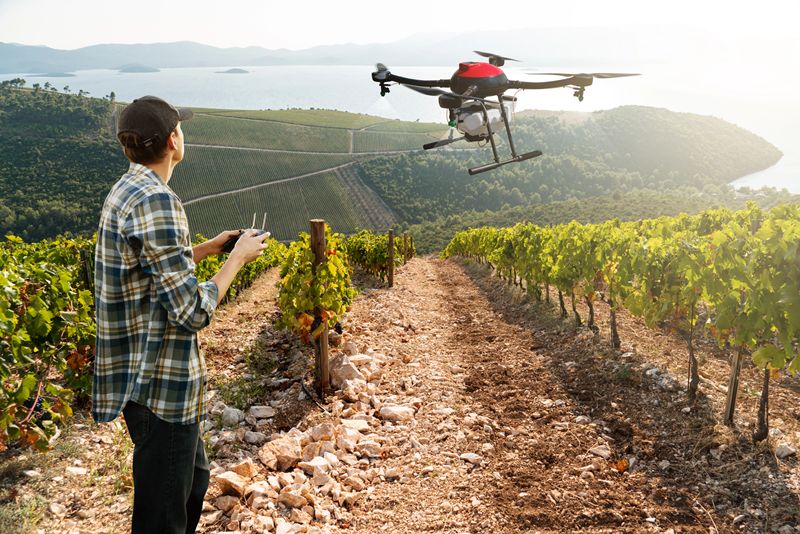
The Protected Designation of Origin Islas Canarias-Canary Wine is joining a multi-region project that will use artificial intelligence, drones, and regenerative farming practices to modernize vineyard work on steep slopes, an area of winegrowing where machinery often cannot replace manual labor.
Canary Wine is taking part through the Association of Winegrowers and Wineries of the Canary Islands, known as AVIBO, in the Penvitis+ project, according to information released by the organization. The initiative has received €599,238.85 in public funding from Spain’s Fund for Agricultural Guarantee, or FEGA, under the country’s 2023-2027 Common Agricultural Policy strategic plan.
The project is aimed at vineyards on slopes above 30%, terrain that sharply limits mechanization and keeps much of the work in growers’ hands. In parts of Spain, that kind of difficult hillside production is often referred to as heroic viticulture because of the physical demands, higher costs, and safety risks involved.
Penvitis+, whose full name describes it as an intelligent and sustainable viticulture program for climate adaptation and improved vineyard quality on steep slopes, brings together 12 entities from Galicia, the Canary Islands, and Catalonia. The coordinator is the Catalan wine cluster association INNOVI. The work is scheduled to run through the 2026, 2027, and 2028 winegrowing seasons.
One of the project’s main goals is to apply AI-based tools in vineyards to build predictive models that can anticipate at least 80% of incidents linked to pests and diseases. The plan calls for combining the Fitovit model with systems developed in the Canary Islands, with scientific validation by the Viticulture and Enology Station of Galicia, known as EVEGA-AGACAL.
According to the project outline, those tools are intended to cut the use of plant protection products by 30% on participating plots. If that target is met, the effect could extend beyond field operations. For wineries and grape suppliers, especially in difficult mountain or coastal sites, lower chemical use and more accurate treatment timing could help control costs, support sustainability goals, and protect fruit quality in a period of more frequent weather stress. That is particularly relevant for the wine business, where grape condition directly affects yield, style, and price.
A second major line of work will focus on drones for the application of crop treatments in steep and hard-to-reach vineyards. Project partners aim to reduce manual labor time for those tasks by 30%, while also improving worker safety and making applications more precise.
The trials will be carried out on vineyards in the Canary Islands, Galicia, and Catalonia that are considered representative of heroic viticulture. Among the test sites are plots operated by Adegas Moure in Ribeira Sacra, where slopes can reach 70%. Those conditions are expected to give researchers a demanding setting in which to measure drone performance and compare it with conventional methods.
The project’s third pillar centers on soil health and regenerative practices designed to make vineyards more resilient to climate change. Organizers said the work will include cover crops and vegetation and canopy management aimed at conserving moisture, reducing erosion, and shielding grape clusters from high temperatures.
One stated objective is to reduce the effects of heat stress on grape ripening by 30%. The project says that could help maintain a better balance of sugars, acidity, and pH in the fruit, a key issue for wine quality as hotter conditions alter ripening patterns. In practical terms, that matters for both still and sparkling wine production because shifts in acidity and sugar levels can affect alcohol, freshness, harvest timing, and the style a winery is able to produce.
The climate focus reflects growing pressure on many wine regions. Steep-slope vineyards are often valued for their landscape, heritage, and distinctive fruit, but they can also be more exposed to erosion, heat, drought, and the logistical limits of manual work. Heavy rain, rising temperatures, and changing ripening cycles have added to those pressures.
Along with AVIBO, the beneficiaries in the project include the governing council of the Priorat Qualified Designation of Origin, Adegas Moure, and Celler Mas Doix. Other participating organizations are the governing council of the Ribeira Sacra Designation of Origin, Bodegas Viñátigo, the Catalan Institute of Vine and Wine, known as INCAVI, EVEGA-AGACAL, the Canary Islands Institute for Agri-Food Quality, or ICCA, GALA Media, and Zabala Innovation.
The project also includes a knowledge-transfer component. Organizers said they plan to hold technical sessions and produce reports and outreach materials for growers, wineries, appellation bodies, and technology centers so that the tools and methods tested in Penvitis+ can be applied in other wine regions with similar conditions. The work is also intended to help preserve vineyard landscapes and reduce the risk of rural land abandonment in areas where steep terrain makes farming harder and more expensive.