Swiss wine grapes command €2.85 per kilogram, the highest national price in Vinetur’s 2026 harvest survey
Argentina ranks last at €0.21 per kilogram, leaving a 13.6-fold spread across the survey’s wine grape markets.
Tuesday, September 8, 2026
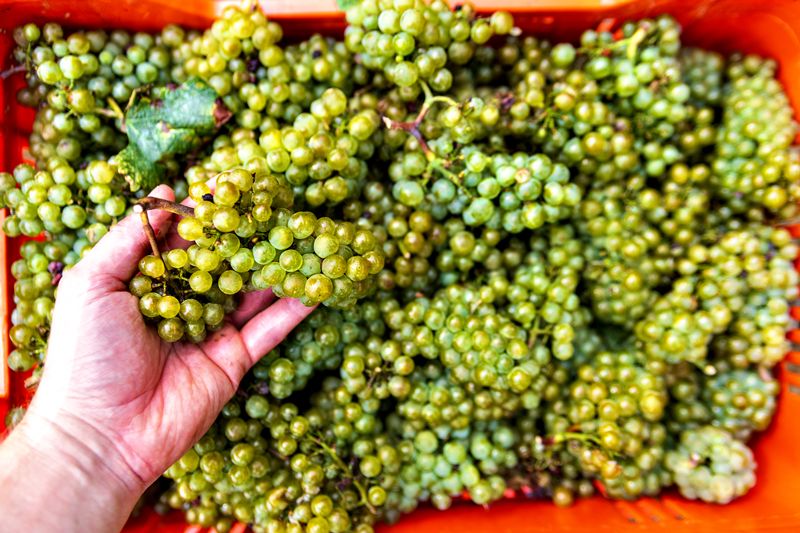
A Vinetur analysis released Tuesday found that wine grape prices for the 2026 harvest vary sharply across producing countries, with Switzerland showing the highest central national price at €2.85 per kilogram and Argentina the lowest at €0.21 per kilogram as of Sept. 8.
The report compares only grapes intended for winemaking and measures the price paid, or attributable, to growers in euros per kilogram. It excludes table grapes, raisins, bulk wine prices, bottled wine values, wine output, vineyard yields, and global production totals. Vinetur said the comparison should be read as a snapshot taken on Sept. 8, when the 2026 harvest in the Southern Hemisphere had already ended in major producers such as Australia and South Africa, while the summer-fall 2026 harvest in several Northern Hemisphere countries was still under way.
That timing is central to the report’s findings. Vinetur said Australia and Moldova were the clearest cases where 2026 national benchmarks were already traceable. In much of Europe, including Germany, France, Italy, and Spain, harvest data and market signals were available, but final national average prices were not. The publication said presenting a supposedly official number for every country would create a false sense of precision, so it separated countries into three categories: direct 2026 data, observed 2026 prices normalized into a national figure, and estimates built from recent purchase series, variety mix, contract signals, costs, and broader market trends.
The widest gap in the study is between Switzerland and Argentina. Vinetur said Switzerland’s €2.85 per kilogram central price is about 13.6 times Argentina’s €0.21. The report said that difference does not mean Swiss grapes are 13.6 times better in quality, but reflects different cost structures, scarcity, productivity, market positioning, and the ability to pass value through the supply chain.
Among large commercial markets, France was placed at €1.20 per kilogram, Germany and Canada at €1.05, New Zealand at €1.11, the United States at €0.85, Greece at €0.82, Italy at €0.50, Portugal at €0.52, Spain at €0.31, Chile at €0.22, and Argentina at €0.21. Australia, one of the most closely documented cases in the report, was set at €0.35 per kilogram. Moldova was placed at €0.38, South Africa at €0.39, and Brazil at €0.39.
Vinetur said Australia offered the strongest single benchmark in the survey because Wine Australia has already published a weighted average price of AUD 570 per ton for purchased grapes in the 2026 harvest, down 6% from a year earlier. Converted at exchange rates near the Sept. 8 cutoff, that equals about €0.35 per kilogram. The report used that figure to show how low grape prices can be even in a developed wine industry.
Moldova was identified as another relatively firm reference point. Vinetur said the country’s product council, with participation from the Agriculture Ministry, set an indicative harvest range of MDL 6.8 to MDL 8.2 per kilogram, equal to roughly €0.34 to €0.41. The report used a central value of €0.38 per kilogram and said premiums of 15%-30% may still apply for higher-quality or native varieties, while lower-value grapes may trade below that band.
In Spain, the publication described a market under strong pressure. It said large-scale transactions for some grapes have been seen at around €0.20 to €0.28 per kilogram, while other commercial grapes have traded closer to €0.35 to €0.40. The resulting national normalized figure was set at €0.31 per kilogram. Vinetur said contracts remained open in some Spanish markets, making a final national average premature.
France was treated as one of the most complex cases because of the gap between ordinary commercial grapes and elite regions. Vinetur said some 2026 market offers for winemaking grapes were around €1.10 to €1.20 per kilogram, but much higher-priced segments can pull the national weighted picture upward. It said France cannot be represented fairly by a single basic grape quote because grapes from areas such as Champagne have historically traded at several euros per kilogram.
The same logic shaped the treatment of Greece. Vinetur placed the country at €0.82 per kilogram, but said the Greek range deliberately excluded exceptional lots that were reported near €10 per kilogram during the 2026 harvest. The report said including those rare transactions mechanically in a national average would distort the broader market. It applied a similar warning to France, the United States, and Switzerland, where a small share of very expensive fruit can skew simple averages.
In the United States, Vinetur set the central national price at €0.85 per kilogram. It said the last broad official benchmark before the current harvest put California’s average grape price for 2025 at about $979 per short ton, equal to about €0.93 at current exchange rates. But the 2026 spot market has shown much heavier pressure, with some deals near $800 per ton and weak demand described in August market reporting. Vinetur said that pushed the national normalized figure lower for 2026, while noting that premium vineyards can still command far higher prices.
Canada was also placed at €1.05 per kilogram, supported by published 2026 grape price schedules in Ontario and current offers showing some grapes near CAD 2,500 per short ton. Vinetur said those high-end figures should not be projected across the whole country, but they point to a market with significant internal dispersion.
In South America, the report put Chile at €0.22 per kilogram and Argentina at €0.21. Vinetur said Argentina remained one of the cheapest markets in the sample, with harvest offers in basic segments around ARS 200 to ARS 210 per kilogram, while industry representatives argued values should be at least ARS 260. The report said growers had complained that nominal prices were still near the previous season’s level. After weighting cheaper purchases against higher-value varietal grapes, Vinetur arrived at the €0.21 national figure. Chile’s estimate was slightly higher at €0.22, based on public market monitoring by ODEPA and a wide gap between basic fruit and more sought-after varietals.
Among major exporters in the Southern Hemisphere, New Zealand stood out with one of the highest commercial grape prices at €1.11 per kilogram. Vinetur said recent sector statistics put average grape prices around NZD 2,186 per ton, and the 2026 wine grape price index pointed to positive movement even as wine demand weakened. The result puts New Zealand at more than three times Australia’s level, a contrast the report described as especially revealing because Australia’s number is based on a direct national average for purchased grapes.
Italy, another major producer still in harvest, was placed at €0.50 per kilogram. Vinetur said Italian chambers of commerce and market reporting had already begun posting 2026 grape quotations in August and showed downward pressure in some categories as the new crop entered the market. Portugal was estimated at €0.52, Hungary at €0.52, Romania at €0.48, Turkey at €0.45, India at €0.48, Bulgaria at €0.50, Serbia at €0.55, and China at €0.55. Most of those figures were classified as estimates rather than direct national averages.
The report also placed Austria at €0.90 per kilogram, the Czech Republic at €0.85, Slovenia at €0.80, Croatia at €0.75, Mexico at €0.75, Uruguay at €0.75, Russia at €0.75, and Georgia at €0.35. North Macedonia was one of the lowest-priced European markets at €0.32 per kilogram. Switzerland remained far above the rest of the sample, which Vinetur linked to higher internal costs, lower commercial yields, and a market structure not easily comparable to large industrial grape regions.
Vinetur said the reliability of the figures differs from country to country. Australia and Moldova fall into its highest-confidence group because 2026 references are already explicit and traceable. Argentina, Canada, Chile, Spain, the United States, France, Greece, Italy, and New Zealand were placed in a middle category where there is substantial current-season evidence but no final national average. Many other countries were listed as estimates, and Vinetur said those numbers should often be read with a tolerance of roughly ±15%-25%.
The publication also cautioned readers not to treat its “commercial band” as a statistical confidence interval. Instead, it said the band is meant to show where most commercial wine grapes in a country are reasonably concentrated, excluding exceptional cult vineyards, related-party transactions, and rare outliers. France’s band ran from €0.45 to €8.50 per kilogram, the United States from €0.45 to €3.00, Canada from €0.55 to €2.20, and Greece from €0.45 to €1.60 after extraordinary lots were excluded.
Exchange rates were normalized near the Sept. 8 cutoff. Vinetur said it used official values published Sept. 7, including $1.1622 per euro, A$1.6109, C$1.6062, NZ$1.9780, 18.5856 South African rand, 7.7995 Chinese yuan, 5.9576 Brazilian reais, 363.20 Hungarian forints, 5.2519 Romanian lei, 56.289 Turkish lira, and 0.9405 Swiss francs. That conversion matters most in countries facing currency swings, including Turkey, South Africa, and Argentina.
The study said the most useful way to compare countries at this stage is to focus on the central national 2026 price rather than on small differences of a few cents, especially in the Northern Hemisphere where harvests are still under way and some contracts remain unsettled. In Germany, for example, Vinetur said the harvest was exceptionally early and active by early September, but there was still no published national 2026 purchase average to replace its €1.05 estimate. Similar caution applies in France, Italy, and Spain, where the current harvest continues to shape market prices and final grower settlements.