Italy’s wine groups withhold a 2026 harvest forecast.
Picking began 8-10 days early in some vineyards, but heat and patchy drought have clouded yield estimates.
Friday, August 7, 2026
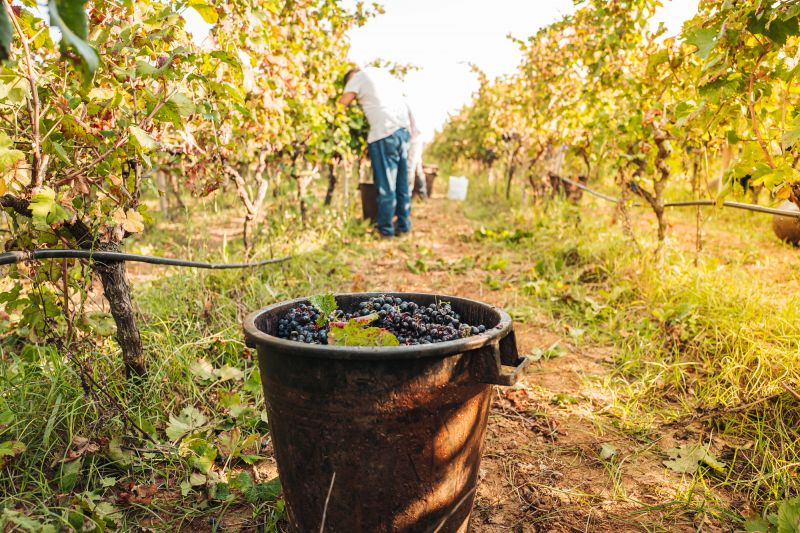
Italy’s 2026 grape harvest has begun in scattered early vineyards from Lombardy to Sicily, about 8-10 days ahead of the usual pace in many areas, but the country’s main wine bodies are declining to publish their customary national production estimate because of unstable weather and a wide gap between strong vineyard health and uncertain yields.
The first cuts do not mean a full harvest is underway across those regions. So far, picking has started mainly in early plots and districts in Oltrepò Pavese, western Sicily, Franciacorta, Abruzzo, Alta Langa, Veneto and Puglia, with growers focusing on Chardonnay, Pinot Noir, Pinot Grigio and other grapes used for sparkling wine bases or early white wines. Franciacorta began on July 30, the first time in its history that the harvest opened in July, according to the consortium there.
The early start has been driven mainly by heat, which sped up vine development. In younger vineyards, on free-draining soils and in parcels without irrigation, that same heat and dryness may now work the other way by slowing growth and trimming berry weight. That tension helps explain why Assoenologi, ISMEA and Unione Italiana Vini have chosen not to release a preliminary national forecast this year. The three groups said they will wait until the end of the campaign to publish consolidated figures.
That decision matters because Italy’s official 2025 final output, declared by the agriculture ministry, came to 44.384 million hectoliters, well below the 47.4 million hectoliters projected in September last year by the same institutional network. In 2026, the regional signals available so far suggest a crop that could land close to last year’s level, but that remains a low-confidence inference rather than an official estimate.
What looks stronger at this stage is the quality outlook. Vineyard health is generally good, and pressure from downy mildew and powdery mildew has been limited in much of the country. The main risks are different: a loss of balance between sugar and acidity, smaller clusters and berries because of water stress, localized hail, some late frost damage and isolated outbreaks of flavescence dorée and esca.
Harvest dates vary sharply by region. Oltrepò Pavese started on July 28. Western Sicily moved at the end of July. Franciacorta followed on July 30, with the first fruit coming from Gussago and Monte Orfano. Abruzzo announced its first cuts on Aug. 3, mainly for Pecorino, Chardonnay and other early white varieties. Alta Langa set Aug. 5 for Pinot Noir and Chardonnay. Puglia officially opened on Aug. 5 in Leverano, with the first cut in the Salice Salentino DOP area. In Veneto, early districts are already active. Marche is expected to begin during the week of Aug. 10, again with Pinot Noir and Chardonnay for sparkling wines. Prosecco DOC is expected to start between Aug. 15 and Aug. 25 for Pinot and Chardonnay, with Glera following later in August and September. Chianti DOCG is expected to begin around Sept. 10 for Trebbiano and Vermentino, with red varieties later.
The unevenness of the season is clear in the regional data. Veneto appears broadly stable or slightly lower than 2025, with good to excellent quality, but officials there are already pointing to water stress and possible declines of 5% to 10% in parts of Treviso, Vicenza and Verona. Prosecco DOC could fall 5% to 7%, with producers watching water supply in stony soils and the threat of local hail. In Trentino, survey results have diverged, with one reading suggesting little change and another indicating gains of 7% to 8%, even after hail damaged about 250 hectares in Vallagarina. The province of Bolzano is showing signs of a crop 6% to 7% above last year. In Friuli-Venezia Giulia, some estimates point to gains of 5% to 10%, but only in irrigated vineyards, making a regional extrapolation unreliable.
Elsewhere, Lambrusco areas around Modena and Reggio Emilia are seen roughly in line with 2025, with excellent quality but a growing divide between irrigated and dry-farmed sites. Chianti DOCG is showing a slight recovery, though continued heat could reduce cluster weight. In coastal Tuscany’s Maremma, some forecasts suggest gains of 5%, and in a few areas as much as 10%, with healthy fruit and controlled mildew but visible stress in looser soils without irrigation. Marche is expected to produce about 870,000 hectoliters, similar to last year, though its 16 DOPs may come in slightly lower. Abruzzo has no defensible output estimate yet, but growers are describing the season as promising despite hail, heat and a trend toward higher sugars and lower acidity. In Sannio, some local estimates call for an increase of 5% to 10%. Puglia and Sicily have no solid regional volume forecast, though both are being watched closely for quality.
The weather background helps explain both the early start and the caution. June 2026 was Europe’s second warmest June on record, according to Copernicus, with an average land temperature of 19.14 degrees Celsius, 1.78 degrees above the 1991-2020 norm. Italy was among the areas drier than normal, and by mid-July the European Drought Observatory still showed watch, warning or alert conditions in parts of the country. Yet the pattern has not been uniform. Veneto closed July at 2.1 degrees Celsius above normal, with an average rainfall deficit of 9%, though differences inside the region were large. Franciacorta had received 25% less rain than its historical reference by July 12 and was hit by hail on several days in May and June. Sicily entered summer with stronger soil water reserves after a rainy winter and spring.
Those differences are shaping the likely style of the wines as much as the size of the crop. Dry summer conditions have generally helped keep fungal disease in check. An early harvest can also allow growers to bring in healthy fruit before new heat spikes or storms arrive. But in white wines and sparkling bases, the main challenge is preserving acidity and freshness. In reds, very high temperatures can create a mismatch between sugar levels, phenolic ripeness and berry size.
The biggest hard number hanging over the season is not vineyard output but wine already in storage. Italy had 46.521 million hectoliters of wine in inventory on June 30, according to the ICQRF “Cantina Italia” report, up 6.7% from a year earlier. It also held 3.704 million hectoliters of must and 55,570 hectoliters of new wine still fermenting. DOP and IGP wines accounted for 80.9% of stored wine, and Veneto alone held 24.8% of the national total. The stock of wine was roughly equal to 105% of Italy’s final declared 2025 production, though inventories also include wines aging normally and product moving through regular commercial rotation.
That inventory pressure is meeting weaker demand. Italian wine exports to countries outside the European Union fell 8.5% by value in the first four months of the year, according to the UIV observatory. Sales to the United States dropped 15.4%, even though April showed some monthly improvement. ISMEA reported in July that ex-cellar wine prices were down 9.6% from a year earlier, with common wines down 20.3%, while average current production costs for wine in June were up 4.7%. That squeeze on margins helps explain why several leading denominations have moved to limit the volume that can reach the market.
In Prosecco DOC, authorities have approved a temporary measure that could add as much as 300,000 hectoliters, but only alongside mandatory storage for part of the production, non-wine destinations for surplus Glera and a maximum grape-to-wine yield of 75%. In Delle Venezie Pinot Grigio, the maximum has been cut from 18 to 16 metric tons per hectare, with the upper production band held in storage. In Brunello di Montalcino, the yield has been reduced from 80 to 70 quintals per hectare from the second hectare onward, with the remaining 10 quintals allowed to go into Rosso di Montalcino or Sant’Antimo. Tuscany has approved similar supply controls for Brunello, Chianti, Chianti Classico and Toscana IGT. These measures mean that the physical crop, the volume eligible to be claimed under a DOP or IGP name and the volume actually released to the market will not be the same thing.
Labor is another uncertainty. There is no official count of missing grape pickers nationwide, but Coldiretti has reported difficulty finding qualified crews. The problem is less about one region than about timing: with several districts ripening earlier at once, demand for trained workers is becoming more concentrated. The Ministry of Labor initially assigned 40,075 entry quotas for seasonal agricultural work in 2026 and later added 5,389 more, bringing the total to 45,464. Those are authorizations, not proof of how many workers actually arrived, were hired or ended up in vineyards.
Italy’s broader farm work force is also aging. INPS data show 1,019,177 agricultural employees in 2024, up 2.4% from 2023, but 36.1% were 50 or older and only 22.3% were under 30. Women accounted for 30.2% of the total. Those figures cover all agriculture rather than harvest work alone, but they add context to an industry that increasingly depends on skilled crews and tighter scheduling.
Heat rules are adding another layer of organization. In Emilia-Romagna, for example, outdoor farm work is barred between 12:30 p.m. and 4 p.m. on days and in areas rated high risk, through Sept. 15. Other regions have adopted similar systems tied to local heat alerts. Wineries and growers are reshaping shifts around those restrictions just as fruit begins to arrive earlier than normal.
For the next few weeks, the most important signals will come from the condition of Glera, Pinot Grigio and sparkling wine base grapes in the second half of August, followed by real cluster weights and the sugar-acid balance at the start of September. Later-ripening reds such as Sangiovese, Nebbiolo, Montepulciano and Aglianico will determine how much of the season’s early promise survives the hottest part of the campaign.