Sicily Elevates Wine Tourism to a Core Industry
A new report says winery visits are rising, with foreign tourists driving growth across the island’s wine sector.
2026-05-15
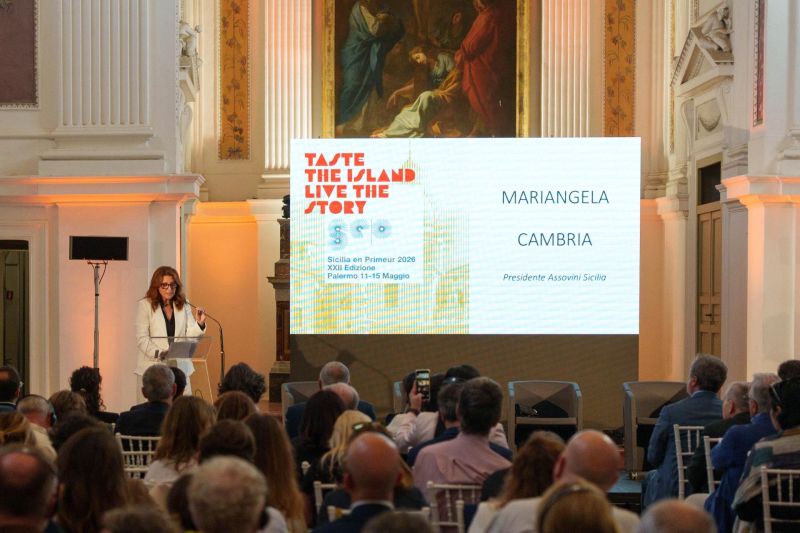
Palermo opened the 22nd edition of Sicilia en Primeur this week with a clear message from Assovini Sicilia: wine tourism is no longer a side activity for the island’s wineries, but a central part of their business and a growing part of Sicily’s tourism economy.
The event began May 12 at the Oratorio dei Bianchi with the conference “Taste the Island. Live the Story” and will run through May 15, bringing more than 100 journalists from around the world to Sicily for tastings, winery visits and other experiences. This year’s edition includes 56 member wineries and more than 1,000 labels presented across the program. Organizers also used Palermo as a stage to highlight sites that are less familiar to many visitors, including the recently renovated Real Albergo delle Povere, the Church of Santa Maria dello Spasimo and Palazzo Sant’Elia.
Mariangela Cambria, president of Assovini Sicilia, said the group chose Palermo because it reflects the mix of history, cultures and identities that shape Sicilian wine. She said wine tourism should be seen not only as an economic opportunity, but also as a way to tell the story of the island through its landscape, food, art and people.
The opening conference centered on a new report from CESEO-Lumsa on wine tourism in Sicily. The study portrays a sector that is already international and increasingly organized, but still in need of stronger coordination if it is to turn demand into lasting value. According to the report, 61.4% of wineries surveyed said visitor numbers rose in 2025. Foreign guests made up most customers at 74.7% of wineries, with visitors coming mainly from Europe and the United States.
The report also shows that wine tourism is becoming a meaningful source of revenue. For 58.3% of wineries, it accounts for about 10% of total turnover, excluding direct wine sales. Guided tours and tastings are now important marketing tools as well as sales channels.
Sustainability emerged as one of Sicily’s strongest points. The survey found that 86.7% of wineries generate energy from renewable sources, while 56.2% meet at least 40% of their energy needs with green power. Another 88% have eliminated single-use plastic in hospitality areas, and about seven in ten use lighter bottles.
The study also found that wineries have expanded their visitor services. Tasting rooms, wine shops, guided visits and dedicated staff are now common. Nearly six in ten wineries said they have already planned new experiences for 2026, aiming for more elaborate offerings that can command higher prices and attract repeat visitors. Basic digital tools such as websites, e-commerce platforms and mailing lists are widespread, but more advanced systems remain limited. Only 20% of wineries said they have a full Wine Club, and 30.6% reported using artificial intelligence, mostly for marketing and communications.
Dario Stefàno, president of CESEO at Lumsa University in Rome, said access to detailed data is essential if institutions and businesses want to move beyond scattered efforts and build a more competitive sector. Antonello Maruotti, CESEO’s scientific coordinator, said the challenge is no longer simply attracting visitors to wineries but turning international demand into stable economic value across the region.
The conference also focused on younger consumers. Vincenzo Russo, professor of consumer psychology and neuromarketing at IULM University in Milan, presented findings from the Youth & Wine Observatory showing that 51% of Italians ages 20 to 24 drink wine, the highest level recorded for that age group. He said direct experiences at wineries are one of the main reasons young people become interested in wine. His point was that younger consumers are not rejecting wine; they are looking for authenticity, connection and cultural context.
Artificial intelligence was another major topic. Edoardo Colombo, president of Turismi.AI, said AI could help Sicilian wine tourism become more personalized and more competitive by using data and predictive tools to better respond to visitor needs. Filippo Galanti, co-founder of Wine Suite, spoke about training and hospitality as key parts of winery strategy and said staff professionalism will matter more as visitors seek higher-quality experiences.
Luca Sammartino, Sicily’s regional councilor for agriculture, said wine tourism is becoming one of the pillars supporting the island’s economy. He said Sicily is already Italy’s second most popular food-and-wine destination after Tuscany and argued that demand for authentic local experiences is helping diversify tourism on the island.
Assovini Sicilia said the goal now is to build on Sicily’s strengths — its vineyards, biodiversity, culture and hospitality — while creating a shared strategy that can support growth across the island’s wine sector.

Founded in 2007, Vinetur® is a registered trademark of VGSC S.L. with a long history in the wine industry.
VGSC, S.L. with VAT number B70255591 is a spanish company legally registered in the Commercial Register of the city of Santiago de Compostela, with registration number: Bulletin 181, Reference 356049 in Volume 13, Page 107, Section 6, Sheet 45028, Entry 2.
Email: [email protected]
Headquarters and offices located in Vilagarcia de Arousa, Spain.