Late pruning raises grapevine disease risk
Field study in Spain and France found pruning wounds stayed vulnerable for at least 8 weeks, with weather shaping infection levels
2026-05-06
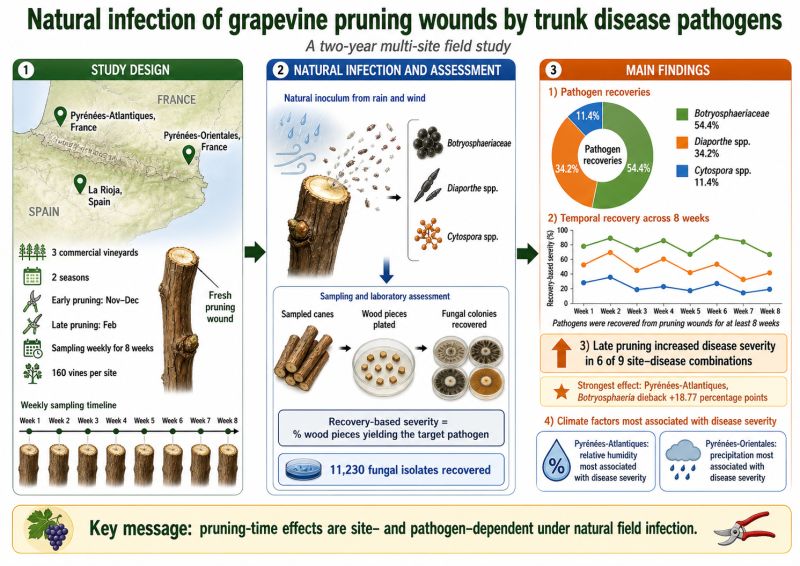
A two-year field study in vineyards in Spain and France found that grapevine pruning wounds remained vulnerable to infection by trunk disease fungi for at least 8 weeks after cutting, with the timing of pruning and local weather conditions shaping how much disease developed.
The research, posted Wednesday as a preprint and not yet peer-reviewed, followed 160 vines at each of three commercial vineyards in La Rioja, Pyrénées-Atlantiques and Pyrénées-Orientales. The team compared early dormant-season pruning, done in November or December depending on the site, with late pruning in February. They then sampled wounds weekly for 8 weeks across two growing seasons to see which fungi naturally colonized the wood.
From 11,230 fungal isolates recovered from plated wood pieces, Botryosphaeriaceae made up 54.4%, Diaporthe species 34.2% and Cytospora species 11.4%. Those groups are linked to Botryosphaeria dieback, Phomopsis dieback and Cytospora canker, three major grapevine trunk diseases that can shorten vineyard life and reduce productivity.
The study found that disease severity changed significantly over time at every site and for every disease group. But the pattern was not the same from vineyard to vineyard. In some cases, severity rose and fell over the 8-week period rather than declining steadily. The authors said that reflected the combined effect of wound healing, changing inoculum pressure and weather conditions that affected dispersal and colonization.
Late pruning led to higher disease severity in 6 of the 9 site-disease combinations tested. The strongest effect was in Pyrénées-Atlantiques, where late pruning increased Botryosphaeria dieback severity by 18.77 percentage points. At the same site, late pruning also raised Cytospora canker severity by 7.24 percentage points and Phomopsis dieback by 6.52 percentage points.
In La Rioja, late pruning increased Botryosphaeria dieback by 3.26 percentage points and Phomopsis dieback by 4.10 percentage points, while Cytospora canker was not significantly affected by pruning time. In Pyrénées-Orientales, late pruning significantly increased only Botryosphaeria dieback, by 10.27 percentage points.
The vineyards also differed in which fungi dominated. In La Rioja, Diaporthe species were slightly more common than Botryosphaeriaceae. In both French vineyards, Botryosphaeriaceae were the leading group. Across all sites, Diplodia seriata was the most frequently identified Botryosphaeriaceae species, while Diaporthe ampelina accounted for most Diaporthe isolates and Cytospora viticola for most Cytospora isolates.
Weather patterns appeared to matter, but differently at each site. In Pyrénées-Atlantiques, relative humidity showed the clearest association with disease severity. In Pyrénées-Orientales, precipitation was the main factor linked to infection levels. In La Rioja, climatic associations were weak overall.
The authors said their findings support a more local approach to pruning decisions rather than a single rule for all vineyards. They argued that pruning date should be considered alongside sanitation measures and wound protection products, especially in regions where humid conditions may favor infection after late winter pruning.
The work adds field data to a debate that has often relied on artificial inoculation studies under controlled conditions. Those studies have shown that wound susceptibility usually declines as wounds age, but the new research suggests that natural infection in commercial vineyards is more complex because spores arrive unevenly and weather changes from week to week.
The study was supported by project EFA 033/01 - VITRES, co-financed through the Interreg V-A Spain-France-Andorra program.
