Argentina will hold its first Women Brewers Day in September
The annual observance will spotlight women’s work across craft beer in a sector organizers estimate is about 30% female.
Thursday, August 27, 2026
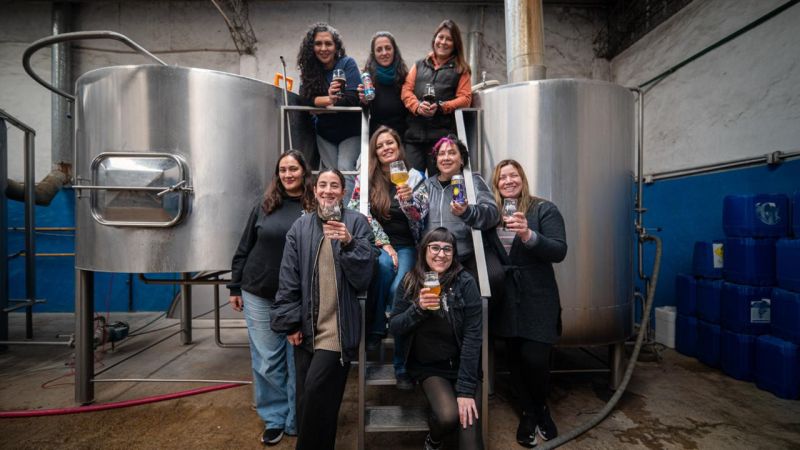
Argentina will mark its first Women Brewers Day on the first Saturday of September under a new industry-backed initiative meant to give public recognition to women working across the country’s craft beer business and to document their historical role in brewing.
The effort was proposed by the groups Colectiva de Cerveceras and Birreras de Argentina, with support from the Argentine Chamber of Craft Brewers. Organizers want the first Saturday of September to become a permanent annual date for events focused on women in brewing, from production and laboratory work to education, communications, tasting panels and business leadership.
The first observance is expected to take place in early September with activities in different parts of the country, including brewing sessions, tastings, beer presentations, courses and brewery visits led by women. The organizers say the goal is both symbolic and practical: to make women more visible in a sector that remains largely male-dominated and to encourage younger women to enter the industry.
Rulo Bustillo, vice president of the Argentine Chamber of Craft Brewers, said the date is intended to recognize women’s contribution to beer production over centuries while also highlighting the work being done today by thousands of women in the industry. He said the initiative is designed to serve as a tool for awareness and public outreach through educational, cultural and community activities.
The date was chosen as a double tribute. One part honors Hildegard of Bingen, the 12th-century abbess, scholar and naturalist often cited as one of the key historical figures in Western brewing for documenting the properties and benefits of hops in beer making. The second tribute is to Argentine brewer María Fernández Preisegger, known as “La Galle,” from Daireaux in Buenos Aires Province. Organizers describe her as a brewer, teacher, environmental advocate and biotechnologist who was among the early brewers in Argentina to develop an inclusive gluten-free beer project through her brewery, Ninka.
There are no official national figures on women’s participation in Argentina’s beer industry, but organizers estimate that women account for about 30% of people working in brewing-related activities. That estimate includes jobs in breweries, production, laboratories, communications, education and tasting panels. Organizers say the share is similar to, or in some cases lower than, that seen in other Latin American countries.
One of the first public steps tied to the initiative took place on July 28, when brewers gathered for a collaborative brew day at Madre Tierra in La Plata. The brewery is co-owned by Rocío Lezcano, a sociologist and brewer who recently published a book on women in Argentina’s brewing sector based on sociological research into their role in the field. Organizers said that work also helped shape the push to establish the annual date.
The beer chosen for the collaborative brew was a Grisette, a historic style from the mining region of Hainaut on the border of present-day Belgium and France. Traditionally known as a light, refreshing beer associated with miners, Grisette is typically low in alcohol, usually between 3.0% and 5.0%, pale gold in color and sometimes slightly cloudy because of wheat use. It is known for a light body, a dry finish, high carbonation and herbal or citrus notes. Organizers plan to present the beer during Women Brewers Day and distribute it in cans and kegs in different parts of the country to help promote the observance in bars and beer venues.
Lezcano said women’s presence in craft beer should be treated as normal at every level of the business, from production and laboratory work to management, sales and decision-making. She said training and support networks are essential if more women are to build professional careers in the field, gain access to new positions and find mentors in a sector with a long history of male leadership. She also argued that greater gender balance can broaden the industry’s approach to recipes, local ingredients, food pairings and the connection between beer, gastronomy and regional culture.
The campaign comes as Argentina’s craft beer industry continues to be shaped by small-scale businesses with limited room for expansion. A recent survey by the Argentine Chamber of Craft Brewers, based on a sample of breweries across the country, found that 70% have installed capacity of less than 10,000 liters per month. Only 3% operate at a level above 100,000 liters per month, a scale closer to semi-industrial production.
That structure has implications for hiring, training and access to leadership roles. The chamber’s survey found that 74% of breweries operate with seven people or fewer, including owners. The industry is also relatively young. The middle 50% of surveyed breweries opened between 2013 and 2018, meaning most have been in business for less than 13 years. Just 19% said they had diversified into other beverages, suggesting that most remain heavily dependent on beer sales alone.
Business models vary, but direct sales dominate. According to the chamber, 42% of breweries operate only as production facilities, 27% combine brewing with a taproom, and 21% also run their own bars. The remaining 10% use other formats, including contract production and occasional events. The survey also found that 75% do not work with distributors and instead sell directly to consumers, leaving breweries to handle their own logistics and retail channels.
Consumer demand still centers on accessible styles. The chamber said 90% of breweries listed Blonde, Golden or Pilsen among their top three best-selling beers. American IPA ranked second at 64%, followed by APA or Session IPA at 48%. Honey beer appeared in 38% of breweries’ top-selling styles, a sign of local preference for softer, slightly sweet profiles.
For the groups behind Women Brewers Day, those market realities form part of the case for making women’s work more visible. In a fragmented industry made up mostly of young, small businesses, organizers say recognition, training opportunities, access to financing and a stronger presence in technical and decision-making jobs will be necessary if women are to gain a larger role in shaping the next stage of Argentina’s craft beer sector.