The 2026 U.S. grape harvest begins early, pointing to a smaller crop.
Field reports, not official estimates, are guiding growers through light coastal yields, frost losses and uncertain winery demand.
2026-08-07
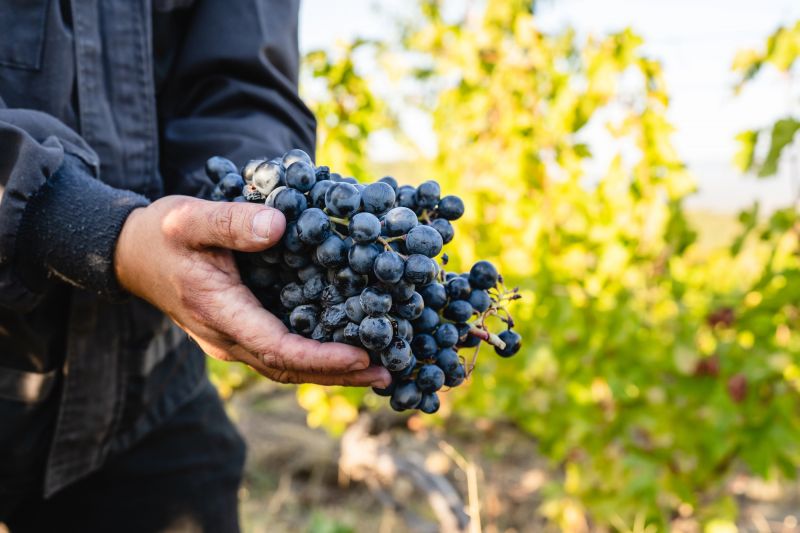
The clearest reading of the 2026 U.S. grape harvest, with picking already underway in parts of California and Texas, is that the season is early, uneven and likely smaller than a historically normal crop. What it is not, at least yet, is a harvest with a solid national tonnage estimate. As of Aug. 7, neither the federal government nor the private market had published a fully documented figure for total U.S. grape production, and growers, wineries and brokers were relying instead on field reports, weather patterns and early harvest signals.
That makes timing the strongest point of agreement. Across much of California, bud break and vine growth ran ahead after a warm late winter and an unusually warm March. A wet winter left soils with good moisture, but the spring that followed was cool, rainy and windy during bloom. In many coastal vineyards, that hurt fruit set and left looser clusters and fewer berries than growers would normally expect. Viticulture consultants and grower groups have described the pattern as broad, but they have also stressed that it is not uniform from one vineyard to the next.
The first signs of that early calendar showed up weeks ago. Sparkling wine fruit was picked in Santa Barbara on June 30, according to Ciatti, the brokerage and market firm. In Napa Valley, Chardonnay for sparkling wine was harvested on July 21, according to Napa Valley Vintners. In Paso Robles, Tablas Creek Vineyard said Syrah had reached veraison on July 9 and that harvest could begin around the week of Aug. 10, which would make it one of the earliest starts in the estate’s history.
California matters more than any other state because it will shape the national result. The state’s 2025 wine grape crush fell to 2.626 million tons from 2.866 million tons in 2024, a drop of 8.4%, according to the California Department of Food and Agriculture and USDA-NASS. Even a 2026 harvest that ends up similar to 2025 would still be small by recent standards. The same state report estimated California wine grape acreage at 540,000 acres, with 510,000 bearing, and said more than 21,000 acres had been removed in the prior 12 months.
This year, the strongest evidence of lower crop loads is on the coast, not yet statewide. In Sonoma County, grower organizations have reported healthy canopies and good soil moisture but light yields. In Alexander Valley, some Cabernet Sauvignon blocks were being estimated at 50%-60% of their long-term average, a local signal that industry groups say should not be treated as a countywide or statewide figure. The California Association of Winegrape Growers has also collected reports of losses ranging from moderate to severe in some coastal vineyards because of poor set and shatter. At the same time, observations from Lodi and parts of the Central Valley suggest much less damage, which is why analysts have been careful not to extend coastal losses to all of California.
The state’s final crush will also depend on something other than agronomy: whether grapes have buyers. In the current market, biological production and commercial crush are not the same thing. Healthy fruit can still be left on the vine if it is not under contract or if wineries decide they do not need more inventory. Terrain, a California market intelligence group, has said a meaningful amount of fruit was left unpicked last year for lack of buyers, though that remains a trade estimate, not an official tally.
That market backdrop is central to the 2026 story. A smaller crop may help reduce excess supply, but it does not solve weak demand. California’s 2025 crush was the lowest since 1999, yet many growers still faced soft prices and limited buying interest. The average price in arm’s-length grape transactions fell 8% in 2025, with Napa Valley one of the clearest exceptions to the broader decline. Silicon Valley Bank, in its annual wine industry outlook, said the market downturn should ease in 2026 but is more likely to bottom in 2027 or 2028 than to turn quickly higher next year.
Exports have added more pressure. The Wine Institute said U.S. wine exports to Canada fell 78% in 2025, a decline it valued at about $357 million. That loss has reinforced the correction already underway in vineyards through removals, temporary abandonment and low-input farming in blocks that no longer pencil out.
In practical terms, that means the 2026 crush could end up smaller than the crop in the field. Brokers and growers say the gap between grapes produced and grapes actually processed may be one of the most important numbers of the season, especially in California, Washington and Texas.
In the Pacific Northwest, the picture is earlier than normal in some respects, but not as advanced as California, and far less certain on tonnage. In Washington’s Columbia Valley, Northwest Wine Report said Cabernet Sauvignon veraison was observed on July 13, only three days ahead of the average since 2013, even though some spring development stages had been running 10 to 12 days early. AgWest Farm Credit said in mid-July that it was still too early to judge yield or quality with confidence.
Oregon’s Willamette Valley has looked steadier so far. Dundee Hills Winegrowers said the season there had been moderate, a bit warmer than average, with healthy canopies, good acidity and little heat stress in that area. Harvest is expected to begin from early to mid-September. But Oregon also starts from a low base. The Oregon Wine Board said the state produced 96,898 tons in 2025, down 25%, while planted acreage fell 5.5%. None of that is a forecast for 2026, only a reminder of how much the state had already contracted before this season began.
The main Northwest risk now is fire and smoke. Washington’s Department of Ecology has reported multiple large fires and periods of unhealthy air over parts of the Columbia Basin. Oregon has also had more than 30 large fires, mostly east of the main wine regions but still relevant because smoke can travel. Growers, laboratories and wineries all say visible smoke or a high air quality index does not automatically mean smoke taint in grapes. The outcome depends on timing, duration, wind patterns, variety, ripening stage and lab analysis. Even so, smoke has already become one of the most closely watched variables in both states.
Texas is much further along. Harvest started with Viognier in early July, and by early August wineries and vineyards in both the Hill Country and the High Plains were active. The work has often shifted to night or predawn hours because of heat near 100 degrees Fahrenheit. Texas Wine Growers and Texas Fine Wine have both said the surviving fruit in many places is healthy and promising, but the crop is light and highly uneven.
A March freeze hit parts of the Hill Country hard enough to wipe out production in some vineyards. Other sites kept a partial crop. The High Plains appears to be in better shape overall, though growers there have still dealt with late frost, drought, wind and hail. No statewide Texas tonnage estimate has been published.
Virginia and New York show the same pattern of sharp local losses and weak regional certainty. In Virginia, USDA’s Farm Service Agency designated 43 primary counties and 61 contiguous counties as disaster areas because of frost. Some farms reported losses greater than 30%, while others said the damage was close to total. The variation reflects elevation, variety and the timing of bud break. One block may be near normal while the next is nearly empty.
New York also had serious spring frost damage, followed by hot and dry weather in some areas. The state declared disaster areas in 32 counties after frost, wind and hail events, and state officials said more than $30 million in damage had been reported across affected fruit crops, not just grapes. In the Finger Lakes, some growers have said losses could approach 50% in badly hit sites, while others entered the season with enough inventory from the large 2025 harvest to blunt some commercial pressure. Here too, there is no sound basis yet for turning scattered reports into a regional crop number.
Elsewhere in the East and Midwest, frost damage has been reported in parts of Ohio and Maryland, and growers in Michigan have been tracking increased disease pressure from downy mildew, powdery mildew and black rot. Those are important developments for those states, but not enough on their own to define the national harvest.
On quality, growers and winemakers are generally more optimistic than they are on volume. Light crop loads, small berries, healthy canopies and cool nights can all support concentration and acidity when the fruit stays sound. That favorable pattern appears in many California coastal vineyards, in parts of Oregon, in portions of the Texas High Plains and in Eastern vineyards that escaped the worst frost.
But that is still a statement about potential, not finished wine. In California, sugars may rise faster than flavors and tannins if warm weather pushes ripening too quickly. In the Northwest, smoke exposure could still change decisions about what gets harvested, accepted or rejected. In New York and Virginia, fruit from secondary buds may ripen unevenly. In wetter regions, disease pressure can still build quickly if late summer turns rainy.
Labor and logistics add another layer of uncertainty. There is no national employment estimate yet tied specifically to the 2026 harvest, but the likely pattern is fewer total vineyard workdays where crop loads are light, combined with more pressure at local peaks because the schedule is early and compressed. When regions and varieties overlap, the competition for picking crews, trucks, tanks, presses, lab space and overnight winery shifts becomes more intense.
The federal H-2A farm worker program remains a major part of that labor system. Through March 31, 2026, the Labor Department had certified 254,688 H-2A positions nationwide, including 23,506 in California and 25,368 in Washington. Those figures represent approved jobs, not workers who necessarily arrived, and they are not limited to grape harvest work. Research from the UC Giannini Foundation has estimated that H-2A accounts for about 5% of California’s farm labor force and roughly 20% of average U.S. crop employment. UC Davis reported in May that growers and farm employers were dealing with fear and uncertainty related to immigration policy, though it found little hard evidence at that point of widespread crop losses caused by labor shortages.
Heat and smoke raise costs even when labor is available. Harvesting at night, adding breaks and hydration, supplying protective gear and monitoring air quality all add expense. In Washington, the statewide minimum wage for 2026 is $17.13 an hour, and agricultural overtime applies after 40 hours a week. If ripening converges into a short window, overtime costs can rise even while total seasonal work falls.
The next formal checkpoint comes on Aug. 12, when USDA-NASS is scheduled to publish its next Crop Production report. Even that release may not settle the key questions for wine grapes, because national grape data often combine fruit used for wine, juice, table grapes and raisins. By then, though, growers and wineries hope to know more about how much of California’s interior crop is carrying normal loads, how much Northwest smoke is reaching vineyards during ripening, and how much fruit without contracts is likely to find tank space.
Between now and then, wineries are sampling grapes district by district, not by headline. In California, they are watching whether cool nights hold and whether sugar stays in step with flavor. In Washington and Oregon, they are matching field observations with lab tests for smoke compounds. In Texas, they are trying to move fruit through the system before heat takes a toll. In New York and Virginia, they are following how secondary-crop fruit catches up and whether late rain changes disease pressure or picking dates.
