Tokyo’s Sake Fair Drew a Surprisingly Young Crowd
Visitors under 40 made up more than 50% of attendance as brewers pushed lighter drinks and stronger export branding
2026-07-09
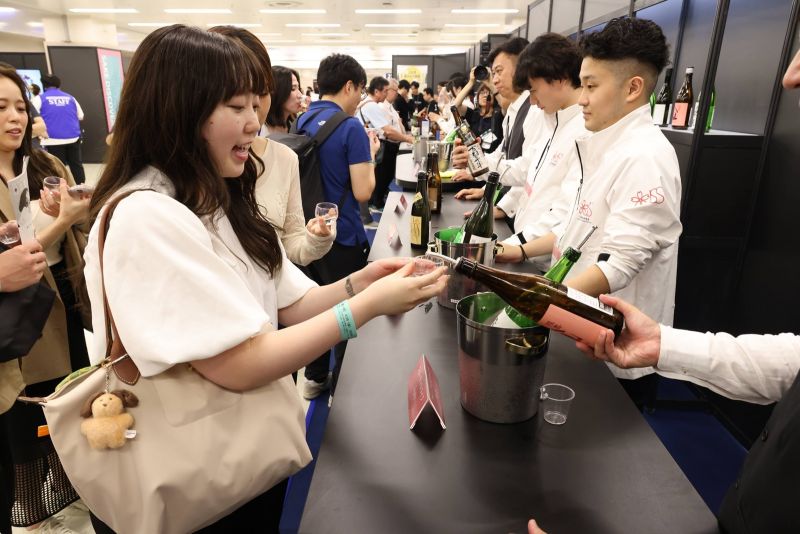
Tokyo’s Sake Fair returned in June as one of the world’s largest gatherings devoted to Japanese rice wine, drawing more than 5,600 visitors and putting new focus on two challenges facing the industry: how to bring in younger drinkers at home and how to build stronger demand abroad.
The 17th edition of the fair was held on June 19 and 20 in Tokyo, marking its return there after two years, according to the Japan Sake and Shochu Makers Association, the organizer. The event combined the All Japan Sake Fair, where about 1,200 types of sake from 45 prefectures were poured, with the public tasting of all entries submitted to the Annual Japan Sake Awards 2026, one of the country’s oldest and most established sake competitions.
This year’s fair came at a time when domestic sake consumption continues to decline, reflecting a broader pattern seen with traditional alcoholic drinks in several countries. Organizers said they used the event to test ways to lower barriers for new consumers while also presenting sake as a product with stronger export potential and clearer regional identity.
One of the most notable changes was a new ticket structure based on age. For the first time, the association created one category for visitors ages 20 to 39 and another for those 40 and older. The aim was to make it easier for younger adults to attend and to create more direct contact between that generation and sake.
The result, organizers said, was that visitors under age 40 made up more than 50% of total attendance. That figure stands out in Japan, where people under 40 account for about 25% of the legal drinking-age population, based on population estimates from the Ministry of Internal Affairs and Communications cited by the association. In effect, younger adults attended at roughly twice their share of the drinking-age population.
Hitoshi Utsunomiya, a director at the association, said the move was not simply about discounting tickets for younger consumers. He said opportunities for intergenerational drinking in workplaces and local communities have fallen since the Covid-19 pandemic, reducing casual exposure to sake among younger adults. The fair, he said, was designed to restore some of that contact in a setting where newcomers could discover styles they liked.
The event also gave prominent space to “Sake Highs,” a lighter mixed drink made by combining sake and carbonated water in a 1:1 ratio. Organizers presented it as an entry point for beginners and younger consumers who may find standard sake too strong or too formal. By dilution, alcohol content falls from around 15% to about 7%.
The association said the Sake High initiative began officially in 2024 as part of a broader effort by brewers, wholesalers and retailers to widen sake’s appeal. It is now available at more than 10,000 establishments across Japan. At the fair, a dedicated booth drew younger visitors who gathered around a format that resembles other low-alcohol highballs already familiar in Japan’s bar scene.
Kensuke Shichida, chair of the association’s demand development committee, said producers see lower-alcohol serves as especially relevant during increasingly hot Japanese summers. Some breweries have already started releasing products designed specifically for use in Sake Highs. Taichiro Fukumitsu, president of Fukumitsuya Sake Brewery in Ishikawa Prefecture, said his prefecture has continued promoting the drink as a way to reach people who consume alcohol but do not usually choose sake.
Alongside its domestic push, the fair also served as a platform for export development. This year the association invited eight sake and wine professionals from Vietnam and Thailand to visit sake-related businesses in Tokyo and Niigata and attend the fair. The choice of those markets reflects Asia’s growing importance for Japanese producers. The association said Asia accounted for about 63% of Japan’s sake export value in 2025.
Among those invited was Ratthapon Doungthip of Thailand, who works in sake education and events as a Sake Culture Advocate. He described the public tasting of competition entries as a rare chance to sample top-level bottles from across Japan in one place. He also said watching Japanese consumers move quickly toward certain booths offered insight into which regions and labels attract strong loyalty inside Japan itself.
That distinction matters for exporters because international recognition does not always match domestic preferences. For trade professionals trying to build markets overseas, understanding what Japanese drinkers value can help shape how sake is presented abroad, whether through restaurant lists, retail shelves or educational tastings.
Lincoln Vû, head sommelier at Da Loc Co., Ltd., a major wine and spirits importer in Vietnam, said sake remains small within Vietnam’s broader alcohol market but continues to grow. He said he plans to promote more food pairings in restaurants and venues where he works in order to show consumers how flexible sake can be at the table.
That message fits with a larger concern inside Japan’s industry: as the word “sake” becomes more widely known overseas and production outside Japan expands, producers want clearer recognition for “Nihonshu,” the term protected under Japan’s geographical indication system for sake made in Japan using Japanese-grown rice.
At this year’s fair, that point was tied closely to regional identity. Booths representing 45 prefectures highlighted differences shaped by water sources, rice varieties, climate and brewing methods. Organizers argued that overseas consumers should understand Nihonshu not as a single uniform category but as a product whose character changes from place to place.
That regional framing is becoming more important as local governments and producer groups seek stronger geographical branding. One example highlighted at the fair came from Yamagata Prefecture, where breweries have carried out overseas promotions together with selected rice growers. Masumi Nakano, president of Dewazakura Sake Brewery and an adviser to the Yamagata Prefectural Sake Brewers Association, said those joint efforts are intended to show foreign buyers how raw materials and local production are linked.
Such collaboration is unusual even by wine industry standards, where vineyard origin is often central to marketing. In sake, bringing rice farmers into export promotion gives trade professionals direct access to information about cultivation practices that they would rarely hear firsthand. It also gives growers a clearer view of how their crop is transformed into finished bottles sold abroad.
Nakano said Yamagata recently carried out such an initiative in Hong Kong. He added that export growth and new forms of promotion are helping make work in regional sake industries more attractive to younger people, an issue with wider implications for rural economies facing aging populations and labor shortages.
The export backdrop has given producers reason for optimism even as domestic consumption weakens. According to figures cited by the association, Japan’s customs-cleared sake exports reached ¥45.9 billion in 2025, up 6% from a year earlier. Export volume rose 8% to 33.55 million liters, or about 3.73 million nine-liter cases. Both value and volume increased from the previous year, making 2025 the second-highest export performance on record. Compared with 2020, export value has roughly doubled.
The fair itself has also evolved with broader changes in how Japan presents its traditional drinks. In 2025 it was held in Osaka during Expo 2025 under the name Kokushu Fair. Kokushu refers collectively to beverages such as sake, honkaku shochu and awamori that are rooted in traditional koji-based fermentation methods recognized by UNESCO as intangible cultural heritage in late 2024.
Back in Tokyo this year, however, sake remained at the center of attention. For producers facing shrinking consumption at home but rising interest abroad, the event offered both a sales pitch and a test case: lighter serves for new drinkers, stronger regional storytelling for foreign markets and a renewed effort to connect one of Japan’s oldest drinks with a younger generation that did not inherit it automatically.
