Robots Combat Vineyard Diseases as Global Wine Production Hits Lowest Level Since 1961
AI-powered machines help growers detect and treat fungal outbreaks, offering hope for sustainable wine yields amid climate challenges
2026-01-28
In 2023, the global wine industry faced a major setback when downy mildew devastated vineyards across Europe, with Tuscany losing 70% of its wine production. The fungal disease, which attacks grape leaves and bunches, contributed to a 10% drop in worldwide wine output compared to 2022, marking the lowest production since 1961. The International Organisation of Vine and Wine (OIV) attributed these losses not only to disease but also to extreme weather events such as droughts, floods, and wildfires that affected all major wine-producing regions.
Despite these challenges, Italy maintained its position as the world’s largest wine producer in 2025, yielding 47.3 million hectoliters (Mhl), ahead of France at 35.9 Mhl and Spain at 29.4 Mhl. The United States and Australia followed in fourth and fifth place, respectively.
To address the growing threat of vineyard diseases and labor shortages, researchers and companies are turning to robotics and artificial intelligence for solutions. At Cornell University, scientists are developing the PhytoPatholoBot, a self-navigating robot designed to scout for grape diseases in vineyards. The robot moves between rows of trellised grapevines, capturing side-view images of the canopy. Using an AI model, it distinguishes healthy plant tissue from areas showing disease symptoms by analyzing pixel data within each image.
The PhytoPatholoBot’s findings are enhanced by integrating NASA remote sensing data, GPS information, and computer modeling that interprets spectral signatures emitted by plants. This combination allows for near-real-time identification of disease type, location, and severity within a vineyard. Vineyard managers receive this information quickly, enabling them to respond before infections spread widely. Researchers say this level of automation is especially valuable where manual scouting is limited by time or labor constraints.
Commercial vineyards in Europe are already deploying autonomous robots for disease management. In Italy, the Icaro X4 robot from Free Green Nature operates in a Sangiovese vineyard to treat downy mildew using UVC light. The solar-powered platform can run continuously for up to 72 hours—even during rain, when mildew risk is highest—thanks to its hybrid powertrain. Besides disease treatment, it performs routine vineyard tasks.
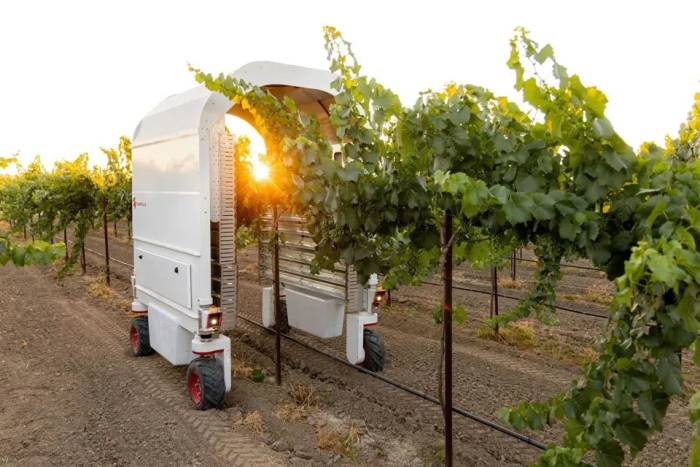
In the United States, similar technology is being tested for both disease control and crop monitoring. Saga Robotics, a Norwegian startup spun out from research at the Norwegian University of Life Sciences, has developed the Thorvald robot. The company recently raised $11.2 million in equity funding to expand operations in the U.K. and U.S.
Dr. Damian Flynn, chief product officer at Saga Robotics, says that growers face two main challenges: reliance on chemical treatments and labor shortages. Chemical pesticides and fungicides are expensive and can lose effectiveness over time as plants develop resistance. There are also environmental concerns about chemical runoff into soil and water sources.
Flynn explains that labor costs continue to rise while availability declines, making traditional crop management increasingly difficult. He believes autonomous robots like Thorvald offer a solution to both problems.
Thorvald uses UVC light as a preventive treatment against fungal diseases by disrupting the DNA of spores before they can infect plants. The robot is equipped with multiple cameras that capture video footage as it moves through vineyards. Machine learning models analyze this footage to count grape clusters and assess ripeness after each treatment pass.
All collected data is aggregated by row, field, and farm over time, providing detailed insights into crop development and yield forecasts up to two weeks in advance. Flynn notes that such comprehensive monitoring would be impossible for humans to achieve manually across large farms.
The AI-based vision system on Thorvald not only helps with disease detection but also supports labor planning by identifying areas needing attention early on. Flynn adds that accurate yield predictions can help growers avoid penalties or price reductions if harvest expectations change unexpectedly.
Thorvald robots have already made an impact in California’s vineyards—treating nearly 1,300 acres last season—and play a significant role in the U.K., where they account for 20% of the strawberry harvest.
As climate change continues to stress grape production worldwide, automation technologies like those developed by Cornell University and Saga Robotics are becoming essential tools for vineyard managers seeking sustainable ways to protect crops and maintain yields amid unpredictable conditions.
