EU Wine Sector to Receive Up to 80% Climate Funding Under New Reform Deal
Provisional agreement aims to boost sustainability, simplify labeling, and support rural economies as industry faces global pressures.
Thursday, December 4, 2025

European Union officials have reached a provisional agreement on a new policy framework aimed at strengthening and modernizing the EU wine sector. The deal, announced in Brussels after negotiations between the Council of the European Union and the European Parliament, introduces a series of measures designed to help wine producers adapt to changing market conditions, address climate challenges, and support rural economies.
The agreement comes at a time when the European wine industry faces significant pressures. These include shifting consumer preferences, demographic changes, climate-related risks, and market uncertainties. The EU is responsible for about 60% of global wine production and is the third-largest agri-food export sector in Europe. The sector also plays a key role in supporting rural jobs and preserving cultural heritage, with most vineyards linked to protected geographical indications.
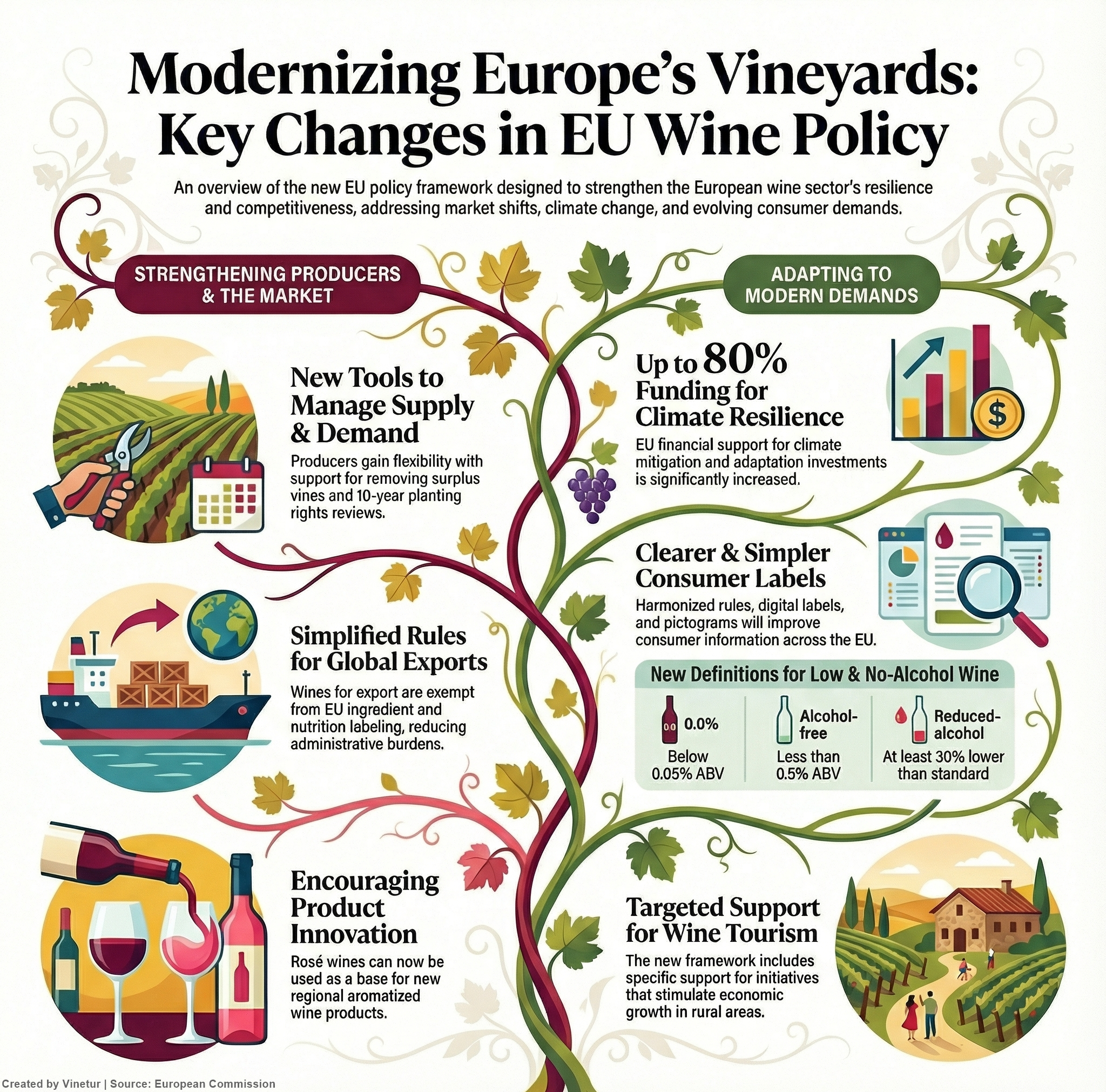
Under the new framework, member states will have more flexibility to manage supply and demand. One measure allows countries to support the removal of surplus vines to prevent oversupply and maintain market stability. The previous end date for planting rights has been scrapped in favor of a ten-year review period, giving producers more certainty and adaptability.
Climate resilience is another focus of the agreement. Member states can now increase EU financial support for investments related to climate mitigation and adaptation, covering up to 80% of eligible costs. This is intended to speed up the transition toward more sustainable wine production practices.
Labeling rules will be simplified and harmonized across the EU. This change aims to reduce administrative costs for producers and make it easier for consumers to access clear information about wine products. Digital labels and pictograms will be introduced as part of this effort.
The agreement also includes targeted support for wine tourism initiatives. By encouraging wine tourism, EU officials hope to stimulate economic growth in rural regions where many vineyards are located.
New rules clarify how reduced or no-alcohol wines are labeled. Products with less than 0.5% alcohol can be labeled as “alcohol-free,” while those below 0.05% may use “0.0%.” Wines with reduced alcohol content—defined as at least 30% lower than standard strength—will carry the designation “reduced-alcohol,” replacing previous terms like “alcohol-light.”
For wines destined for export outside the EU, producers will be exempt from listing ingredients and providing nutrition declarations required for the internal market. This move is expected to reduce administrative burdens for exporters.
The agreement also addresses plant health by increasing support for actions against diseases such as flavescence dorée, which threatens vineyards across Europe. Funding will go toward monitoring, diagnostics, training, and research.
Innovation in wine production is encouraged through new rules allowing rosé wines to serve as a base for regional aromatized wine products. This change is intended to help producers respond to evolving consumer tastes and develop new product styles.
Jacob Jensen, Denmark’s Minister for Food, Agriculture and Fisheries, said that the agreement would help ensure that European wine producers can adapt and compete globally while protecting rural livelihoods and maintaining quality standards.
The provisional deal must still be formally endorsed by both the Council and the European Parliament before it becomes law. The process follows recommendations from a high-level group on wine policy established by the European Commission earlier this year.
EU officials say these reforms are necessary to help the sector remain competitive in a rapidly changing global market while supporting local communities and preserving Europe’s rich winemaking traditions.