What happens when you distil beer, and why the result changes more than it seems
Where the alcohol comes from, which part of the aroma can remain, and why sweetness, body, colour, carbonation and foam do not carry over intact.

Views › 502
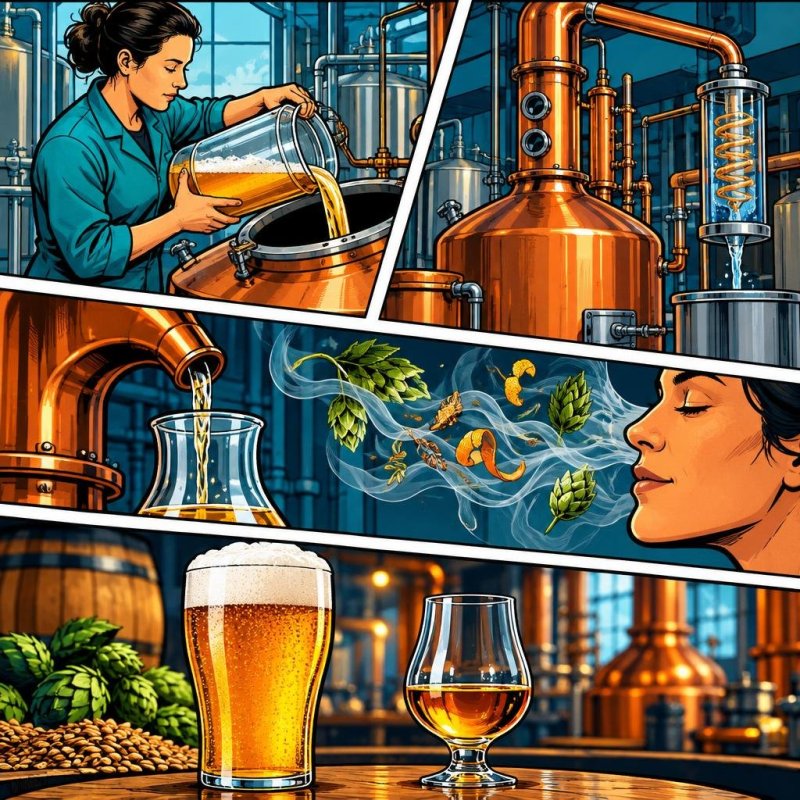
Yes, beer can be used to make a distilled drink. But it would not be the same beer with extra strength. Distillation separates some of its components, concentrates alcohol that was already there, and changes which aromas and sensations reach the glass.
Yes, but the result is no longer the same beer
If beer is distilled, what you get is best understood as a beer distillate or, if you prefer, a beer spirit. Some people may casually call it a liquor, but it is better not to assume the result will be sweet: distilling does not add sugar or automatically turn the drink into a sweet liqueur.
The key idea is simple: yes, beer can be used as the base for a distilled drink, but that distillate does not preserve the original beverage intact. Distillation can raise the proportion of alcohol in the final liquid, but it does not create new alcohol, and it does not carry every component of the beer across at the same time or in the same amount.
Key idea
Distilling beer gives you a beer distillate, not the same drink with more strength.
Distillation can raise the alcohol strength, but it does not add sugar or create new alcohol.
Fermentation makes alcohol; distillation separates it
Fermentation is the process in which yeast turns sugars into alcohol. That is where the ethanol in beer comes from. Distillation happens afterwards and is something different: a separation based on turning part of the liquid into vapour and then condensing it again. So distilling does not make more ethanol; it recovers part of the original liquid with a different composition.
That point matters because distillation is sometimes imagined as if pure alcohol came out first and pure water later, and that is not how it works. The liquid that is recovered is still a mixture: it contains ethanol, water and other substances that also make their way into the vapour under the conditions of the process. The change is real, but it is neither a complete purification nor an exact copy of beer in concentrated form.
This is where a useful word appears: volatile. A volatile substance is one that can pass into vapour under the conditions of the process. Some parts of beer do that more easily than others. That difference helps explain why certain aromas can reach the distillate while other elements of the original drink stay behind.
Three useful words for following the explanation
Fermentation
Yeast turns sugars into alcohol.
That is where the ethanol in beer comes from.
Distillation
It is a separation by vaporisation and condensation.
The recovered liquid is still a mixture, not pure alcohol.
Volatile
Able to pass into vapour under the conditions of the process.
That is why some aromas travel with the alcohol more easily than sugars and proteins do.
What may remain of the aroma, and what hops do not tell you
Beer contains many aromatic substances, including esters, alcohols and terpene compounds. Because some of those compounds are volatile, part of the beer’s aromatic identity can pass into the distillate. But passing across is not the same as staying unchanged: proportions shift, some compounds carry over more easily than others, and the result no longer smells or tastes exactly like the original beer.
That also explains why the starting beer matters. Research on beer distillates shows that brewing and fermentation influence the result, and practical experience from producers points the same way: two different beers do not have to yield similar distillates. Even so, that influence is not enough to promise a specific tasting profile or to say that one beer style will always keep certain notes after distillation.
With hops, it helps to separate two ideas that are often blurred together. One is aroma: beer contains volatile aromatic compounds that come from hops. The other is bitterness. The presence of hop-derived aroma compounds does not, by itself, let you predict how bitter the distillate will be. There is no solid basis for saying that a more bitter beer will always produce a proportionally more bitter distillate, or the reverse.
That is also why it is better not to call the result whisky as if the equivalence were automatic. There are distilled drinks made from fermented bases similar to beer, sometimes even brewed without hops, but that only shows a family resemblance between processes. For a general reader, the clearest description is still beer distillate, without turning a useful comparison into a universal label.
Sweetness, body, colour and foam do not carry over intact
Not everything you recognise in a beer can travel into the distillate in the same way. Sugars and proteins are among the non-volatile components, which means they do not pass into vapour the way ethanol and some aromatic compounds do. That is why you should not expect the original sweetness or body of the beer to be fully reproduced in the distillate.
The same goes for colour. A very dark beer does not mean you should imagine an equally dark distillate, because many colouring substances belong to the non-volatile fraction. Of course, a finished bottle may have received other treatments afterwards, such as ageing or later adjustments, but that would no longer be the simple consequence of distilling the starting beer.
Foam and carbonation change as well. The physical experience of drinking beer depends to a large extent on dissolved gas and on how it interacts with other components in the liquid. In documentation on beer distillates, carbon dioxide is treated as something to manage during the process, not as a feature that is preserved to recreate the same sensation as the original drink. That is why the result should not be imagined as a smaller, stronger beer with the same head of foam.
What may reach the distillate, and what does not carry across in the same way
Can travel with the vapour
Water, ethanol and part of the volatile aromatic compounds.
The beer’s imprint may remain, but only partially and in altered form.
Does not transfer in the same way
Sugars and proteins do not pass across like the volatile fraction.
That is why sweetness, body, colour, carbonation and foam are not reproduced intact.
More concentration does not mean more alcohol created
Alcohol strength is the proportion of alcohol by volume in a drink. When beer is distilled, that proportion can rise because part of the alcohol already present is separated and concentrated. But a higher strength does not mean new alcohol has appeared out of nowhere. Fermentation produced the ethanol earlier; distillation only changes how it is distributed within the recovered liquid.
There is no universal figure for how much liquid will be obtained or what the final strength will be. That depends on the starting beer, on how the separation is carried out, and on later decisions such as a possible adjustment with water. Giving a fixed percentage or a standard yield would present as a general rule something that varies from case to case.
Common questions
Does the alcohol strength go up?
It can, because part of the alcohol already present in the beer is concentrated.
Is more alcohol created?
No. Fermentation produced the ethanol earlier; distillation only separates and redistributes it.
Can one universal figure be given?
No. Final strength and the amount obtained depend on the beer, the separation and any later adjustments.
A different drink, not a kitchen experiment
The short answer to the opening question is that distilling beer can indeed produce another alcoholic drink, but not an intact beer with extra strength. Part of its origin may still be present, especially in aromatic terms, while other very recognisable features, such as sweetness, body, colour, gas or foam, do not carry across in the same way. The result depends on a selective separation, not on a simple amplification of everything that was in the bottle.
It is also worth keeping one basic precaution in mind: ethanol vapours are flammable. This explanation is meant to help you understand a transformation in the drink, not to reproduce it in a kitchen or assume a home setup is safe. Knowing what changes when beer is distilled is not the same as turning it into a sensible household experiment.