Which spirit causes the worst hangover, and what the evidence really says
The bourbon-versus-vodka comparison helps explain the role of congeners, but it does not support a universal ranking or identify a single culprit.

Views › 520
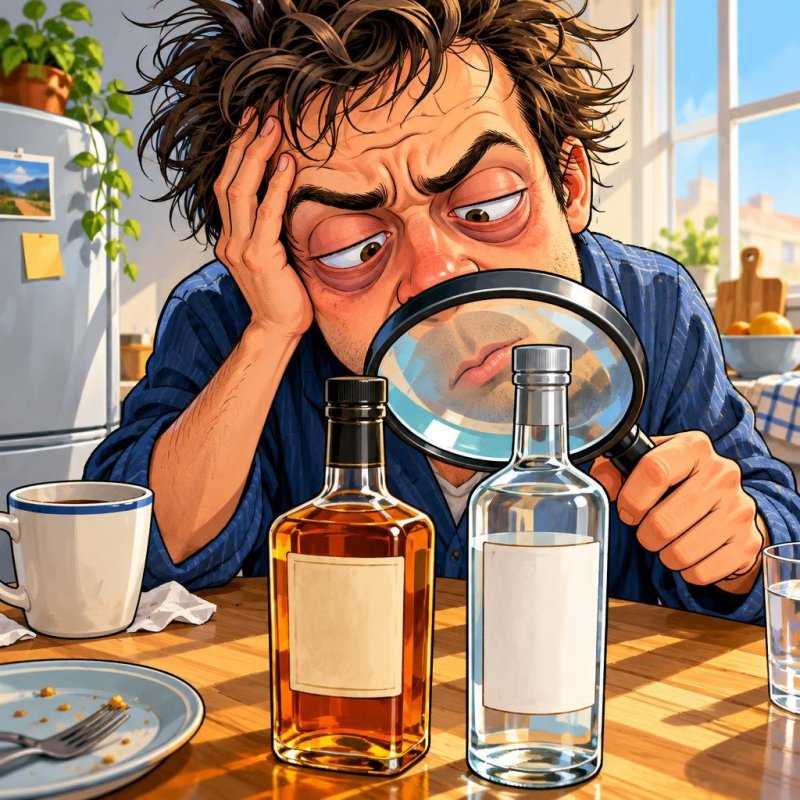
The short answer is less definitive than the cliché suggests: congeners may contribute to hangovers, but the evidence does not let us pin the blame on one molecule for each spirit or rank every drink from worst to best. Ethanol remains the main factor, and what we know comes from specific comparisons between whole beverages, not from a universal table with a verdict for every bottle.
Is there one spirit that causes the worst hangover?
There may be differences between drinks, but that does not mean each spirit has a known congener responsible for them. The review literature and the key human trial point in the same direction: a drink with more congeners may be linked to worse next-day symptoms, but that observation is not enough to assign blame molecule by molecule or build a universal hangover ranking.
It also helps to tighten the language. In everyday speech, many people use liquor for any strong alcoholic drink, but chemically that is not a uniform category. The focus here is mainly on spirits and on how to read the evidence: measuring a drink’s composition answers what it contains; observing symptoms in people answers what happened; and comparing whole beverages does not isolate the effect of each ingredient on its own.
Key point
Congeners may influence hangover, but the evidence does not allow us to assign one guilty molecule to each spirit.
Ethanol remains the main factor, and comparing whole drinks is not enough to build a universal ranking.
What the drink contains and what the body turns it into
Ethanol is the alcohol responsible for ordinary intoxication. Congeners are other minor components in a drink, distinct from ethanol, that come from the raw materials and the production process. They can include methanol, aldehydes, esters and other alcohols. Some are part of the aroma and flavour, so congener does not automatically mean contaminant or defect.
A metabolite is a substance the body produces when it transforms another substance. That distinction matters because many hangover explanations mix up different levels of the story. Acetaldehyde, for example, may be present in a drink, but it is also formed when the body metabolises ethanol. Higher alcohols are alcohols other than ethanol, such as propanol or isobutanol; higher is a chemical term, not a sign of better or worse quality.
A hangover is not caused by one thing alone either. Medical sources describe it as a set of symptoms after drinking alcohol in which sleep disruption, digestive irritation, inflammatory responses and other processes all play a part. Dehydration may contribute, but it does not explain the whole picture on its own. That is why it would be misleading to shift responsibility away from ethanol and onto supposed impurities, as if switching category were enough to drink without consequences.
Four terms that make the evidence easier to read
Ethanol
The alcohol responsible for ordinary intoxication.
It remains central to any explanation of hangover.
Congeners
Minor components in the drink other than ethanol.
They may contribute aroma and flavour; they are not synonymous with contaminants or defects.
Metabolite
A substance the body produces when it transforms another.
It helps separate what the drink contains from what the body generates.
Higher alcohols
Alcohols other than ethanol, such as propanol or isobutanol.
Higher is a chemical name, not a quality judgement.
Bourbon versus vodka: what the trial actually found
The most useful human comparison is bourbon versus vodka. That trial included 95 adults aged 21 to 33 who were used to episodes of heavy drinking. They were assigned bourbon or vodka, and each participant also had a placebo session. The design aimed to keep alcohol exposure comparable between groups so that any difference observed would not simply come from one group having consumed more ethanol.
The main result was clear but limited: people given bourbon reported a more intense hangover than those given vodka. That fits with the idea that a higher congener load can worsen the next-day experience. What it does not tell us is which of those compounds caused the difference. The study compared whole drinks, not methanol against acetaldehyde, not higher alcohols against esters, and not one isolated chemical family against another.
It is just as important to read what the study did not find. In next-day neurocognitive tests, there was no difference attributable to the type of drink. In other words, less reported hangover did not automatically mean better functioning. And because the sample consisted of selected young adults under specific drinking conditions, the trial does not justify turning bourbon and vodka into fixed extremes for all categories, ages, brands or amounts.
Chemical suspects and the missing proof
Methanol often comes up as a candidate because it is present in small amounts in alcoholic drinks and because its metabolites can be toxic. But the human studies available do not point to one uniform answer. In one experiment with 18 men, researchers observed an association between changes in blood methanol and a subjective measure of hangover, taking changes in ethanol into account. By contrast, a naturalistic study with 36 participants found increased methanol in urine after drinking, but no significant link with overall hangover severity.
That difference is not a minor detail. The studies did not measure the same thing, in the same biological sample, or with the same design. So methanol cannot be presented as the proven cause of the hangover from any specific spirit. And there is also a vital toxicological distinction: the minor presence of methanol in a drink is not the same thing as severe methanol poisoning. The latter can cause blindness or death and should not be confused with a stronger hangover.
Something similar applies to acetaldehyde. It helps to separate the acetaldehyde that may be present in the drink from the acetaldehyde the body produces when it metabolises ethanol. An experimental study with 23 men found no correlation between peak blood acetaldehyde and hangover intensity. That sets limits on the simple idea that more acetaldehyde always means more hangover, but it does not prove the compound plays no part at all in the biological processes involved.
Other chemical families also enter the conversation without settling it on their own. Higher alcohols, esters and certain phenolic compounds, including tannins, have been identified and quantified in different spirits. Esters contribute to the aroma of drinks such as whisky, brandy and rum. But detecting them, or measuring how much is present, does not show how much each one contributes to human discomfort. Even results from animal studies using whisky higher-alcohol fractions cannot simply be transferred to people or treated as clinical proof of cause or protection.
| Compound or family | What the studies show | What that does not let us conclude |
|---|---|---|
| Methanol | One study found an association with subjective hangover measures in blood; another found no significant link with overall severity when using urine. | There is no uniform causal proof and no confirmed culprit for any specific spirit. |
| Acetaldehyde | One experimental study found no correlation between blood peaks and hangover intensity. | That is not enough to blame a drink’s hangover on its acetaldehyde, and it does not prove complete biological non-involvement either. |
| Higher alcohols, esters and phenolic compounds | They are identified and measured in different spirits, and some contribute to aroma and flavour. | Their presence or concentration alone does not let us predict human hangover. |
What we know by spirit, without turning it into a ranking
If the question is which spirit, the most honest answer is an evidence map. In humans, the strongest comparison is bourbon versus vodka, with more reported hangover after bourbon in that specific trial. For other whiskies, brandy or rum, the evidence gathered mainly describes variable mixes of higher alcohols, esters and other congeners. That tells us about composition, not about a reliable clinical hierarchy between categories.
A good counterexample to several shortcuts is blanco tequila analysed in a rectification study. The point here is not to decide whether it causes more or less hangover, because the study did not assess that outcome, but to show that clear does not mean free of congeners. By the same logic, the result seen with vodka should not automatically be extended to gin or any other clear spirit: shared appearance does not mean shared composition or the same observed effect in people.
Nor are darker colour, sweetness or a more intense aroma direct measures of toxicity or future hangover. Those traits may reflect production style, aromatic families or added ingredients, but the sources available do not support turning them into a reliable rule of thumb. Still less so when talking about sweet liqueurs or mixed drinks, which are not a chemically uniform category and do not have enough clinical comparisons here to deserve a serious place on any podium.
Which decisions actually make sense
The most useful decision is not to chase the perfect spirit but to reduce the total amount of alcohol consumed. Changing category may alter the next day’s discomfort, but it does not replace the central fact of how much ethanol enters the body. And counting glasses alone is not enough to compare exposure: the amount poured and the alcoholic strength matter too. That is a practical way to avoid fooling yourself, not a formula for predicting any one person’s hangover.
It also helps to separate feeling worse from functioning worse, and feeling better from being fully recovered. The bourbon-versus-vodka trial suggests there may be differences in reported hangover without a clear advantage for one drink type in next-day neurocognitive testing. So a less unpleasant morning does not guarantee that the body has recovered in the same way, and no choice of spirit offers a serious promise of immunity.
What makes little sense is looking for household shortcuts to erase the problem afterwards. Coffee, showers or drinking more do not remove a hangover, and drinking again may prolong the discomfort. The practical lesson from this research is less flashy but more solid: congeners may matter, yes, but ethanol remains at the centre, and no drink gets a toxicological free pass simply because it is clearer, pricier or smoother on the palate.
Which decisions actually make sense
- Prioritise total alcohol intake over switching category.
- Do not compare exposure by number of drinks alone: serving size and strength both matter.
- Do not treat less discomfort as proof of full functional recovery.
- Do not expect coffee, showers or drinking more to remove a hangover.