How to pair cheese and wine with more confidence: five starting points and a simple way to test whether they work
A practical guide built around cheese intensity, texture, saltiness and maturity, with a simple tasting method to help you decide whether a pairing really works for you.

Views › 446
Talk of perfect cheese and wine pairings can sound absolute, but in practice it makes more sense to treat them as a starting point. Some combinations are genuinely useful for getting started, yet the best one will be the one you enjoy when you taste it carefully, without treating any rule as compulsory.
The perfect pairing starts with what you already like
If you begin with a cheese and a wine you already enjoy on their own, you are more likely to land on a good pairing than if you chase a universal formula. Different studies and professional recommendations point to the same basic idea: preferences vary from person to person, and they can also vary between groups of consumers with different habits. So a famous match may work brilliantly for many people and still not be your favourite.
A classic guideline is to avoid letting one completely overpower the other, but that alone does not guarantee pleasure. In one study of cheddar and Shiraz, participants’ preferences seemed to depend more on how much they liked the wine than on any supposedly perfect equality between the two. And while some laboratory or simulation studies help explain interactions, they do not by themselves measure the real pleasure of eating and drinking.
The useful idea is not to hunt for an unquestionable pairing, but to build a simple map to guide you. You can use balance of intensity as a professional cue, try a classic contrast if it appeals to you, and then decide from your own experience. That is more realistic than presenting whites, reds, sparkling or sweet wines as universal answers for every cheese.
Key idea
These pairings are there to guide you, not to impose a universal match.
If you already enjoy the cheese and the wine separately, you have a better starting point for finding a combination you will enjoy.
Before choosing the wine, recognise the cheese
Before you think about grape variety or origin, look at the cheese. Four clues are easy to spot: flavour intensity, texture, saltiness and maturity. A fresh cheese usually calls for a different approach from an aged one; a very salty cheese behaves differently from a delicate one; and a creamy cheese can be mild or quite intense. Even under the same commercial name, maturity can change the experience dramatically.
Then translate the wine into simple language. Dry means you barely perceive any sweetness. Acidity is the sense of freshness or brightness. Body is the impression of lightness or weight in the mouth. Astringency is that rougher, more grippy sensation; it is not the same as a dry wine. And aromatic does not mean sweet: a wine can smell very expressive and still be dry.
With those clues, you can already look for alternatives without relying on specific names. If the cheese is fresh, mild and noticeably tangy, it often makes sense to think of an equally fresh wine. If the cheese is firm, mature and more strongly flavoured, you can explore a wine with more presence and see whether you enjoy the result. If a blue cheese feels very salty and intense, you may prefer it with a sweet contrast. The key is to preserve the overall profile, not to copy a famous example blindly.
It also helps to be wary of labels that are too broad. Not every goat’s cheese tastes the same, not every soft cheese is mild, and not every wine from the same grape variety offers the same sweetness, acidity or body. Examples are useful as reference points, but choosing by texture, maturity and intensity is usually more reliable than relying on the product name alone.
Four useful words before you choose
Dry
Hardly any sweetness is perceived.
It does not mean rough or grippy.
Acidity
The sensation of freshness or brightness.
It often works well with fresh, light cheeses.
Body
The impression of lightness or weight in the mouth.
It helps you judge whether the wine will feel lighter or more present.
Astringency
A rougher, more grippy tactile sensation.
It is not the same as a dry wine.
Five cheese and wine pairings to start with
These five pairings work best as starting points rather than rules. They help you recognise patterns and find similar substitutes if you cannot get the exact example. What matters is understanding why the pairing is plausible and where its limits are.
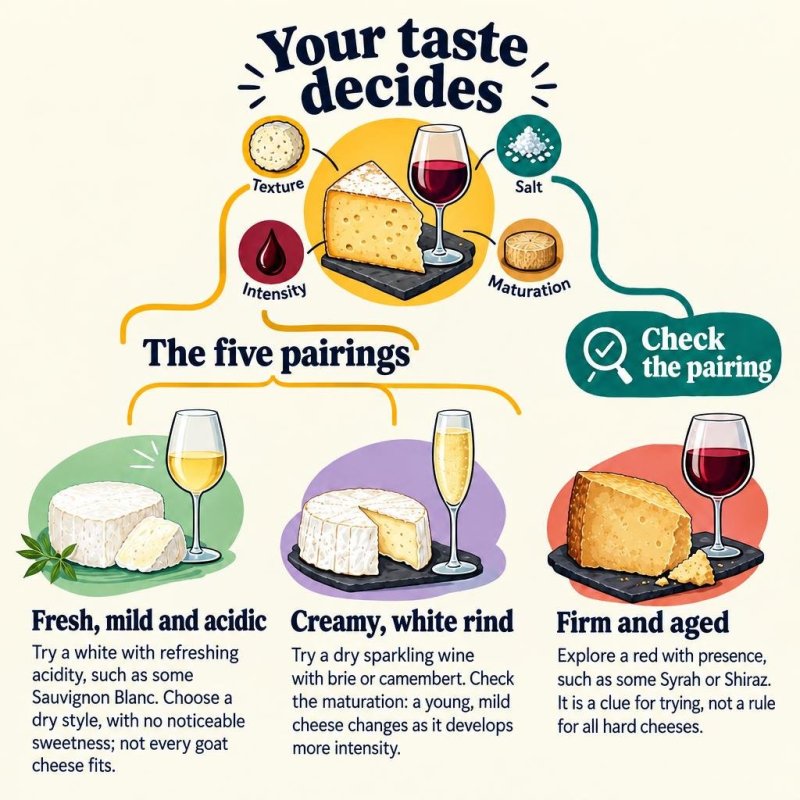
For a fresh, mild cheese with noticeable acidity, such as a fresh goat’s cheese or something with a similar profile, try a white wine with marked acidity. Some Sauvignon Blancs or a dry Riesling fit that idea of shared freshness well. If you want an alternative, do not focus only on the animal the milk comes from: look for a clean, light, slightly tangy cheese and a lively white with no obvious sweetness. This guideline does not automatically carry over to more mature or more intense goat’s cheeses.
With creamy white-rind cheeses such as Brie, Camembert or similar styles, a dry sparkling wine is a good place to start. The creamy texture and the style of wine often make an appealing pair, but it is worth checking the condition of the cheese before repeating the match without thinking. A young, mild cheese does not behave like a very ripe one with a more developed aroma and deeper flavour. Bubbles help at many tables, but they are not a universal key for every texture or intensity.
If the cheese is firm, mature and strongly flavoured, such as an aged cheddar or something comparable, you can explore a red with some presence, for example certain Syrah or Shiraz wines. There is a useful study that supports trying that specific pairing, but its reach is limited: it does not prove that all hard cheeses call for powerful reds, or that every bottle of that variety will behave in the same way. If you substitute the example, keep the firmness, maturity and intensity of the cheese in mind, and test again.
With an intense, salty blue cheese, the contrast with a sweet wine remains a classic reference worth trying if you enjoy sweetness. That could be a sweet white or a sweet-style Port, as long as the main idea is the contrast between salt and sweetness. Still, the fact that it is a celebrated pairing does not mean everyone will like it, or that every sweet wine is automatically the best option for every blue cheese.
For washed-rind cheeses, meaning cheeses whose surface is washed during maturation, and for their penetrating aroma, an aromatic white is often suggested, for example certain Gewürztraminer wines. The useful clue here is aromatic expressiveness, not an automatic jump in alcohol or the idea that a strong smell must demand a more powerful red. It is also worth checking the wine’s sweetness, because the grape name alone does not tell you whether it will be dry or slightly sweet. If you like intense aromas but not sweetness, look for a drier version of that style.
| Cheese profile | Wine style | What to watch |
|---|---|---|
| Fresh, mild and with noticeable acidity | White with marked acidity | Do not transfer the idea to an aged goat’s cheese just because of the milk source. |
| Creamy white-rind | Dry sparkling | Maturity can change the result a lot. |
| Firm, mature and strongly flavoured | Red with presence | Not all hard cheeses or all Syrah/Shiraz wines behave the same way. |
| Intense, salty blue | Sweet white or sweet-style Port | It works best if you enjoy the contrast with sweetness. |
| Washed-rind and penetrating aroma | Aromatic white | Check whether the wine is dry or has some sweetness. |
Test the pairing with a bite and a sip
The most practical way to decide at home is simple. Taste the wine on its own first. Then taste the cheese on its own. After that, take a small bite of cheese and go back to the wine. This sequence does not turn your table into a laboratory, but it does let you compare before and after, which is exactly what matters when you want to know whether the pairing truly convinces you.
When you return to the wine, notice three things: whether you like it more, less or the same; whether it feels rougher or softer; and whether both products still remain pleasant on their own. In the cheddar and Shiraz study, researchers observed a reduction in astringency after the cheese, but also a shorter persistence of the wine’s flavour. In other words, a change is real, but change does not always mean every aspect improves.
Do the first test without honey, jams, dried fruit or other accompaniments. Add them later, once you are clear about the basic relationship between the cheese and the wine. That way, you can understand what each extra element contributes. Sugar, salt, acidity and fat in food can all change the way wine is perceived, so those extras are not a mistake, but they do alter the pairing and are worth noticing separately.
Quick test at home
- Taste the wine on its own first.
- Then taste the cheese on its own.
- Take a small bite and go back to the wine.
- Decide whether you like the pairing more, less or the same as each one separately.
- Add honey, jam or dried fruit only after that first comparison.
If you are serving only one wine, adapt the cheese selection
When you only want to open one bottle, the most sensible move is to start with a wine you already like and build a short cheese selection around it. You can use one of the five pairings in this guide as your base and stay close to that profile. If you choose a fresh white, it makes sense to gather fresher or less intense cheeses; if you choose a red with more presence, you can try more strongly flavoured cheeses, without assuming that firmness or maturity alone guarantees affinity.
If you can taste before serving, even better. Sometimes it is enough to remove a pairing that never quite comes together, or to serve a particularly intense cheese separately. Do not assume that two cheeses of the same type are exact equivalents, or that two wines from the same grape variety will respond in the same way. The maturity of the cheese and the style of winemaking can shift the result quite a lot, even when the name looks identical.
Keeping track of your favourite pairings, even when they contradict classic advice, is part of learning. Professional guides and sensory studies help you start with better judgement, but they do not replace your own preferences. If a well-known pairing leaves you cold, use it as a reference point for adjustment: less intensity, more freshness, more sweetness or less astringency. That is often where your own version of the perfect pairing appears.