How to spot five common flavour faults in beer
Cardboard, butter or a vegetal note can reveal more than you might think when you pause, smell carefully and compare them with the beer’s expected profile.
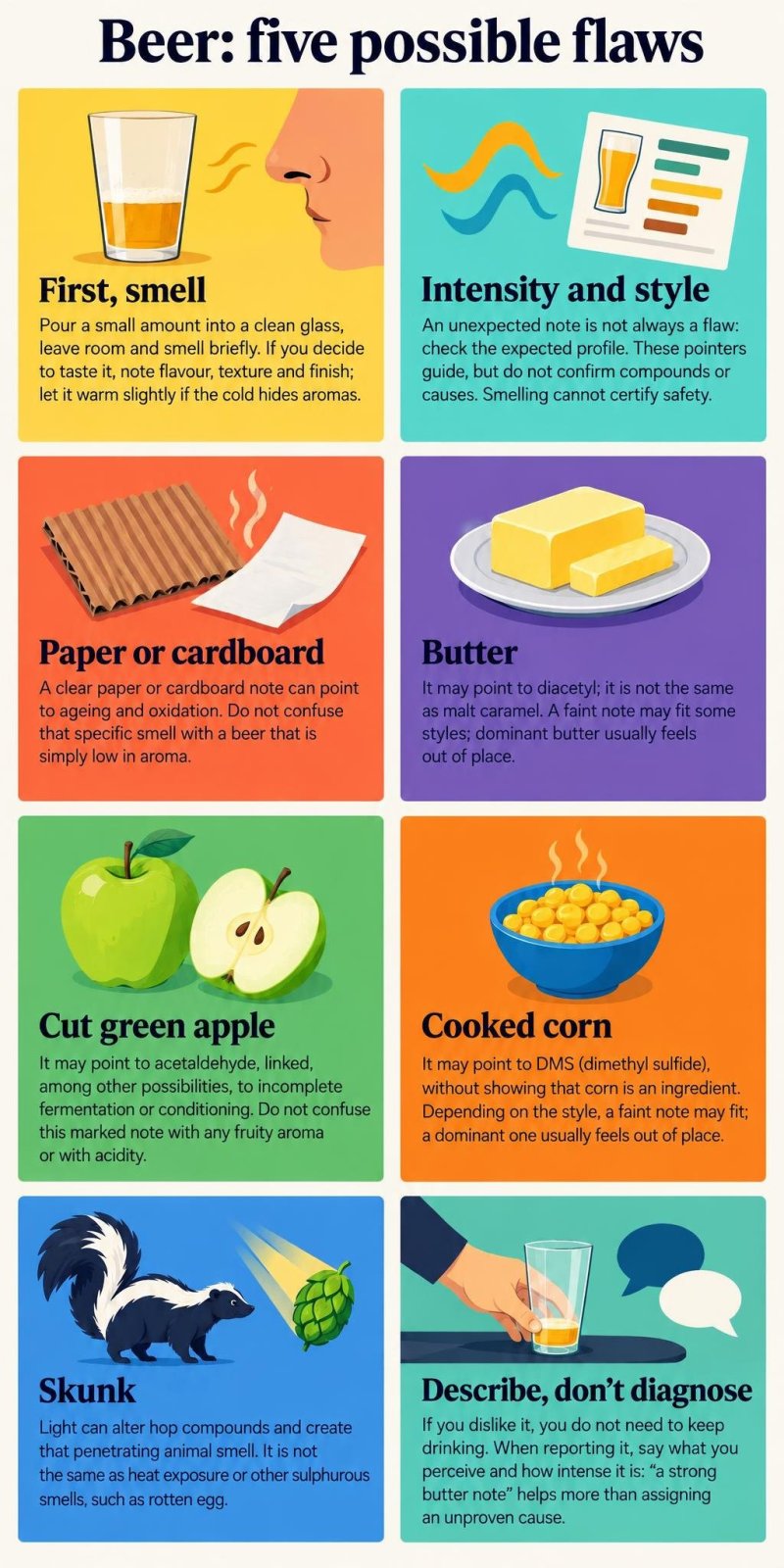
You do not need a chemistry background or formal tasting training to notice when something feels off in a beer. This guide helps you recognise five sensory signs widely used in beer education, tell them apart from features that belong to certain styles, and describe a disappointing pint in simple words.
An unusual note is not always a fault
These five cases are not a global ranking and they do not cover every possible problem in beer. They are a common teaching selection because they help train sensory memory through everyday references: cardboard, butter, green apple, cooked corn, and skunk.
Before calling an unexpected aroma a defect, it helps to look at two things: intensity and context. A faint note may be part of the profile of some beers, while that same note can feel out of place if it dominates. Not every beer is meant to smell or taste like a light, neutral lager either: fruit, spice, coffee, chocolate or a strong hop character can all be perfectly normal.
One more caution matters here: these associations are useful guides, but on their own they do not prove which compound is in the glass or why it is there. They help you describe what you perceive more clearly, not confirm a specific brewing, storage or service problem. And judging flavour is not the same as assessing safety; the absence of these aromas does not guarantee that a beer is safe.
Smell first and describe it; then taste if you want to
The simplest way to start is to pour a small amount into a clean glass and leave some space above the liquid so the aromas can gather. Bring the glass to your nose and take short sniffs. Much of what we call flavour is recognised first through smell, so it is worth pausing for a few seconds before the first sip.
If you decide to taste it, pay attention to three things: which flavours confirm what you smelled, what texture it leaves in the mouth, and how long it lingers. Sometimes a note barely shows on the nose and becomes clearer when you swallow; sometimes the opposite happens. If the cold is muting the aromas, let the beer warm slightly and smell it again. There is no need to force one fixed temperature or wait until it reaches room temperature.
Try to describe before you diagnose. Phrases such as “it reminds me of damp cardboard”, “I get strong butter”, or “it leaves a cooked-corn finish” are more useful than simply saying “it’s bad”. They are also more helpful if you ask what the intended profile was or decide to report the experience to the venue or brewer.
A simple way to observe more carefully
- Pour a small amount into a clean glass and leave space above the beer.
- Bring the glass to your nose and take short sniffs before the first sip.
- If the cold is muting the aromas, wait a little and smell again.
- If you taste it, focus on flavour, texture and persistence.
Paper or cardboard: a sign of ageing and oxidation
If a beer clearly reminds you of paper or cardboard, that usually points to the kind of deterioration associated with ageing and oxidation. Sometimes it is not just that dull, papery impression: the hop aroma may also seem faded and the beer may feel less lively overall.
The key is to look for a specific memory of cardboard or paper, not just conclude that the beer “doesn’t smell of much”. A quiet, simple or not especially expressive beer is not automatically oxidised. The hasty judgement comes when low intensity is mistaken for the recognisable smell of cardboard.
There is one small but important exception: some beers made for ageing can develop integrated oxidative notes over time. That still does not turn dominant cardboard into a virtue.
Butter: when to suspect diacetyl
The easiest reference here is butter. It can also recall buttered popcorn or butterscotch, but for a beginner it is best to start with that simple image: a beer that smells or tastes like butter when it should not.
Then comes the technical name, diacetyl, a compound linked to fermentation. In some cases the mouthfeel may seem slightly slick or oily, but that texture only supports the impression; it is not proof on its own. The most useful thing is still to recognise the buttery note clearly.
A common confusion starts here: butter is not the same as a general malty or caramel-like character. Many dark or malt-forward beers can show sweet, toasty or caramel notes without that meaning diacetyl. Suspicion rises when the butter stands out above the rest of the profile and feels out of place.
A very low presence may also be acceptable in some specific styles. For the drinker, the important thing is not memorising which ones, but understanding the difference between a faint hint and a dominant note. If it quietly supports the beer, it may fit; if it takes over, it is usually seen as a fault.
Butter is not the same as sweet malt
A sign of diacetyl
It recalls butter or buttered popcorn.
Suspicion grows when it stands out and feels out of place in the whole beer.
Malt character
It can bring sweet, toasty or caramel-like impressions.
On its own, that does not mean there is a fault.
Fresh-cut green apple: the clue to acetaldehyde
When the impression resembles freshly cut green apple, the useful reference is acetaldehyde. That specific image works better than talking about “fruit” in general, because many beers are legitimately fruity and there is nothing wrong with that.
A marked green-apple note can be linked to incomplete fermentation or maturation, among other possibilities. It is wise to stop there. From a single glass you cannot prove the exact cause, so it is best to avoid firm claims about what happened during production.
It also helps not to confuse this clue with acidity or with any kind of apple note. A beer that feels fresh, citrusy or softly reminiscent of white fruit is not defective by default. The most useful sign is that distinct sense of fresh-cut green apple standing out and clashing with the whole.
Cooked corn: how to recognise DMS
If the aroma brings to mind cooked corn, tinned corn or a similar cooked vegetable note, the usual reference is dimethyl sulfide, shortened to DMS. You do not need to remember the chemical name to spot it: it is enough to recall that kitchen-like, vegetal and slightly sweet impression, closer to hot corn than to dry grain.
In the briefest technical explanation, DMS can form from substances present in malt. But for drinking with better judgement, what matters is something else: a low note may sit comfortably in some profiles, while an obvious and persistent presence usually feels far less appropriate. Once again, intensity is decisive.
Another common misunderstanding is worth clearing up: a beer smelling of corn does not prove that corn was used as an ingredient. In the same way that a wine can remind you of vanilla without being made from vanilla, an aroma association does not identify the recipe by itself.
Skunk: a fault caused by light
This may be the least familiar descriptor for some readers. A skunk is an animal known for a very strong, aggressive smell. Even if you have never encountered one up close, the useful idea is this: a sharp, animal-like and highly unpleasant character, different from a simple sulfur note.
When that impression appears, one documented explanation is light damage. Light can react with compounds derived from hops and create the aroma known in English as lightstruck. It is not the same thing as beer simply getting warm, so it is best not to use “lightstruck” as an automatic label for any beer that smells bad or sulfurous.
It is also worth separating this clue from other sulfur aromas. A rotten-egg smell, for example, is not the same as that skunky character. And while some packaging gives more protection from light than others, the colour of a bottle or can does not by itself confirm that this fault is present.
| Everyday reference | Tasting term | Important nuance |
|---|---|---|
| Paper or cardboard | Oxidation | A beer with little aroma is not enough to diagnose it. |
| Butter | Diacetyl | A very low level may fit some styles; a dominant one usually feels out of place. |
| Fresh-cut green apple | Acetaldehyde | It should not be confused with any fruity note or with acidity. |
| Cooked or tinned corn | DMS | That aroma does not prove corn was used as an ingredient. |
| Skunk | Lightstruck | It is not the same as heat damage or just any sulfur smell. |
If you do not enjoy it, describe what you notice
If a beer tastes unpleasant to you, there is no need to keep drinking in order to identify the exact compound. You can stop there. If you are unsure, checking the brewer’s description or asking what the intended profile was can help you work out whether you found a note that belongs to the style or one that stands out too much.
If you decide to report the problem, describing the perception and its intensity usually works better than asserting an unproven cause. “I get very strong butter”, “it reminds me of persistent cardboard”, or “there’s a very clear cooked-corn smell” are more useful comments than immediately blaming poor fermentation, bad storage or dirty lines.
These five references are a starting map, not a test. Some people will pick them up quickly and others will need to compare several beers or repeat the exercise calmly. What matters is building enough vocabulary to observe more carefully and decide whether what is in your glass is something you still want to drink.
If a beer is not pleasant for you
- You do not need to keep drinking to identify the exact compound.
- If in doubt, check the expected profile or ask how that beer is meant to be.
- Describe what you perceive and how intense it is: persistent cardboard, strong butter, clear cooked corn.
- Do not claim an unproven cause or treat this kind of tasting as a safety test.