Italy moves to cut historic terrace permit times to 45 days
The government gave preliminary approval to a draft that would let outdoor seating win automatic consent if officials miss the deadline
Friday, October 30, 2026
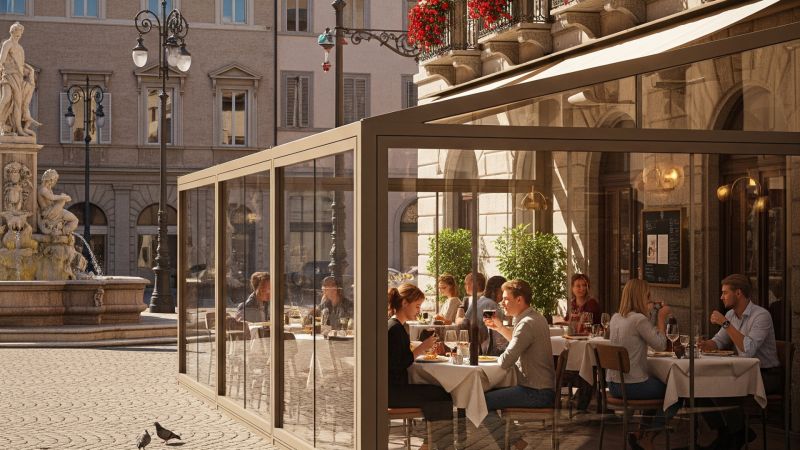
Italy is moving to shorten the approval process for outdoor restaurant terraces in historic areas, a change that could make it easier for bars, restaurants and hotels to plan investments after years of temporary extensions and uncertain rules.
On Wednesday, October 28, the Council of Ministers gave preliminary approval to a national reorganization plan for public-space concessions and the regulation of “dehors,” the outdoor seating structures used by hospitality businesses. According to the outline prepared jointly by the Ministry of Culture and the Ministry of Enterprises and Made in Italy, cultural and landscape authorizations tied to those structures would have to be issued within 45 days, compared with ordinary procedures that can run as long as 120 days.
The proposal would cut as much as 75 days from the current maximum timetable in the cases covered by the reform. It also includes a “silence-is-consent” mechanism, meaning the authorization would be deemed granted if the administration does not act within the deadline, according to the ministry framework described by industry and government materials.
The draft is aimed at one of the most sensitive areas of Italy’s hospitality economy: the use of public space near buildings and areas protected for their cultural or landscape value. The Ministry of Culture is responsible for heritage protection, while the Ministry of Enterprises and Made in Italy oversees the business side of the reform. Municipal governments would keep their powers over the occupation of public space, but the new national rules are meant to standardize how heritage-related approvals are handled.
The plan is not final. The October 28 approval was preliminary, and the measure still has to complete its legal and administrative process before it can take effect. Under the timetable cited by the sector, the government is expected to finish that process before December 31.
The change matters because outdoor seating has become a central part of the business model for many Italian hospitality operators. For restaurants and bars, terraces can expand capacity, support sales during peak seasons and help justify spending on furniture, weather protection, lighting and related upgrades. Operators have argued that repeated short-term extensions and long approval times have made it difficult to decide whether to invest.
On Thursday, October 29, FIPE-Confcommercio, the main federation representing public establishments in Italy, said it strongly welcomed the preliminary approval. The group said businesses were not asking for deregulation but for clear rules and fixed timelines that would allow them to invest with more confidence, modernize services and support employment.
FIPE also said the draft would help move the sector away from a cycle of temporary renewals and toward a stable legal framework. That point is important in a market where many operators have had to manage outdoor areas under emergency-era rules that were repeatedly extended rather than fully replaced.
At the same time, the government is trying to balance business demands with heritage protection, a politically sensitive issue in a country where many city centers are subject to strict visual and architectural controls. According to the ministry approach described in the materials, the stricter cultural and landscape authorizations would be focused on spaces directly adjacent to assets of exceptional cultural value, rather than being applied more broadly.
That narrowing is likely to be one of the most closely watched elements of the reform. Supporters say it would reduce unnecessary bureaucracy in places where the heritage risk is limited, while preserving tighter scrutiny around the most sensitive sites. Critics, if they emerge during the legislative process, are likely to focus on whether a shorter timetable and automatic consent could weaken oversight in historic urban areas.
The business federation has framed the measure not only as an economic issue but also as an urban one. In its statement, FIPE said outdoor seating areas should not be treated as simple occupation of public land, arguing that they can contribute to social life, safety and the day-to-day use of public spaces. It also said the draft recognizes the role of operators in maintaining urban decorum and quality hospitality while respecting the historic identity of Italian cities.
For investors and operators, the practical question is how predictable the new system would be if it is enacted. A 45-day limit would give businesses a much clearer schedule for planning seasonal openings, construction work and financing. It would also reduce the risk that projects stall for months while companies continue to pay rent and other fixed costs without knowing whether an outdoor area will be authorized.
The reform could be especially relevant for establishments in city centers, tourism zones and heritage districts, where outdoor seating often drives a significant share of turnover but approvals are more complex. Hotels with food and beverage service, independent cafes and full-service restaurants would all be affected, although the impact would vary by municipality because local governments would still control the rules on public-space concessions.
The proposal now moves into the next stage of approval, where the wording of the decree and the balance between simplification and preservation could still change. For now, what the government has put forward is a national attempt to replace temporary fixes with a permanent framework: quicker deadlines, automatic consent if authorities do not respond, and a more limited application of cultural and landscape checks to the areas closest to Italy’s most valuable heritage sites.