Bonhams Paris Will Auction a 1945 La Tâche From Domaine de la Romanée-Conti
The bottle, estimated at €15,000 to €20,000, comes from the first peacetime Burgundy vintage after World War II.
Friday, October 16, 2026
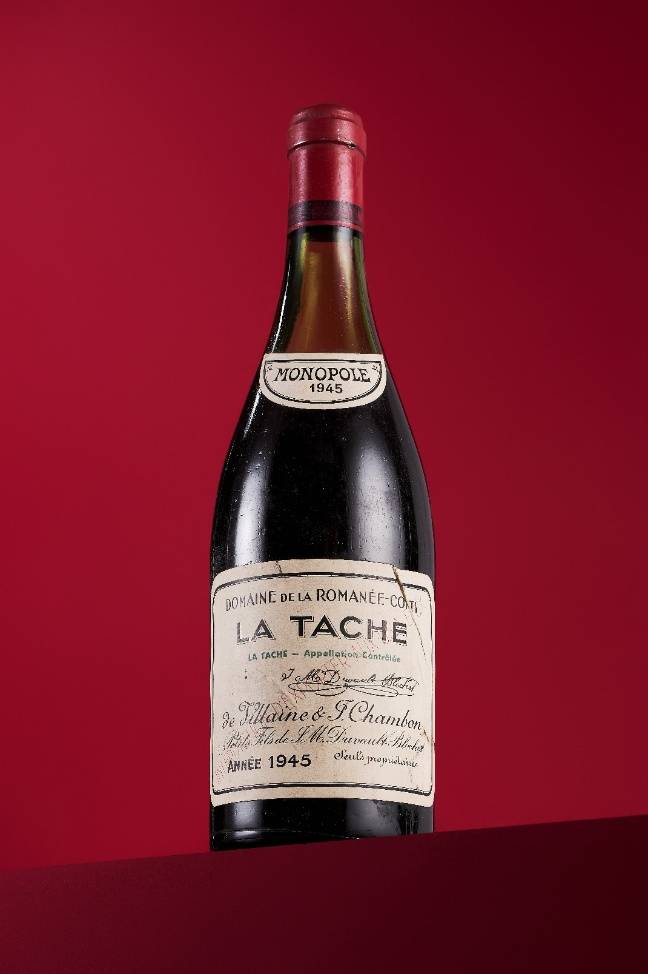
Bonhams Paris is set to auction a bottle of Domaine de la Romanée-Conti La Tâche 1945 on Nov. 7, offering collectors a wine the auction house describes as one of the most historically important bottles from Burgundy’s postwar era. The bottle, part of a private collection, carries an estimate of €15,000 to €20,000 and will be sold in an in-room auction at Bonhams’ Paris saleroom on Avenue Hoche.
The sale centers on a single vintage that holds an unusual place in both French wine history and the history of Domaine de la Romanée-Conti, the producer widely known as DRC. Bonhams said the 1945 La Tâche reflects a turning point for the estate and for Burgundy after World War II, when vineyards were recovering from years of disruption and hardship.
La Tâche had already been an important vineyard for centuries, but its modern identity took shape in the 1930s. Domaine de la Romanée-Conti acquired the historic parcel in 1933. Three years later, in 1936, the enlarged vineyard received its own Grand Cru appellation, formally establishing La Tâche as a monopole of the estate, meaning the entire vineyard was under the control of a single producer.
The 1945 vintage is especially prized because of both timing and scarcity. It was the first peacetime vintage after the end of World War II. Bonhams said spring frost and summer storms sharply reduced yields that year across Burgundy. The grapes that remained, however, reached high levels of ripeness and concentration, producing wines known for power and intensity in very small quantities.
That rarity is only part of the reason the bottle is drawing attention. Bonhams said 1945 also marked the end of an era at Domaine de la Romanée-Conti. After that harvest, the estate uprooted its very old ungrafted Romanée-Conti vines, which had survived the phylloxera crisis that devastated many European vineyards in the late 19th century. According to the auction house, vine material from La Tâche was later used in the replanting of Romanée-Conti in 1947 and 1948.
That transition gave La Tâche an even larger role within the estate. From 1946 through 1951, Romanée-Conti produced no wine, Bonhams said, making La Tâche the estate’s leading wine during that period. The newly replanted Romanée-Conti vines did not yield their first post-phylloxera vintage until 1952. In that sense, the 1945 La Tâche sits at the boundary between two eras: the last phase before major replanting and the beginning of the estate’s modern identity.
The auction house is also emphasizing the bottle’s provenance, a major factor in the market for rare wine. Bonhams said the bottle was given to its current owner in 1974 and has remained in the same cellar since then. It was stored, according to the company, undisturbed for more than 50 years in the cellars of a well-known wine estate in France. Bonhams said its specialists and an independent expert examined the bottle to document its history and support its authenticity.
Amayès Aouli, Bonhams’ global head of wine and spirits, said in a statement that opportunities to handle and bring a bottle of La Tâche 1945 to market are exceptionally uncommon. He said the house considered the wine significant not only for its rarity, but also for the way it connects the history of one estate to a broader historical moment after the war.
The bottle will be offered in a sale titled “Domaine de la Romanée-Conti & Domaine Leroy: Two Private Collections, featuring La Tâche 1945.” Bonhams said the broader auction will include other wines from Domaine de la Romanée-Conti and Domaine Leroy, two of Burgundy’s most closely watched names in the secondary market.
Fine wine has remained a strong niche within the global auction business, with buyers paying special attention to provenance, storage conditions, and independent review as concerns over counterfeits and relabeled bottles continue to shape the high-end market. Older Burgundy, especially from DRC, can attract intense interest because of its limited production, the fragility of surviving bottles, and the producer’s standing among collectors.
Bonhams, founded in 1793, operates sales in several major markets, including Paris, London, New York, Hong Kong, and locations in the United States. Its wine department has spent more than two decades handling auctions of fine wine, according to the company. The Nov. 7 sale in Paris is scheduled to begin at 2 p.m.
For collectors, the appeal of this bottle lies in more than age alone. It comes from a vintage shaped by war’s aftermath, weather-related scarcity, and a major change inside one of Burgundy’s most famous estates. Those elements, together with a long documented stay in a single cellar, are likely to determine how much interest the bottle draws when it comes to the block in Paris next month.