Japan’s Sake Industry Uses World Sake Day to Court Younger Drinkers
The campaign follows a 12% drop in domestic shipments since 2020, with exports gaining ground in France.
Tuesday, October 6, 2026
Japan’s sake industry is using World Sake Day on October 1 to push for new drinkers at home and broader acceptance abroad as domestic shipments fall and exports continue to grow, according to a release issued by the Japan Sake and Shochu Makers Association.
The industry group, known as JSS, said the annual observance was established in 1978 to preserve sake culture and pass it to future generations. October 1 was chosen because it once marked the start of the brewing year, although the production calendar now runs from July 1 through June 30.
In this year’s campaign, the association is focusing on two challenges at once: how to make nihonshu, or Japanese sake, more familiar to younger consumers in Japan, and how to move it beyond its traditional role as a companion to Japanese food in overseas markets.
Only sake made with Japanese-grown rice and brewed and bottled in Japan can be labeled nihonshu, the association said, adding that the term is protected as a geographical indication. JSS Director Hitoshi Utsunomiya said the group wants to use World Sake Day to promote the drink’s appeal in Japan and overseas.
The push comes as the domestic market remains under pressure. JSS said shipments of nihonshu in Japan totaled about 40 million cases in 2025, calculated at 9 liters per case, down 12% from 2020. From January through June 2026, shipments fell another 5.8% from the same period a year earlier.
To address that decline, the association and brewers are trying to present sake in forms that may feel more accessible to younger adults. One of the main examples is “Sake High,” or sake highball, which mixes nihonshu with carbonated water. JSS said a sake with 15% alcohol content becomes about 7.5% alcohol when mixed at a 1:1 ratio with sparkling water. The association said the effort, which began in earnest in 2024, has spread to more than 10,000 outlets across Japan.
The industry is also trying to make large public events more attractive to younger visitors. At Sake Fair 2026, held in June, discounted tickets were offered to people ages 20 to 39. The association said such measures are intended to create more chances for consumers to try sake firsthand rather than encounter it only as a traditional or formal drink.
Alongside the effort to broaden consumption, the industry is also emphasizing the preservation of brewing skills after a major cultural designation. In December 2024, Japan’s “traditional knowledge and skills of sake-making with koji mold in Japan” was added to UNESCO’s Representative List of the Intangible Cultural Heritage of Humanity.
JSS said that recognition has added urgency to training younger workers in both the theory and practice of brewing. The National Research Institute of Brewing, according to the release, runs lectures and hands-on training based on brewing research, production theory and management. The practical side of the training focuses on controlling the microorganisms central to sake brewing and learning techniques through direct sensory experience.
The institute said many recent participants have had relatively limited years of experience. Some want a stronger grasp of the basic principles of sake production, while others want exposure to methods they cannot learn at their own breweries. The institute also said participants have become more active in exchanging views with instructors and one another, especially in sessions focused on sensory evaluation of aroma and flavor.
While domestic demand has weakened, exports have continued to climb in value. JSS said nihonshu exports reached about JPY45.9 billion in 2025, with volume at about 3.73 million 9-liter cases. Both figures were higher than the year before. In the first half of 2026, export value rose 4.2% from a year earlier to JPY23.8 billion, although export volume edged down 0.8% to about 1.85 million cases.
The association said it has tried to support overseas growth by working with sommeliers, who can introduce sake to diners through pairing menus and beverage programs. JSS has had a partnership with the Union de la Sommellerie Française since 2020 and with the Association de la Sommellerie Internationale since 2022.
France has become one of the main test cases for that strategy. Keiichiro Miyagawa, a sommelier and importer based in France who also works with JSS, said local restaurants have increasingly looked for alternatives to wine and that sake has begun to be seen as a credible option rather than a novelty. He said years of work by importers have helped chefs and sommeliers understand how sake can be explained to customers in their own terms.
Miyagawa said current research shows nihonshu is now served at about 22% of three-Michelin-starred restaurants in France, about 22% of two-starred restaurants, and about 33% of one-starred restaurants in Paris. He said those figures would have been difficult to imagine 15 years ago and suggest that sake is starting to move from the category of a foreign specialty into a regular pairing choice in top restaurants.
He also said signs of change are appearing in retail. Companies that traditionally sold wine online have started asking about handling nihonshu, he said, and wine shops are gradually beginning to stock it. According to JSS, the value of nihonshu exports to France in 2025 was about three times the 2020 level, making France the largest market for Japanese sake in Europe.
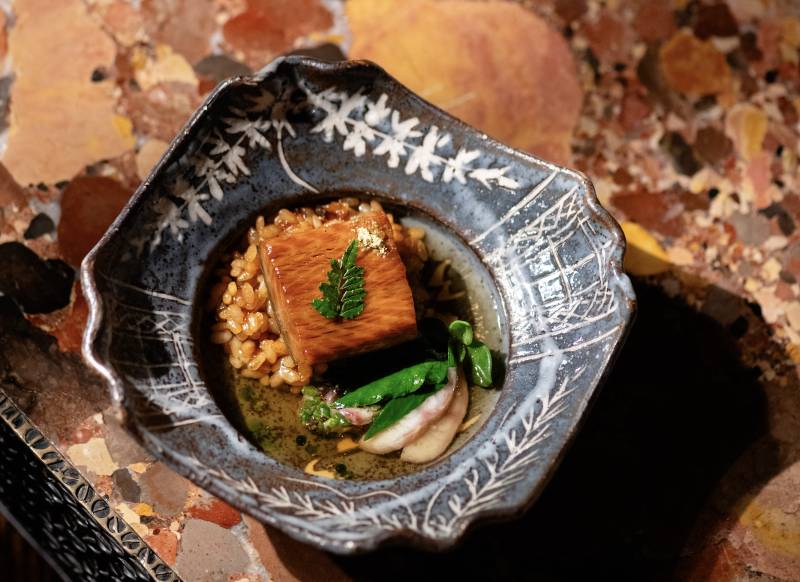
Some of the strongest support for sake’s expansion beyond Japanese restaurants is coming from high-end hotel dining rooms in Paris. Emmanuel Cadieu, wine director at Cheval Blanc Paris, said he particularly values a pairing of eel and aged sake at the hotel’s Japanese restaurant, Hakuba. The dish uses ikejime eel that is aged and simmered in a sauce containing soy sauce, mirin and sake. Cadieu said the roasted hazelnut and sweet spice notes found in aged sake can align closely with the depth of the sauce.
At the same time, Cadieu said he does not want diners to think of sake as a beverage only for Japanese cuisine. He described texture and umami as two of sake’s defining strengths and said those qualities can complement a dish and lengthen its finish in ways that create many pairing possibilities.
Florian Guilloteau, who oversees the sommelier department at Ritz Paris, made a similar argument. He pointed to a dish at the hotel’s restaurant, Espadon, that combines oily fish, blackcurrant and coffee. He said the texture and depth of sake can connect the richness of the fish, the bitterness of the coffee and the fruit of the blackcurrant.
Guilloteau said one of sake’s main advantages is its ability to enhance flavors already present in a dish. Where wine often creates contrast through acidity, tannin and aromatic intensity, he said, sake more often extends and amplifies what is already on the plate. That can reveal different aspects of both the food and the drink.
Both sommeliers said sake has potential with a much wider range of foods than many diners assume. Guilloteau said fuller, more structured styles can work with roasted or grilled meat and sauces built from meat juices. Cadieu said richer and creamier styles can suit fish cooked with browned butter or creamy risotto, while aged sake can pair with reduced meat jus, roasted vegetables and aged cheeses. Their comments reflect one of the industry’s main overseas goals this year: positioning nihonshu not simply as a marker of Japanese tradition, but as a versatile beverage that can fit into local dining cultures and fine-dining service outside Japan.