European Parliament weighs wine’s role in health policy
Panelists urged officials to distinguish moderate drinking with meals from harmful alcohol use in disease prevention rules.
Tuesday, September 29, 2026
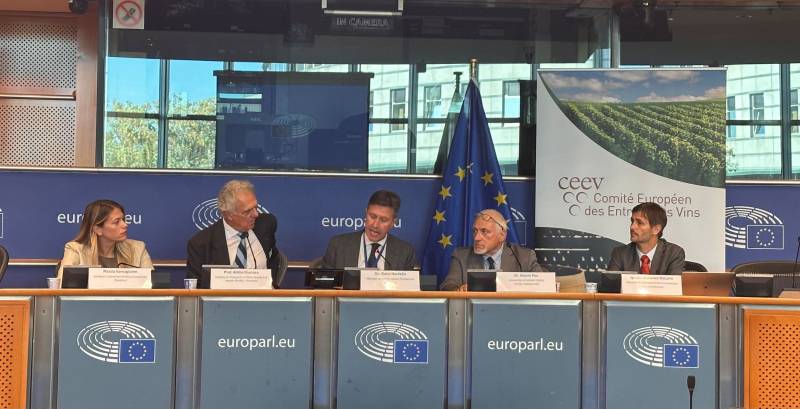
Scientists, lawmakers and wine industry representatives met at the European Parliament in Brussels on Tuesday for a debate over how wine should be treated in public health policy as European institutions step up work on cancer, cardiovascular disease and other non-communicable diseases.
The event, titled “Health debates: Can wine be part of a healthy lifestyle?”, was hosted by Italian lawmaker Dario Nardella of the center-left Socialists and Democrats group and organized by the Comité Européen des Entreprises Vins, the main trade body for European wine companies. According to the organizers, the discussion focused on whether policymaking should weigh drinking patterns, diet, social habits and broader lifestyle factors, rather than treat all alcohol consumption in the same way.
The meeting took place as alcohol policy remains under close review in Europe and internationally. Public health authorities have pushed for stronger prevention measures tied to alcohol’s role in cancer and other diseases, while producers and some lawmakers have argued that regulation should distinguish between harmful drinking and moderate consumption with meals. That disagreement has become more visible in debates over health warnings, consumer information and how to frame alcohol risks in official guidance.
Speaking at the close of the event, Nardella said public health protection had to remain a central political responsibility, but added that prevention policy should be based on scientific evidence and reflect what he called the complexity of people’s diets, lifestyles and behavior. He also said wine was part of Europe’s agricultural, economic and cultural heritage, especially in rural producing regions.
The scientific panel featured Gianni Pes, a senior researcher at the University of Sassari known for work on so-called Blue Zones, and Attilio Giacosa, a gastroenterologist and president of the Istituto per la Ricerca su Vino, Alimentazione e Salute. Both speakers argued that research on longevity cannot be reduced to a single factor and should be read in the context of broader living patterns.
Pes pointed to Sardinia, one of the regions often cited in Blue Zones research, and said long life there has been associated with daily physical activity, traditional food, family and community ties, and social interaction. He said wine has traditionally been present in that setting, generally consumed moderately and with food, but described it as only one part of a larger pattern. He said the link between wine and health remained scientifically complex and debated.
Giacosa said science should deal with that complexity rather than rely on simplified messages. He said alcohol abuse was clearly harmful and that some people should not drink at all. At the same time, he said researchers should examine dose, drinking patterns, whether alcohol is consumed with meals, and the overall dietary and lifestyle context before drawing policy conclusions.
Those arguments reflect a long-running dispute in alcohol research. For years, some observational studies suggested that light or moderate drinking, especially in Mediterranean settings, might be linked to certain cardiovascular benefits. More recent reviews and public health agencies have questioned those findings, saying the evidence can be distorted by differences in income, diet, exercise, smoking history and the way former drinkers are grouped in studies. Major health bodies, including the World Health Organization, have also stressed that alcohol is a carcinogen and that risk can rise even at low levels of consumption.
That tension was present throughout Tuesday’s discussion. Marzia Varvaglione, president of CEEV, said the industry recognized the risks tied to harmful alcohol use and supported moderation, education and informed choices. She said European policy should distinguish between harmful consumption patterns and wine consumed moderately within what she called a balanced lifestyle. She also said the sector was not trying to encourage drinking, but to preserve a culture in which adults who choose wine can consume it responsibly.
The organizers linked the discussion to current policy debates beyond cancer, including cardiovascular disease and broader non-communicable disease strategies. The event program also referred to the World Health Organization’s ongoing work and to recent international discussions on prevention policy. It framed the session as an effort to keep the debate “grounded in science” at a time when wine is facing stronger health scrutiny.
The Blue Zones theme played a central role in the program. Organizers cited Sardinia in Italy, Ikaria in Greece and Nicoya in Costa Rica as examples of places studied for healthy aging and longevity. Their argument was that these regions should be understood through a combination of food habits, movement, environment and social relationships, with wine, where it is present, treated as one element rather than the defining cause.
Ignacio Sánchez Recarte, CEEV’s secretary general, said after the event that Europe needed open dialogue between scientists and policymakers as it develops its approach to cancer, cardiovascular disease and other non-communicable illnesses. He said a “whole-of-society” approach was needed and that stakeholders should be part of the discussion alongside researchers and public officials.
CEEV said it represents European Union wine, aromatized wine and vinegar companies through 24 national associations, two sectoral associations and a consortium of four major wine companies, with members from 13 EU member states as well as Switzerland, the United Kingdom and Ukraine. The group says its members account for more than 90% of European wine exports, a position that gives it a strong interest in how health policy debates in Brussels shape labeling, marketing and consumer perception across the bloc.