European wine leaders press for a new policy framework as consumption falls 14%
At a summit in Italy, industry executives and policymakers urged Brussels to bolster competitiveness, climate resilience and market access
Thursday, June 25, 2026
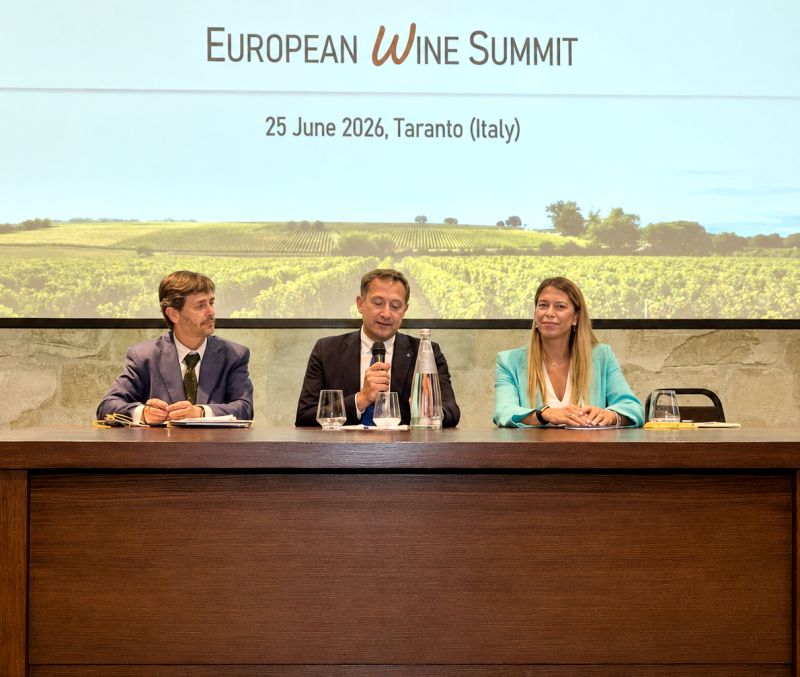
More than 130 representatives from European and national institutions, wine companies, growers, academics and trade groups met Thursday in Taranto, Italy, for the European Wine Summit, where industry leaders and policymakers called for a new policy framework to help the European Union wine sector cope with falling consumption, climate pressure and trade uncertainty.
The meeting was organized by the European Committee of Wine Companies, known as CEEV, with its Italian members Federvini and Unione Italiana Vini. Participants included Christophe Hansen, the European commissioner for agriculture and food; Italy’s agriculture minister, Francesco Lollobrigida, by video message; Matteo Zoppas, president of the Italian Trade & Investment Agency; members of the European Parliament; and executives from across the wine supply chain.
The summit took place as the global wine business faces a prolonged downturn. According to figures presented at the event, worldwide wine volumes fell from 242 million hectoliters in 2016 to an estimated 208 million hectoliters in 2025, a decline of 14% over the past decade. International wine trade, after reaching a record value of €38 billion in 2022, is projected to fall to €33.8 billion by 2025.
Speakers said those shifts are being driven by structural changes in demand as well as external pressures including climate change and geopolitical instability. In that setting, organizers argued that Europe’s wine model, which ties local production to export markets through integrated value chains, remains central to the sector’s resilience. They said that system supports a €130 billion contribution to the European economy by linking growers, producers, brands and overseas consumers.
Much of the discussion centered on whether European Union policies, especially the Common Agricultural Policy, reflect current market conditions. Participants said future measures should do more to support investment, innovation, competitiveness and market access while addressing structural imbalances without weakening production capacity.
The summit also focused on consumer trends and health policy. Organizers said participants discussed how to improve wine’s appeal among adult consumers and called for a science-based approach to health-related regulation. They also stressed the need for proportionate and harmonized rules across the bloc and for sustainability goals that remain economically viable for producers and companies.
Marzia Varvaglione, president of CEEV, said the industry needed to confront its problems without losing confidence in its future. She said European wine represents history, culture, territory and craftsmanship, and argued that the sector must reconnect with society and attract new adult consumers.
Hansen said in Taranto that European wine is part of the bloc’s cultural heritage, regional identity and rural economy. He said he had come to listen directly to producers facing market, climate and consumer challenges and pointed to the European Commission’s proposed Wine Package as a tool to help member states and businesses adapt and strengthen competitiveness.
Ignacio Sánchez Recarte, CEEV’s secretary general, said the discussions showed broad agreement across the value chain and among policymakers that Europe needs a coherent long-term strategy for wine. He said the sector still has strong assets despite deep changes in the market.
The program included a market overview from Tiziana Sarnari of ISMEA and two panel discussions: one on reforming the Common Agricultural Policy safety net for wine production and another on wine’s place in science and health policy. Speakers included lawmakers Dario Nardella and Michele Picaro; Luca Rigotti of Copa Cogeca’s wine working party; Samuel Masse of the independent growers’ group CEVI; Piero Mastroberardino of CEEV; Attilio Giacosa of IRVAS; Sandro Sartor of Wine in Moderation; and Fabiola Sfodera of Sapienza University.
Organizers said the conclusions from Taranto will feed into ongoing debate over future European policy for wine as institutions and industry groups weigh how to respond to declining consumption, rising costs, regulatory complexity and unstable trade conditions.