Champagne Harvest 2023: A dance between Rot and Ripeness
The early harvest debate: Acidity vs. Alcohol Content
2023-09-13
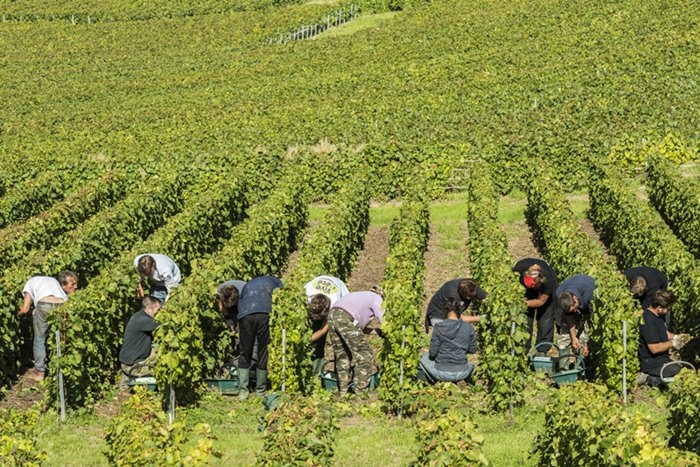
This year's Champagne harvest commenced with a blend of anticipation and concern. As the vineyards of Montgueux—a region celebrated for its exceptional Chardonnay—gave way to this year's produce, several factors came into play to shape the nature of the 2023 vintage.
Growers in Montgueux sought to start their harvest a day earlier than the official kick-off date of September 2nd, with the aim of preserving acidity and mitigating the effects of grey rot. These reasons have been met with a degree of skepticism by experts, given the relatively minimal grey rot in Chardonnay vineyards and the increased acidity levels compared to recent years.
Oenologists, or wine experts, believe in a rather proactive approach. Their argument centers on the idea that it's more beneficial to prioritize clean fruit with higher acidity levels over a slightly elevated alcohol content. As Michel Parisot, the Technical and Vineyard Director at Union Auboise—the largest cooperative in the Aube—pointed out in the Journal l'Est Eclair, the past few years have witnessed a dip in acidity. Thus, picking grapes earlier can add a refreshing touch to the non-vintage wines, impacting not just this year but many more to follow.
Buffering Against Inconsistencies
In light of the unusual yield this year, the INAO approved an increase in the maximum volume of réserve individuelle (RI), a system that lets vineyards store excess grapes for years when the yield doesn't meet commercial requirements. With commercial yields set by market expectations, rather than actual vineyard outputs, this allows growers some leeway to maintain quality.
For context, while the commercial yield this year is pegged at 11,400 kg/ha, the estimated actual yield is nearly double that. This gap allows growers to add significant volumes to their RI.
A Year of Record Bunch Weights
Two main factors—stellar flowering conditions and consistent rainfall—have contributed to a record average bunch weight for 2023, which is a staggering 30% higher than the previous record set in 2005. But while the initial part of the season was smooth, August witnessed erratic weather patterns. The combination of heavy showers and hot, humid weather created prime conditions for grey rot, especially in vineyards with abundant yield. This, paired with a concurrent heatwave, further exacerbated sour rot pressure.
State of the Vineyards
Recent data from the réseau MATU, Champagne's official pre-harvest monitoring tool, alongside insights from the Comité Interprofessionnel du vin de Champagne (CIVC) shed light on the condition of vineyards as the harvest began. The large yields this year have impacted the development of the potential alcohol degree, potentially affecting picking dates for certain vineyards. Additionally, the increasing prevalence of rot is a significant concern for growers.
Observations from the Field
Despite the challenges, some vineyards report positive signs. Sébastien Dubuisson, the CIVC's Quality and Sustainable Development Director, has emphasized that while potential alcohol levels may be on the lower end, the phenolic ripeness observed this year surpasses that of previous years with higher alcohol potential.
The key, as both growers and experts such as Dubuisson suggest, is maintaining a delicate balance between achieving ripeness and fending off rot. If managed well, 2023 might just produce a vintage to rival the legendary 2002 or 1985. The catch, however, lies in meticulous selection during harvest. While the tradition of stringent picking has waned over the years, its reimplementation this season may be pivotal.

Founded in 2007, Vinetur® is a registered trademark of VGSC S.L. with a long history in the wine industry.
VGSC, S.L. with VAT number B70255591 is a spanish company legally registered in the Commercial Register of the city of Santiago de Compostela, with registration number: Bulletin 181, Reference 356049 in Volume 13, Page 107, Section 6, Sheet 45028, Entry 2.
Email: [email protected]
Headquarters and offices located in Vilagarcia de Arousa, Spain.