Why herbal liqueur turns milky white when you add water
The ouzo effect explains how aromatic oils behave when a drink is diluted or chilled, and why the same cloudiness can also appear in absinthe, gin or limoncello

Views › 252
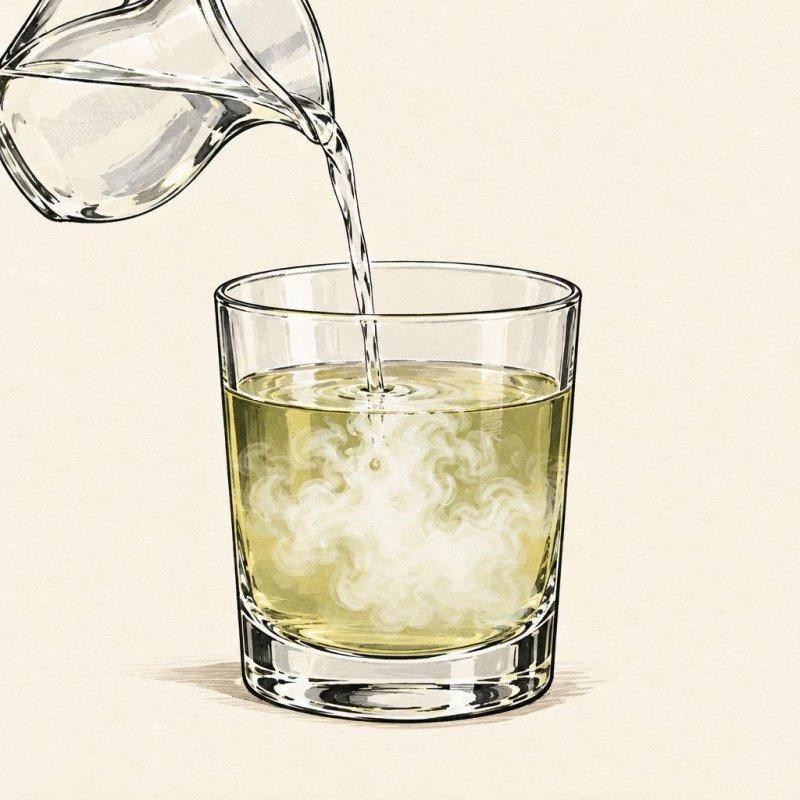
Sometimes all it takes is a splash of water for a herbal liqueur to shift from clear to cloudy, as if milk had been mixed in. That change is usually neither magic nor a trick of the bottle: it has a physical explanation known as the ouzo effect or the louche effect, and it can also appear in other aromatic drinks when the conditions of the mixture change.
The cloud in the glass has a name
When a herbal liqueur turns cloudy after water is added, it may be a spontaneous emulsion. Put simply, certain aromatic substances that were evenly dissolved in the drink no longer stay dissolved in quite the same way and instead form tiny droplets throughout the liquid, without vigorous shaking and without any emulsifier being added. This is usually called the ouzo effect or the louche effect.
The name became famous through anise-flavoured drinks, but the idea is not limited to one recipe. In some anise-based herbal liqueurs, researchers have identified a composition consistent with this mechanism, and absinthe has been studied specifically during dilution. That helps explain why the same scene can play out in different glasses without meaning that every herbal drink will behave in the same way.
Three terms that help explain the cloud in the glass
Ouzo effect
The usual name for the clouding that appears when certain aromatic drinks change mixture.
Louche effect
Another name for the same phenomenon, strongly associated with anise-flavoured drinks and absinthe.
Spontaneous emulsion
The formation of tiny droplets throughout the liquid without vigorous shaking and without adding an emulsifier.
What water does to aromatic oils
These drinks have three main players: water, ethanol and aromatic compounds that are not very soluble in water. As long as there is enough alcohol, ethanol acts as a medium that helps keep those compounds dissolved. That is why the liquid can look bright and clear before anything is added.
When water is poured in, the volume does not just increase: the solvent power of the mixture changes. The proportion of ethanol falls, and some aromatic substances no longer find the same environment to remain dissolved. Part of them can then regroup as very small droplets spread through the drink. That shift is at the heart of the ouzo effect.
One important point is worth making. The clear starting state should not be pictured as lots of invisible droplets simply waiting to grow. In the systems that have been studied, those compounds can genuinely be dissolved before dilution. The droplets appear when the conditions of the mixture change, not because already suspended droplets suddenly become visible.
Anethole is the classic example used to explain this because it has been widely studied in anise-flavoured drinks, but it is not a synonym for essential oil and it does not, on its own, describe every recipe. The amount of aromatic material matters, but so do its exact nature, the water-to-alcohol ratio and the temperature. That is why a very fragrant drink will not always turn milky, while another with a lighter aromatic load may do so under certain conditions.
Why those droplets look like milk
Once they form, those droplets change the way light passes through the liquid. Instead of moving through it cleanly, light is scattered by the many tiny particles spread through the mixture. The eye reads that as haze, opalescence or a whitish appearance reminiscent of milk.
The comparison with milk is purely visual. It does not mean the drink has a similar composition or that a new, pure white substance has been created. Depending on the liqueur and its pigments, the cloud may leave a yellowish, greenish or cream tone, and sometimes the result looks more pearly than stark white.
It looks like milk, but it is not milk
The milky appearance happens because many tiny droplets scatter light and reduce transparency.
The drink may still keep yellow, greenish or cream tones; the comparison with milk is only visual.
From anise to citrus: it is not exclusive to one drink
The best-known case is anise-flavoured spirits, because trans-anethole has been used as an experimental model for the phenomenon. That scientific basis fits well with herbal liqueurs that include an anise base: in some formulations that have been studied, anethole stands out among the volatile compounds. Even so, that does not justify putting every herbal liqueur on the market into the same box, because their recipes can differ greatly.
Absinthe offers another well-documented example. When water is added, it can develop the classic louche cloud, and studies show that this haze depends on how it is diluted and also on temperature. It is solid evidence for understanding the mechanism in a real drink, but not for setting a universal alcohol level or serving temperature that applies to every bottle.
The same principle can appear beyond the world of anise. Some gin formulations, especially those carrying a substantial load of botanical oils, turn cloudy when they come into contact with water and ice. That does not make all gins, or even all craft gins, certain candidates for the same effect: it is an example of a specific composition, not a rule for the whole category.
Limoncello shows that lemon oils can also take part in this kind of emulsion; other citrus liqueurs may behave in a similar way if their components and mixing conditions allow those droplets to form. Studies on limoncello have observed oil droplets in the formulations examined, which broadens the explanation beyond anethole. Some citrus liqueurs may also already appear somewhat cloudy before serving, so not every veiled appearance starts in the glass, and not every citrus recipe will respond in the same way.
Water, cold and ice: three situations worth separating
Adding water and chilling are not the same thing. When water is added, the proportions of the mixture change and the ethanol concentration falls; that alone may be enough for droplets to appear. Chilling a drink, by contrast, does not dilute it or reduce its alcohol proportion by itself. What cold can do, in some systems, is change the solubility of certain compounds and encourage haze even when the composition stays the same.
That has been observed in anise-flavoured drinks such as pastis and in studies on absinthe: as temperature drops, the onset and intensity of cloudiness can change. But it should not be turned into a simple rule such as “the colder it is, the whiter it gets”. The effect depends on the formulation and the exact conditions, and the thresholds are not universal.
Limoncello is a useful reminder of that limit. In the formulations that were studied, the temperature changes examined did not noticeably alter the microscopic structure that was observed. There is no contradiction with anise-based drinks: they are simply different mixtures. Cold can matter in some drinks and make very little difference in others.
Ice adds a second layer to the story. It cools the drink and, as it melts, adds water and dilutes it. Both things can play a role in the appearance of the cloud, but they are different mechanisms. If a glass turns cloudy over ice, there is no need to think the cold has somehow “taken alcohol away”; what is happening is a possible combination of cooling and gradual dilution.
| Situation | What changes | What may happen |
|---|---|---|
| Adding water | The ethanol concentration drops and the solvent power of the mixture changes. | Oil droplets may form and opalescence may appear. |
| Chilling | It does not dilute the drink or reduce the alcohol proportion by itself; it can change solubility. | In some drinks it encourages haze, while in others it barely changes the appearance. |
| Adding ice | It cools the drink and, as it melts, adds water. | The cloud may come from a combination of cooling and dilution. |
What the cloud does tell you, and what it does not
For anyone seeing it at home or in a bar, the practical reading is simple: if a herbal liqueur, an anise-flavoured spirit, an absinthe or a citrus liqueur turns opalescent when water is added or when it is chilled, it may be a normal physical change in the way its aromatic compounds are distributed. Cloudiness, on its own, does not necessarily mean the drink is spoiled or faulty.
What that cloud also cannot do is hand out automatic certificates. More haze does not mean higher quality, greater authenticity or greater safety. And, conversely, not every cloudy bottle or hazy glass should be attributed to the ouzo effect. Appearance may spark curiosity, but it does not replace knowing how the drink is made or distinguishing this phenomenon from other possible causes of turbidity.
What you can reasonably read in that cloud
- It may be a normal physical change in how the aromatic compounds are distributed.
- On its own, it does not prove that the drink is spoiled.
- More cloudiness does not mean more quality, authenticity or safety.
- Not every cloudy bottle or hazy glass is the ouzo effect.