Britain lost 977 licensed hospitality venues in the year to September
The total fell 1.0% to 98,319 after openings failed to keep pace with closures in the latest quarter
Friday, October 30, 2026
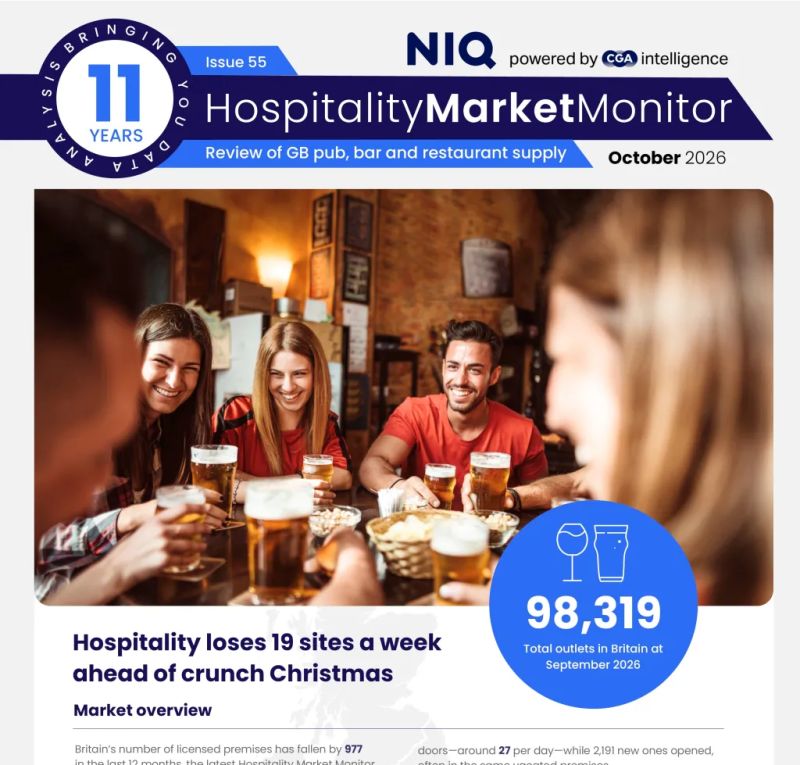
Britain had 98,319 licensed hospitality venues in September after a net loss of 977 pubs, bars, restaurants and other sites over 12 months, according to market data released Friday, October 30, by NIQ.
The figures, drawn from NIQ’s Hospitality Market Monitor using CGA data, showed the number of licensed premises fell 1.0% from September 2025 to September 2026. The count is a measure of the number of outlets trading with licenses to sell alcohol, not a measure of sales, insolvencies or revenue.
The report also showed the decline continued in the most recent quarter. Since June, the total number of licensed venues dropped by 245, a 0.2% fall.
Behind that net change was a steady flow of closures and openings. In the three months to the end of September, 2,436 licensed venues shut, while 2,191 opened. That means new openings did not keep pace with closures, even though many of the new businesses took over premises that had recently been vacated.
The data points to a sector still under pressure from high operating costs and cautious consumer spending. NIQ said the pattern matched its other recent hospitality research, which has shown weak trading growth among managed groups and subdued business confidence. In NIQ’s latest survey with Zonal, 37% of hospitality leaders said they were optimistic about prospects for their business over the next 12 months.
The decline was not spread evenly across the industry. Casual dining recorded one of the sharpest falls, with the number of sites down 2.2% from a year earlier. NIQ said that segment has now shrunk 23.4% since the start of the COVID-19 pandemic in 2020, following closures among several established restaurant brands.
Some accommodation-focused segments moved in the opposite direction. The number of licensed hotels rose 0.2% in the year to September, while the holiday and caravan park segment increased 0.7%. NIQ said domestic travel demand after the pandemic, along with some households choosing lower-cost trips, has helped support those parts of the market.
Karl Chessell, director of hospitality operators and food for Europe, the Middle East and Africa at CGA by NIQ, said the net loss of nearly 1,000 licensed sites over a year showed the scale of the pressure on operators. He said some parts of the market were still growing, but the wider direction of the sector remained negative as businesses entered the key Christmas and New Year trading period.
The licensed hospitality market in Britain includes a wide range of businesses, from traditional pubs and late-night bars to restaurants, hotels and mixed-use venues. Because the NIQ monitor tracks total outlet numbers, it captures both the number of businesses leaving the market and the number arriving in their place. That makes the quarterly data useful for showing how much churn is taking place even when the overall net change looks smaller.
The latest figures show that churn remains high. The loss of 977 venues over a year equates to an average of nearly 19 net closures a week, while the July-to-September period worked out to roughly 27 closures a day before new openings were taken into account. The result is a sector where movement is constant, but where the balance is still tilted toward contraction.
The data does not give a cumulative total of openings and closures since January, but the latest quarter shows the same basic pattern seen over the full year: a large number of operators continue to enter the market, yet not enough to offset the pace of exits. That leaves Britain with fewer licensed hospitality venues than it had a year earlier, even as some operators continue to expand in selected categories.