China hosted the World Congress of Vine and Wine for the first time in Asia
More than 600 delegates from 47 countries met in Yinchuan for talks on innovation, standards and climate pressures
Friday, October 16, 2026
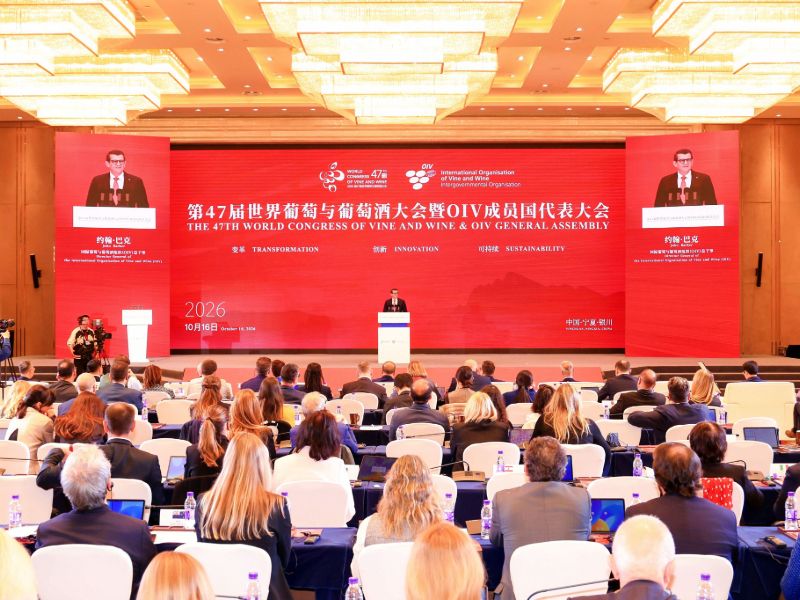
China hosted the 47th World Congress of Vine and Wine this week in Yinchuan, in the Ningxia region, becoming the first country in Asia to hold the event, according to the International Organisation of Vine and Wine, or OIV.
The congress ran from Oct. 12 to Oct. 16 and brought together more than 600 participants from 47 countries for scientific meetings, policy discussions and technical visits focused on the future of the global vine and wine sector. OIV said the participants included delegates from 42 of its member states and five non-member states.
The gathering was held under a broad theme centered on change, innovation and sustainability in the wine industry. OIV said the sessions were designed to address the pressures facing producers, researchers and regulators as the sector adapts to shifting market conditions, environmental challenges and new technical demands.
According to the organization, the program included 420 scientific contributions and six technical visits. The presentations covered a wide range of topics across viticulture, winemaking, economics, regulation, consumer health and product safety. OIV said the scientific work presented during the congress was recognized for its quality and will be published in the coming months as open-access material on the IVES Conference series platform.
The event also served as a showcase for China’s expanding vine and wine sector. During the opening ceremony, representatives from China and OIV reviewed recent developments in both the Chinese market and the wider global industry. The discussions focused on how the sector is responding to a period of deep change and what that means for future production, trade and regulation.
OIV said one of the main points raised during the congress was the industry’s need to keep adapting through research and innovation. It also said delegates stressed the role of international standards in that process, especially as producers and governments try to maintain consistency across markets. The organization described its own standards as an important tool for international harmonization.
The choice of Yinchuan gave the congress a strong regional dimension. Ningxia has become one of China’s best-known wine-producing areas in recent years and has received growing attention for investment, vineyard development and efforts to improve quality. By bringing the congress to the region, China placed its domestic industry in front of a large international audience of scientists, officials and sector leaders.
The final day of the congress was devoted to the 24th OIV General Assembly, where member states adopted 16 resolutions. OIV said the resolutions covered its four main areas of work: viticulture, oenology, economy and law, and safety and health. The organization did not provide full details in the main release, but said a separate summary of the adopted measures would be made available.
Those resolutions are part of OIV’s standard-setting role in the international wine sector. The body describes itself as the world reference organization for vine and wine issues and says its work brings together scientific and technical expertise from governments and specialists. Its recommendations are closely watched by wine-producing countries because they can influence production methods, quality controls, labeling practices, analytical standards and public health measures.
OIV currently has 51 member states. According to the organization, those countries account for 90% of the world’s vineyard surface area, 88% of global wine production and 75% of global wine consumption. It also said that more than 500 experts meet twice a year under its framework to examine and approve resolutions by consensus.
The congress in China reflected the increasingly global nature of the wine business at a time when traditional producers and newer producing regions are facing many of the same questions. Researchers and officials are dealing with climate stress in vineyards, changing consumer behavior, cost pressures, trade issues and debates over health policy. In that context, international forums such as the OIV congress have become a place where governments, scientists and industry representatives compare data and discuss common approaches.
For China, hosting the event was also a signal of its ambition to play a larger role in international wine discussions. While China is better known globally as a major consumer market, the country has also invested in domestic grape growing and wine production, with regions such as Ningxia seeking greater recognition abroad. OIV said the congress helped highlight the distinctive features of China’s vine and wine sector as well as its growing importance.
The congress schedule combined formal scientific sessions with practical site visits, giving delegates a chance to examine local production conditions and regional development efforts. OIV did not detail each visit in its announcement, but said there were six technical visits during the five-day event.
The publication of the scientific papers on the IVES platform is expected to extend the reach of the congress beyond those who attended in person. By making the work freely accessible, OIV said it aims to support wider knowledge sharing across the sector, including among researchers, producers, students and policymakers.
Founded in 1924 and later restructured in 2001, OIV is an intergovernmental scientific and technical organization based in Dijon, France. It works on issues related to grape growing, winemaking methods, economic and legal questions, and consumer health and safety. The organization said the Yinchuan congress was part of its continuing effort to promote scientific cooperation and coordinated responses to the challenges facing the vine and wine industry.