Portuguese Researchers Publish Open Vineyard Dataset to Aid Pruning Robots
The dataset includes 494 annotated images, LiDAR, depth measurements and precise positioning data for vineyard navigation research.
Wednesday, September 23, 2026

Views › 3219
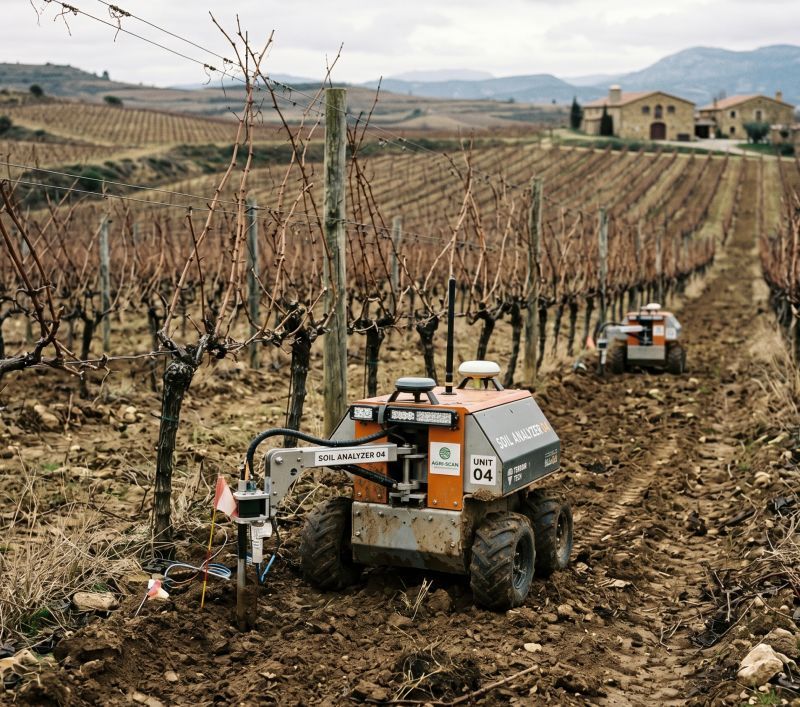
Researchers in Portugal have published an open vineyard dataset designed to help robots identify and locate grapevines for autonomous pruning, a seasonal job that remains labor intensive and difficult to automate.
The dataset was published Wednesday in the journal Scientific Data by Francisco Oliveira, João Castro, Daniel Queirós da Silva, José Boaventura, Mário Cunha and Filipe N. Santos. The team is affiliated with INESC TEC, the University of Trás-os-Montes and Alto Douro, and the University of Porto.
According to the paper, the release brings together RGB images, depth images, LiDAR readings, and GNSS/RTK positioning data collected in a vineyard with both a handheld device and a mobile robot. The authors said the goal is to support the development and testing of computer vision, localization, mapping, and sensor fusion systems that could allow agricultural robots to move through vineyard rows and perform pruning work with less human intervention.
Pruning is one of the more demanding tasks in grape production because workers must make selective cuts to grapevine canes. It is also seasonal, which can make labor planning difficult when workers are in short supply. The researchers said autonomous pruning requires a machine not only to avoid collisions while traveling between vines but also to keep track of each plant well enough to carry out the operation.
To address that problem, the team assembled a dataset intended for training and benchmarking algorithms. In addition to the sensor data, the researchers annotated 494 RGB images from the handheld recordings with segmentation masks in YOLO format, a standard used in machine learning workflows for object detection and image segmentation. That annotated portion is meant to help developers train deep learning models to distinguish grapevine structures from the surrounding environment.
The paper describes the dataset as open access and framed it as a practical resource rather than a finished robotic product. The authors said the material is meant to enable further work on perception and navigation in vineyards, two core technical barriers for pruning robots. Their technical validation, as described in the paper, found the annotated data to be consistent and usable for model training.
The publication appears at a time when agricultural robotics is drawing more attention across crops that depend heavily on manual field work. In vineyards, pruning is especially challenging because vines have irregular shapes, narrow row spacing, and a changing appearance across the growing cycle. Those conditions can make it difficult for a robot to reliably detect plant structures and determine where it is in the field.
By combining image, depth, laser scanning, and high-precision positioning data, the new release gives researchers several ways to approach that problem. RGB images provide standard visual information. Depth data adds distance measurements at the pixel level. LiDAR can help build three-dimensional representations of the vineyard row. GNSS/RTK data supplies precise geolocation, which is important for mapping and repeated operations in the same plot.
The researchers said the data was gathered using both a handheld setup and a mobile robotic platform, which broadens the ways the material can be used. A handheld system can capture close-range observations and may be useful for annotation and model development. A robot-mounted system can reflect the constraints of real field deployment, including motion, viewpoint, and navigation through the row.
The study does not claim that autonomous pruning is ready for widespread commercial use. Instead, it provides infrastructure for the next phase of research by giving laboratories and developers a common reference set for testing methods under vineyard conditions. Standardized datasets have played a major role in advancing robotics and artificial intelligence in other domains because they allow different teams to compare results on the same underlying material.
That matters beyond research labs because vineyards sit at the start of the wine supply chain. More reliable automation in pruning could, over time, help growers manage labor shortages, improve consistency in field operations, and reduce some production pressures for wineries. Any such effect would depend on how well robotic systems perform in real commercial settings and how quickly they can be adopted at a workable cost.
The paper says the project received funding from the European Union’s Horizon Europe research and innovation program under Grant Agreement 101182954. The authors declared no competing interests.
Scientific Data, the journal that published the work, specializes in peer-reviewed descriptions of datasets and their technical validation. In that format, the emphasis is on how the data was collected, documented, and checked for reuse by other researchers, rather than on reporting a single experimental result.
For viticulture researchers and agricultural robotics developers, the value of the release is likely to be in the combination of sensing modalities and the availability of labeled images. Grapevine segmentation and localization are basic steps for any system that must decide where a plant is, how it is shaped, and how to move around it without causing damage. Without that foundation, autonomous cutting decisions are difficult to make safely.
The authors said the dataset is intended to enable work on navigation, mapping, localization, and vision models in vineyards, all of which are necessary before a robot can prune on its own. As growers and equipment companies continue looking for ways to automate repetitive field tasks, resources like this may become an important part of how vineyard robotics moves from prototype to practical use.