A New Analysis Finds U.S. Drinking Is Falling Across Age Groups
Gen Z drinks less intensely, older adults cut back with age, leaving the alcohol industry with broad volume pressure.
Thursday, August 27, 2026
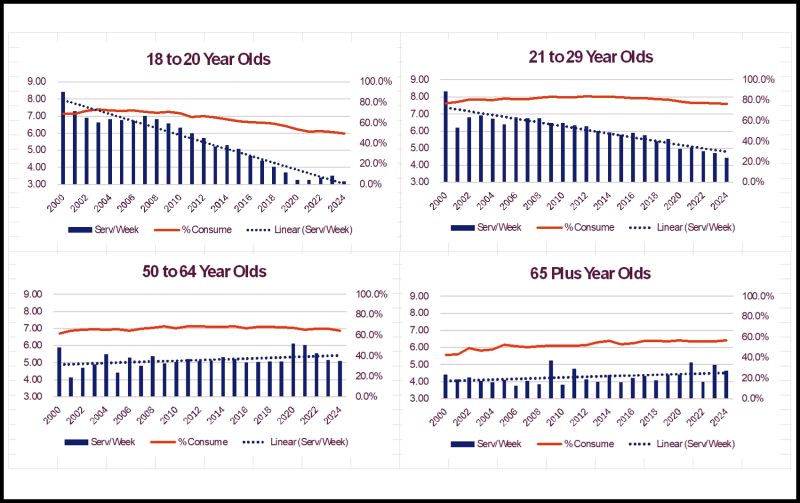
A new analysis of U.S. drinking data is challenging a common argument inside the alcohol business that falling consumption can be pinned mainly on Gen Z or on Baby Boomers.
The study, published by U.S. beverage alcohol advisory firm BW166 and based on figures from the National Survey on Drug Use and Health, says the decline is spread across age groups for different reasons. Younger adults are drinking less often and consuming fewer servings when they do drink, while older adults are cutting back as they age. The result, according to the analysis, is a broader drop in drinking occasions and reported volume across the market.
The report draws on annual federal survey data from 2000 through 2024. BW166 said the period covers about 1 million respondents, or roughly 40,000 people a year. The survey, managed by the Substance Abuse and Mental Health Services Administration, tracks substance use and health behavior in the United States and is widely used to measure long-term consumption trends.
BW166 examined two main indicators for several age groups: the share of people who reported drinking beverage alcohol in a given year and the average number of servings consumed per week. The firm described the second measure as a sign of drinking intensity because it combines how often respondents said they drank during the year and how much they said they consumed on each occasion.
The analysis also stressed a major limitation in self-reported alcohol data. Over the 25-year period, adults who said they drank reported an average of about five servings a week, while market-level sales volumes implied consumption closer to 15 servings a week. BW166 said that means the absolute figures are likely understated, but that the direction of the trend remains useful.
Among 18- to 20-year-olds, the report found one of the sharpest declines. The share of respondents in that age group who said they drank alcohol fell to 50% in 2024 from 70% at the start of the period. Average weekly servings dropped to three from seven. According to the analysis, the downturn began around 2009, first appearing among younger Millennials and then continuing with Gen Z. Because most Americans in that age group are below the legal drinking age of 21, the report said the decline in underage drinking is a positive public health development, even if it may also show that alcohol no longer plays the same role in youth social life that it did for earlier generations.
For adults ages 21 to 29, a group made up largely of Gen Z in 2024, the pattern is different. Participation has held close to 75%, suggesting that many people who did not drink before age 21 begin drinking once it becomes legal. But intensity has weakened. Reported weekly servings for that group fell to 4.5 from 6.5, a drop of about 30%. BW166 argues that this may be more important for the industry than whether young adults drink at all, because steady participation paired with lower intensity still produces lower overall volume.
The report said the slide among 21- to 29-year-olds began around 2012, likely following the same cohort that had already shown lower drinking levels as underage consumers a few years earlier. If that group keeps drinking less than previous generations as it moves through adulthood, the firm said, volume pressure in the U.S. alcohol market is likely to continue.
Middle-aged consumers have been more stable, but not strong enough to offset the shifts at the younger and older ends of the market. For people ages 50 to 64, BW166 said the share reporting alcohol use has remained near 65%, while average servings have held at about five a week. The firm added that adults ages 30 to 49, although not shown in the charts it highlighted, have remained near 75% participation with just over five servings a week. Even in those groups, the report said, both participation and intensity tend to edge lower over time.
For adults 65 and older, where most Baby Boomers now fall, the analysis said the decline is largely explained by aging rather than by a sudden generational rejection of alcohol. As people get older, fewer of them drink and those who do generally consume less, the report said. It noted that the movement of Boomers into the 65-and-over category has produced some increase in both participation and average weekly servings inside that group, but levels still remain below those recorded among adults ages 50 to 64.
That finding is significant because the debate inside the alcohol business has often treated Baby Boomers as a key cause of weakening sales. BW166’s reading of the data is that Boomers are reducing consumption in a way that is common in later life, while Gen Z is reducing it through fewer occasions and fewer servings. In other words, the analysis says, the market is dealing with two different forms of moderation at the same time.
The report places that trend in a larger business context. BW166 said the U.S. alcohol industry is facing a more complex environment than it did during the last major period of volume decline in the 1980s. At that time, it said, alcohol had less competition from energy drinks, functional beverages and products containing THC, the psychoactive compound associated with cannabis. Today, the firm argued, producers are not only competing with other alcohol categories such as beer, wine and spirits, but also with a much broader set of beverage options.
The analysis also pointed to pressure on household budgets. Consumers, it said, have more competing demands on disposable income than in past decades, ranging from student debt and transportation costs to digital entertainment and online gambling. Those financial pressures can reduce how often consumers buy alcoholic beverages even when their attitude toward drinking has not fundamentally changed.
Health concerns are another central factor in the report. BW166 said negative information about alcohol and health has become more visible in public discussion, search results, social media and AI-generated summaries. It added that children and parents are exposed more often to simple warnings about alcohol through schools and public health campaigns. The report said the industry is concerned not only about consumer behavior but also about legal and reputational risk, including comparisons with tobacco.
Some of the health arguments in the analysis are presented from an industry perspective and remain part of a wider scientific debate. BW166 said self-reported consumption in many alcohol and cancer studies may be understated, which in its view could affect the measured point at which risk rises. The report also referred to the increasing use of GLP-1 drugs, which are prescribed for diabetes and weight loss, as a possible future headwind because they may reduce appetite and lower overall food and beverage intake.
The study was circulated in industry coverage this week and was also highlighted by WineNews, the Italian wine publication, as part of a broader discussion about changing alcohol habits across generations. BW166 said the next detailed federal data release, covering 2025, is expected in the fourth quarter of 2026.