Scientists analyze a Guinness bottle recovered from an 1864 shipwreck for clues to recreate the stout.
The intact bottle, raised from the Mindora in the English Channel, may preserve a rare record of Victorian brewing.
Monday, August 24, 2026
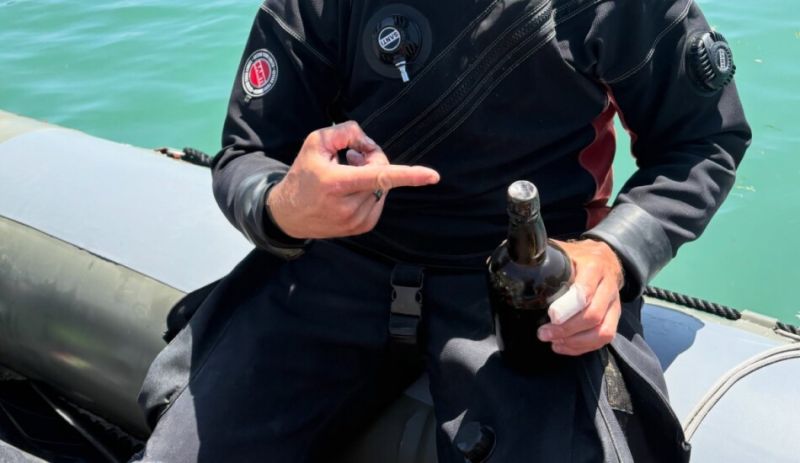
A bottle of Guinness believed to date to 1864 has been recovered from the wreck of the Mindora in the English Channel, and researchers are now studying its contents to learn how the beer was made and whether it might even be recreated.
The bottle was found in 2025 by Belgian diver and amateur photographer Stefan Panis during a dive on the wreck, which lies about 30 meters below the surface off Dover. The discovery became public only recently, after divers obtained documentation linking the cargo of alcoholic drinks on the wreck to the vessel, according to reports on the recovery.
The bottle has been identified as a Guinness “Extra Stout London.” It was described as still sealed and intact when it was brought up from the seabed. That condition has raised interest among divers, brewers and scientists because it may offer a rare look at a 19th-century commercial beer that spent more than 160 years underwater.
According to the account of the find, Guinness at the time was commonly shipped from Ireland to London in wooden barrels. Once in London, the beer was transferred into thicker glass bottles that were better suited to a long sea voyage to Canada. The Mindora, a merchant sailing ship, never completed that journey, but the heavy bottle appears to have withstood decades on the ocean floor.
Divers believe the recovered bottle may not have been alone. They say it is possible it came from a case of 24 bottles that was part of the ship’s cargo. A request has been made to the Receiver of Wreck, the British authority responsible for property recovered from shipwrecks, for permission to recover three more bottles for further testing.
Samples from the beer have already been sent to specialist microbiologists at KU Leuven in Belgium. The researchers have been analyzing the liquid for its alcohol level, sugar content and aromatic profile. Those tests could help establish how much of the original beer has survived and whether the bottle still preserves chemical markers that reflect how Guinness stout was produced in the mid-19th century.
The work has also drawn attention from Guinness researchers, who are interested in whether genetic traces linked to the original ingredients or fermentation process can still be identified. If enough useful material survives, the information could help brewers produce a small experimental batch intended to resemble the stout as it tasted in the 1860s.
That possibility depends on what the scientists find inside the bottle. The contents may have changed significantly over time, even if the seal appears to have held. One of the main questions is whether seawater entered through the cork during the long period underwater. If it did, contamination could limit what can be learned from the beer and make any attempt to assess its original character far more difficult.
Even so, the find is unusual because sealed beverages from that period rarely survive in a condition that allows modern laboratory study. Shipwrecks have yielded wine, spirits and champagne in the past, but a 19th-century stout tied to a known brand and product line offers a different kind of record, one that connects maritime trade, industrial brewing and modern food science.
The recovery also sheds light on how widely Guinness was already moving through international trade routes in the 1860s. A bottle labeled for London but intended for onward shipment across the Atlantic reflects a beer business that was already operating far beyond local markets. If more bottles are recovered from the wreck, researchers may be able to compare them and determine whether one bottle’s condition is typical of the cargo or an exception.
Scientists are also trying to determine whether the beer is still drinkable in any technical sense, though that remains a separate question from whether it could be safely tasted. The answer will depend in large part on the state of the cork and on how much of the original liquid remains unchanged after more than a century and a half on the bottom of the Channel.